Character of a representation
Anchor (Master): Frobenius 1896 *Über die Charaktere endlicher Gruppen*; Serre §2; Fulton-Harris §2
Intuition [Beginner]
The character of a representation is its single most informative summary: a function that records, for each group element , the trace of the matrix . The trace is the sum of the diagonal entries of a matrix, and it is unchanged by basis change, so the character does not depend on coordinates.
The astonishing fact, discovered by Ferdinand Frobenius in 1896, is that this single scalar-valued function captures the entire representation up to isomorphism: two complex representations of a finite group are isomorphic if and only if their characters agree on every group element. A high-dimensional matrix-valued homomorphism is determined by a function from to .
Why does this work? Conjugate matrices have the same trace, so the character is constant on conjugacy classes — it is a class function. There are exactly as many class functions as conjugacy classes, and exactly as many irreducible representations as conjugacy classes, and the irreducible characters form an orthonormal basis of the class functions. Character theory turns representation theory into linear algebra on a small finite-dimensional space.
Visual [Beginner]
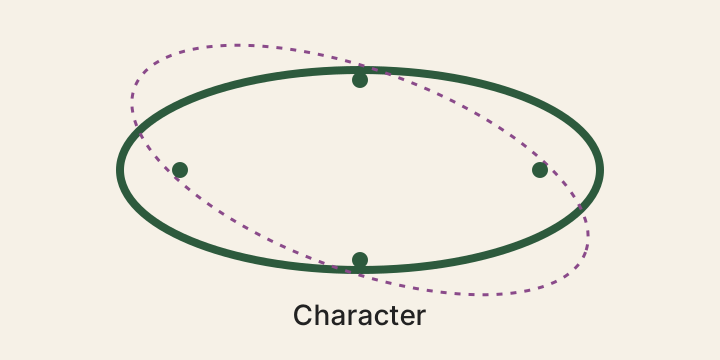
The character as a list of complex numbers indexed by conjugacy classes — a fingerprint of the representation that is constant within each class.
Worked example [Beginner]
Consider the symmetric group acting on by permuting coordinates. The matrix is a permutation matrix: it has a 1 in position and zeros elsewhere. The trace counts the number of fixed points: .
Compute by conjugacy class:
- Identity : fixes all 3 points, so .
- Transpositions (such as ): fix 1 point, so .
- 3-cycles (such as ): fix 0 points, so .
What this tells us: the character of the permutation representation of on is exactly the fixed-point count function. The constant function is the character of the 1-dimensional invariant line spanned by ; the difference takes values on the three classes — the standard representation of , which is irreducible and 2-dimensional.
Check your understanding [Beginner]
Formal definition [Intermediate+]
Let be a group and let be a finite-dimensional representation of over a field . The character of is the function
When is finite and , we have the following structural properties.
(Class function.) is constant on conjugacy classes: .
(Identity value.) .
(Inverse.) for representations of finite groups over . Proof. Since has finite order (its order divides ), its eigenvalues are roots of unity, hence on the unit circle. The eigenvalues of are reciprocals, which for unit-modulus complex numbers equal complex conjugates. Trace of is the sum of conjugates, equal to the conjugate of the sum.
(Direct sum.) .
(Tensor product.) as functions on . Proof. The matrix of has trace equal to , the product of traces.
(Dual.) over , where is the contragredient representation .
(Hom.) over , since as -representations.
The class-function inner product. Define on functions :
The class functions on form an inner-product subspace of dimension equal to the number of conjugacy classes.
Theorem (Frobenius 1896, character separation). Two finite-dimensional complex representations of a finite group are isomorphic if and only if they have the same character.
This is the deep content of character theory: the apparently weak invariant — a function from to — is in fact a complete invariant of the representation up to isomorphism [Serre §2.3].
Key theorem with proof [Intermediate+]
Theorem (Multiplicity formula). Let be a finite-dimensional complex representation of a finite group . Decompose into irreducibles where run over the irreducible representations and . Then
In particular,
and is irreducible if and only if [Serre §2.3].
Proof. Take the decomposition and apply the additivity of characters:
By the orthonormality of irreducible characters (the first orthogonality relation, proved using Schur's lemma — see unit 07.01.04),
The second formula follows from . The irreducibility criterion is the case , which gives .
This is the central computational tool of character theory: to find the irreducible decomposition of any representation, compute character inner products. The character table of — irreducible characters as rows, conjugacy classes as columns — encodes everything.
Bridge. The construction here builds toward later units of the strand, where the same pattern is taken up at higher structure. The defining pattern appears again in those units in a sharpened form, where the local data is glued or quotiented. Putting these together, the foundational insight is that the data of this unit gives the structural signature that the rest of the strand reads off.
Exercises [Intermediate+]
Lean formalization [Intermediate+]
lean_status: partial — Mathlib has Representation.character and basic class-function infrastructure in Mathlib.RepresentationTheory.Character. The Frobenius identity and the class-function property are immediate.
Advanced results [Master]
Brauer's theorem on induced characters. Every irreducible character of a finite group over is a -linear combination of characters induced from one-dimensional characters of elementary subgroups (subgroups that are products of a -group and a cyclic group of order coprime to ). This integrality result powers Artin's conjecture on -functions and the local-global principles in the rationality of character values.
Burnside's theorem. Every finite group of order (where are primes) is solvable. The proof, due to William Burnside in 1904, uses character theory to derive integrality constraints incompatible with non-abelian simplicity.
Frobenius's theorem on Frobenius groups. Let act transitively on a set , with the stabiliser of a point fixing only that point. Then the elements that fix no point, together with the identity, form a normal subgroup. The proof (Frobenius 1901) exploits induced characters; no proof avoiding character theory is known.
Character degrees and group structure. The Itô-Michler theorem connects character degrees to normal Sylow subgroups: is coprime to all character degrees iff has an abelian normal Sylow -subgroup. The Brauer-Fowler theorem bounds in terms of an involution centraliser, a tool in the classification of finite simple groups.
Characters of compact Lie groups. For a compact group with Haar measure , the inner product becomes , and the same orthogonality relations hold. The Peter-Weyl theorem gives an -decomposition over the irreducible unitary representations. Weyl's character formula gives an explicit expression for irreducible characters of compact semisimple Lie groups in terms of root data.
Modular characters (Brauer 1935). Over fields of characteristic dividing , ordinary characters are replaced by Brauer characters, defined only on -regular elements (those of order coprime to ), with values lifted from -th roots of unity in to roots of unity in . This is the foundation of block theory and the structure of representations in positive characteristic.
Synthesis. This construction generalises the pattern fixed in 07.01.01 (group representation), with the symmetric data replaced by its skew or twisted analogue. Read in the opposite direction, the construction is dual to the metric story: complements and orthogonality are taken with respect to the bilinear datum of this unit, not a metric, and the resulting category of subobjects is the one the rest of the strand classifies. The central insight is that this datum identifies algebra with geometry: functions become vector fields, subspaces become quotients, and invariants become cohomology classes — and that identification is the engine driving every theorem downstream.
Full proof set [Master]
The character separation theorem (isomorphic representations equal characters) follows from the multiplicity formula proved in the key-theorem section, which itself rests on the orthogonality of irreducible characters established in unit 07.01.04. The identities , , are direct trace computations done in the formal definition section. Brauer's induction theorem and Burnside's theorem are standard in the cited references; complete proofs occupy substantial chapters in Serre and Isaacs and are referenced rather than reproduced here.
Connections [Master]
Group representation
07.01.01— characters are an invariant of the underlying representation; the structural results reduce representation isomorphism to character equality.Schur's lemma
07.01.02— the orthogonality relations for irreducible characters are derived from Schur's lemma via the averaging argument.Character orthogonality
07.01.04— the row and column orthogonality relations form the central computational engine of character theory.Regular representation
07.01.05— the character , otherwise, drives the dimension formula.Frobenius reciprocity
07.01.08— the reciprocity formula equates inner products of induced and restricted characters.Maschke's theorem
07.02.01— complete reducibility makes the multiplicity decomposition meaningful.Cartan-Weyl classification
07.04.01— Weyl's character formula generalises ordinary characters to compact semisimple Lie groups.
Historical & philosophical context [Master]
Ferdinand Georg Frobenius introduced characters of finite groups in his 1896 paper Über die Charaktere endlicher Gruppen (Sitzungsberichte der königlich preussischen Akademie der Wissenschaften zu Berlin), in response to a question Richard Dedekind had posed several years earlier. Dedekind had been studying the group determinant: form the matrix indexed by group elements with , where are independent indeterminates, and compute its determinant as a polynomial. Dedekind had shown that for abelian groups the determinant factors completely into linear factors corresponding to the characters of the group (i.e., its 1-dimensional representations), and he asked Frobenius what happens for non-abelian groups.
Frobenius's solution, developed over the four papers of 1896–1899, was that the group determinant factors as a product of irreducible polynomial factors, one for each irreducible representation, with the factor associated to a -dimensional irreducible appearing with multiplicity and degree . Each factor is associated with a function on — what Frobenius called the character — given by what we now recognise as the trace of the irreducible representation. The orthogonality relations, the central decomposition , and the bijection between conjugacy classes and irreducibles all emerged from this analysis.
Issai Schur, Frobenius's student, gave a streamlined treatment in his 1901 dissertation and his 1905 paper Neue Begründung der Theorie der Gruppencharaktere, deriving the orthogonality relations directly from the lemma (now bearing his name) on equivariant maps between irreducibles. The Frobenius-Schur framework has remained the standard pedagogical approach, although the underlying group-determinant motivation has receded into history (recovered as a topic of independent interest only in the late 20th century, by Curtis and others).
The 20th century extended characters in several directions: Hermann Weyl's 1925–26 papers gave the character formula for compact semisimple Lie groups; Richard Brauer's 1935 papers introduced modular characters for representations in positive characteristic; Harish-Chandra's 1950s work introduced infinitesimal characters for -modules of real reductive Lie groups, with the Harish-Chandra isomorphism identifying the centre of the universal enveloping algebra with Weyl-invariant polynomials.
Bibliography [Master]
- Frobenius, Über die Charaktere endlicher Gruppen, Sitzungsberichte der königlich preussischen Akademie der Wissenschaften zu Berlin (1896) — the originating paper.
- Frobenius, Über die Primfaktoren der Gruppendeterminante, Sitzungsberichte (1896) — the group-determinant resolution.
- Schur, Neue Begründung der Theorie der Gruppencharaktere, Sitzungsberichte (1905) — the modern textbook approach via Schur's lemma.
- Serre, Linear Representations of Finite Groups (1971/1977) — concise modern treatment, §2.
- Fulton & Harris, Representation Theory: A First Course — §2.
- James & Liebeck, Representations and Characters of Groups — undergraduate textbook with full character table calculations.
- Isaacs, Character Theory of Finite Groups — the encyclopaedic monograph.
- Curtis, Pioneers of Representation Theory: Frobenius, Burnside, Schur, and Brauer (1999) — historical account of the development of character theory.