Compact-open topology and function spaces
Anchor (Master): Steenrod 1967 (originator paper); May *A Concise Course* §5; tom Dieck *Algebraic Topology* §2.4
Intuition [Beginner]
A function from one space to another is itself a kind of object — and the collection of all continuous functions is itself a space, once you decide on a notion of "two functions are close." The compact-open topology is the standard way of doing this, and it is calibrated so that the operation of evaluating a function at a point — feeding and in, getting out — is itself continuous.
The rule is: two functions are close when they agree, up to a small neighbourhood in , on every compact piece of . Picturesquely, draw the graph of ; a function is nearby if its graph stays inside a thin tube around the graph of over every bounded region. On a circle, two loops are close when they trace nearby paths. On the real line, two functions are close when they agree to high precision on every bounded interval.
The payoff is the exponential law: a continuous function of two variables is the same data as a continuous function of one variable . Currying — the move from to — is a homeomorphism, not just a set-theoretic identity. This is what makes function spaces the right setting for homotopy theory: a homotopy is a path in a function space.
Visual [Beginner]
Two functions drawn as graphs over the unit interval, with a thin shaded tube around . The function counts as "close to in the compact-open topology" when its graph stays inside the tube over the compact base .
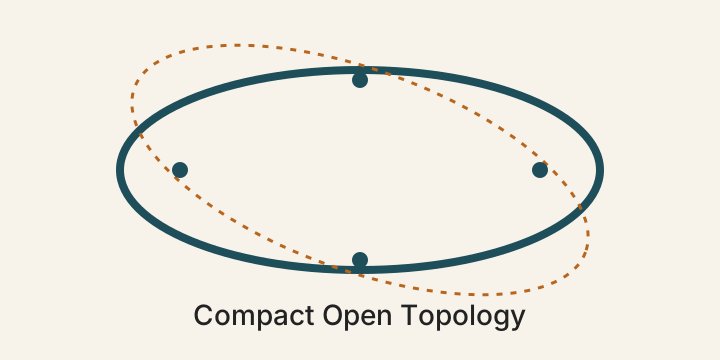
To the right, a grid representing the homeomorphism : the same continuous data, read as a function of two variables on the left and as a function whose values are themselves functions on the right.
Worked example [Beginner]
Take and , and consider the function space of continuous real-valued functions on the unit interval. A subbasis open set has the form
one such for each compact and each open . Pick the specific compact set and the specific open set . Then is the set of all whose values on all lie in the open interval — the constant function is in , and so is , but is not (since ).
A general open neighbourhood of in the compact-open topology is built by finitely intersecting such . What this tells us: closeness in the compact-open topology is "uniform on compact sets, in arbitrary open neighbourhoods" — for compact, this matches uniform convergence; for non-compact , it is uniform convergence on compacta.
Check your understanding [Beginner]
Formal definition [Intermediate+]
Let be topological spaces and let be the set of continuous maps.
Definition (compact-open topology). The compact-open topology on is the topology generated by the subbasis
A basis for this topology consists of finite intersections .
Definition (evaluation map). The evaluation map is
When is locally compact Hausdorff, is continuous with respect to the compact-open topology on and the product topology on [Munkres §46].
Definition (currying). Given , its curry is
Definition (compactly generated space, k-space). A topological space is compactly generated (a k-space) if a subset is closed precisely when is closed in for every compact . Every locally compact Hausdorff space and every first-countable Hausdorff space is compactly generated. The functor that refines the topology to its compactly generated coreflection makes into a coreflective subcategory of [Steenrod 1967].
Definition (CGWH, Steenrod's convenient category). A space is CGWH if it is compactly generated and weak Hausdorff — meaning the image of every continuous map from a compact Hausdorff space into is closed. The category of CGWH spaces, with continuous maps and the -refined product, is cartesian closed.
Non-example. Without local compactness on , the evaluation map need not be continuous in the compact-open topology, and currying need not be a homeomorphism. The CGWH refinement repairs both defects.
Key theorem with proof [Intermediate+]
Theorem (exponential law for locally compact Hausdorff ). Let be topological spaces with locally compact Hausdorff. Then the curry map
is a homeomorphism, where both sides carry the compact-open topology.
Proof. Bijection on points. Given continuous, has continuous (it is the restriction of to ). Continuity of : a subbasic open in is with compact, open; . The set is open and contains ; by the tube lemma (using compactness of ), there is an open neighbourhood of in with , which proves is open. So lands in .
Inverse. Given , define by . This is the composition . Continuity of requires locally compact Hausdorff, which is the hypothesis. Hence is continuous, and , tautologously. So is a set-theoretic bijection.
Continuity of . A subbasic open in has the form with , compact, open. We compute
which is a subbasic open in (since is compact in ).
Continuity of . A subbasic open in is for compact, open. We must show is open in . For each , every has ; using local compactness of to find compact neighbourhoods of slices and the tube lemma to assemble them gives a neighbourhood of inside . The detailed argument is in Munkres §46 [Munkres §46].
So is a homeomorphism.
Bridge. This theorem builds toward the path-space and loop-space constructions that drive 02.01.07 (fibration): the path space and the loop space are function spaces in the compact-open topology, and the path-space fibration depends on the continuity of evaluation at the endpoint. The same exponential law appears again in 02.01.08 (cofibration), where the dual statement identifies maps out of a mapping cylinder with maps from a function space — generalises the bare set-level currying to a homeomorphism of topological spaces. The central insight is that the compact-open topology is exactly calibrated to make left adjoint to ; this is dual to the fact that the mapping cylinder identifies with a deformation retract of a space mapping into . Putting these together, the compact-open topology identifies maps with maps of one fewer variable, which is the foundational reason homotopies, paths, and loops can all be packaged as objects of a function space.
Exercises [Intermediate+]
Advanced results [Master]
The compact-open topology is the canonical topology on continuous-map spaces, but it is not perfectly behaved on all of . Steenrod's 1967 paper A convenient category of topological spaces (Mich. Math. J. 14) [Steenrod 1967] identified the compactly generated weak Hausdorff category as the natural setting in which the function-space machinery is fully cartesian closed, and which contains every CW complex, every metrisable space, and every space arising in algebraic topology in practice.
Theorem (Steenrod 1967, cartesian-closedness of CGWH). Let denote the category of compactly generated weak Hausdorff spaces with continuous maps, and equip it with the -refined product and the function space . Then for all the curry map
is a homeomorphism. Equivalently, is left adjoint to , making cartesian closed.
The category itself is not cartesian closed: the failure of the tube-lemma step in the proof above is genuine, and producing the -refinement is the price one pays for an exponential law that holds without local-compactness hypotheses. Steenrod's reformulation allowed Quillen, May, and others to develop model-categorical homotopy theory on a fully convenient base.
Theorem (loop space adjunction). In the homotopy category $\mathbf{Ho}(\mathbf{CGWH}_)\Sigma\Omega$ are adjoint:*
This is the homotopy-class shadow of the topological-space-level adjunction , itself a special case of the exponential law for pointed maps. The adjunction is the engine of the Freudenthal suspension theorem, of stable homotopy theory (where becomes invertible in the spectrum-level sense), and of the entire infinite-loop-space story (Boardman, May, Segal).
Theorem (path-space fibration, function-space form). For any pointed CGWH space , the evaluation map , , is a Hurewicz fibration with fibre . The proof reduces to continuity of evaluation (via the exponential law for ) and an explicit homotopy-lifting construction; the fibration property of in turn yields the long exact sequence relating to .
Adjacent constructions. The mapping space where packages homotopies as paths in a function space; the homotopy fibre of is realised as , the fibre of the evaluation on the second factor. Each of these constructions is a function-space construction whose continuity properties depend on the cartesian-closed structure of CGWH.
Synthesis. The compact-open topology identifies maps with maps , which is exactly the operation of trading a parameter for an output. The central insight is that this trade is a homeomorphism, not just a bijection, in any reasonable category of spaces — and the foundational reason CGWH is the right convenient category is that the -refinement and weak-Hausdorff condition are precisely what make the trade work without local-compactness side conditions. The suspension-loop adjunction is dual to the fibre-cofibre duality of 02.01.07 and 02.01.08: generates cofibre sequences and generates fibre sequences, and the bridge between them is exactly the exponential law applied to . Putting these together identifies the homotopy category with a setting where every pointed map has both a fibre sequence and a cofibre sequence, related by the loop-suspension adjunction — generalises classical fibre-bundle theory to the higher-categorical / spectrum-level setting that organises modern algebraic topology.
Full proof set [Master]
Proposition (continuity of evaluation under local compactness). Let be locally compact Hausdorff. Then , , is continuous, where carries the compact-open topology and the domain has the product topology.
Proof. Let with , open. By continuity of , the preimage is open in and contains . Local compactness of provides a compact neighbourhood of with , so , meaning . The product open set is then a neighbourhood of , and for any in it, since and . Hence contains , an open neighbourhood of .
Proposition (compact-open topology is jointly continuous on compacts). For a compact Hausdorff space and any space , the evaluation is continuous in the compact-open topology.
Proof. Compact Hausdorff implies locally compact Hausdorff; apply the previous proposition.
Proposition (curry of a continuous map is continuous). For any spaces and any continuous , the curry defined by is continuous in the compact-open topology on .
Proof. It suffices to check that is open in for every subbasic with compact and open. Now
The set is open in and contains for any . By the tube lemma (compactness of ), there is an open neighbourhood of in with , so . Hence is open.
Proposition (currying is injective; surjective when is locally compact Hausdorff). The map is always injective; it is surjective whenever is continuous.
Proof. Injectivity: means for all , hence . Surjectivity: given , define , a composite of followed by . Both factors are continuous (the first because is, the second by hypothesis), so is continuous and .
Proposition (CGWH product is the -refinement). In , the categorical product refines the topology on the underlying set and satisfies the universal property of products in .
Proof sketch. The set-theoretic projections and remain continuous after -refinement (the -refinement only adds open sets); given , continuous from a CGWH space , the unique pairing is continuous on every compact (factoring through where the original product topology suffices), hence continuous into by the universal property of the -refinement. Weak Hausdorffness is preserved because compact Hausdorff images remain closed.
Connections [Master]
Continuous map
02.01.02. The compact-open topology turns the set of continuous maps into a topological space; every fact about as a topological object presupposes that "continuous map" is the right morphism notion in .Topological space
02.01.01. The compact-open topology, the -refinement, and the weak Hausdorff condition are all topological-space constructions; CGWH is the working subcategory of in which homotopy theory is naturally formulated.Fibration
02.01.07. The path-space fibration and its fibre are function-space constructions in the compact-open topology; the long exact sequence of the path-space fibration is the foundational identification .Cofibration
02.01.08. Cofibrations are dual to fibrations under the suspension-loop adjunction . The function-space construction for the unit interval packages homotopies as paths in a mapping space, and is the bridge between the cofibre sequence (built from mapping cones) and the fibre sequence (built from path spaces).Quotient and identification topology
02.01.06. The reduced suspension is a quotient construction; the exponential law identifies a quotient of a product with a function space, dual to the universal-property construction of identification spaces.Homotopy and homotopy group
03.12.01. A homotopy is a continuous , equivalently a path in via the exponential law. The set of homotopy classes becomes a functorial invariant precisely because is a topological space — the foundational reason homotopy theory is about function spaces.
Historical & philosophical context [Master]
Ralph Fox introduced the compact-open topology in 1945 in On topologies for function spaces (Bull. Amer. Math. Soc. 51, 429–432) [Fox 1945], proposing the subbasis as the topology on a function space that makes evaluation continuous when the domain is locally compact and Hausdorff. Fox's paper resolved a then-open question on the right topology for function spaces in the foundational categorical framework of Eilenberg-MacLane.
The technical defect of — that the exponential law fails for general , even when restricted to locally compact spaces, because the product topology is too coarse — was identified by Brown, Steenrod, and others through the 1950s and 1960s. Norman Steenrod's 1967 paper A convenient category of topological spaces (Mich. Math. J. 14, 133–152) [Steenrod 1967] proposed CGWH as the standard working setting and proved its cartesian-closedness, with explicit verifications that the standard spaces of algebraic topology (CW complexes, metrisable spaces, manifolds) all live in this subcategory.
The further programme — replacing CGWH by simplicial sets (Kan), by compactly generated topoi (Grothendieck-school), or by -groupoids in the homotopy-type-theoretic foundations (Voevodsky) — extends Steenrod's identification of the right "convenient" framework into successively broader settings. The compact-open topology and its CGWH refinement remain the standard topological-space-level realisation of the cartesian-closed structure that all of algebraic topology rests on.