Connection on a vector bundle
Anchor (Master): Kobayashi-Nomizu Vol. I §III; Milnor-Stasheff Appendix C
Intuition [Beginner]
A vector bundle has a vector space attached to each point of a base space 03.05.02. The problem is that vectors in different fibers do not automatically live in the same vector space.
A connection is a rule for comparing nearby fibers. It tells you how to move a vector along a path while keeping it as parallel as the bundle allows.
On a flat product bundle, this rule can be the ordinary one: keep the vector components unchanged. On a curved or twisted bundle, keeping a vector parallel may rotate or change its components as you move.
Visual [Beginner]
The red vector is carried along the blue path. The connection tells which vector in the next fiber counts as the parallel continuation.
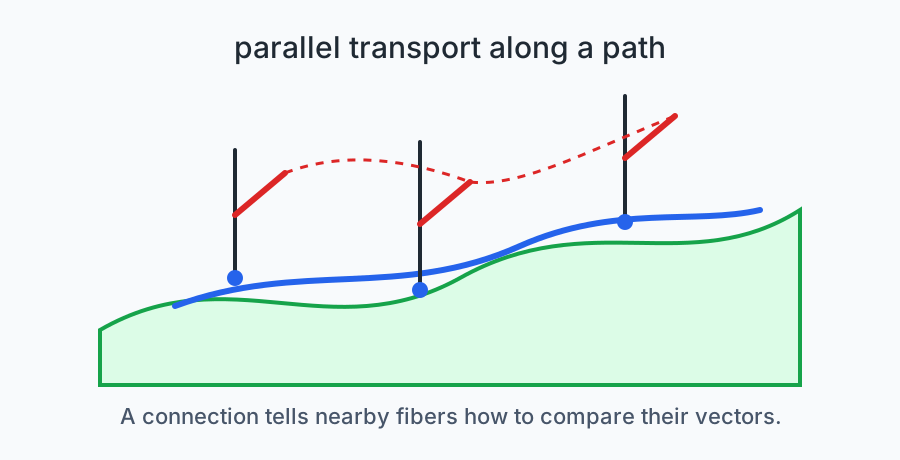
The base path alone does not determine the moving vector. The connection supplies that extra comparison rule.
Worked example [Beginner]
Take the tangent bundle of a sphere. A tangent vector at one point lies in the tangent plane at that point. A tangent vector at a nearby point lies in a different tangent plane.
To compare them, choose a rule for sliding vectors along curves on the sphere. The usual geometric rule keeps the vector tangent and turns it only as much as the sphere forces.
Carry a tangent vector around a small loop near the north pole. It may return rotated. That returned rotation is the first sign of curvature, which measures the failure of parallel transport around loops to be path-independent.
Check your understanding [Beginner]
Formal definition [Intermediate+]
Let be a smooth vector bundle over a smooth manifold. Write for the space of smooth sections and for smooth -valued one-forms.
A connection or covariant derivative on is an -linear map
satisfying the Leibniz rule
for every smooth function and section [Milnor-Stasheff Appendix C].
Equivalently, for each vector field , the operator is -linear and satisfies
In a local frame , a connection is written
where the are one-forms. The matrix is the local connection form.
Key theorem with proof [Intermediate+]
Theorem (connections form an affine space). If and are connections on , then is -linear and therefore defines an element of . Conversely, if is a connection and , then is a connection.
Proof. Let be a smooth function and a section. Using the Leibniz rule for both connections,
Thus is -linear. A -linear map from sections of to -valued one-forms is the same as a one-form with values in : at each point it depends only on the value of the section at that point.
Conversely, let and define . Since is -linear,
So satisfies the Leibniz rule and is a connection.
Bridge. The construction here builds toward 03.09.08 (dirac operator), where the same data is upgraded, and the symmetry side is taken up in 03.05.08 (complex vector bundle). The defining pattern appears again in those units in a sharpened form, where the local data is glued or quotiented. Putting these together, the foundational insight is that the data of this unit gives the structural signature that the rest of the strand reads off.
Exercises [Intermediate+]
Lean formalization [Intermediate+]
lean_status: none — current Mathlib does not have the smooth vector-bundle and covariant-derivative API needed for this unit at the level of the curriculum.
The required formal layer includes smooth vector bundles with sections, bundle-valued forms, End E bundles, and covariant derivatives satisfying the Leibniz rule. The affine-space theorem would then be a natural early lemma.
Curvature and induced connections [Master]
Given a connection , its curvature is the operator
It is -linear in the section variable, so it defines a two-form with values in [Kobayashi-Nomizu §III]. This tensoriality is the reason curvature can enter Chern-Weil theory and gauge theory.
Connections induce connections on dual bundles, tensor products, Hom bundles, determinant bundles, and pullbacks. For example, if and are connections, the induced connection on is characterized by
Compatibility conditions add structure: a connection on a Hermitian vector bundle is unitary if it preserves the Hermitian metric, and a connection on is metric-compatible if it preserves the Riemannian metric.
Local connection forms [Master]
In a local frame, a connection has the form , where is a matrix of one-forms. Under a change of frame by a matrix-valued function , the local form transforms as
The inhomogeneous term is the local expression of the Leibniz rule. Curvature transforms without such an inhomogeneous term:
This contrast explains why connection forms are not tensors but curvature forms are. It also explains the gauge covariance of Yang-Mills theory 03.07.05 and the connection-independence mechanism in Chern-Weil theory 03.06.06.
Connections [Master]
Vector bundle
03.05.02— connections are differential structure added to vector bundles.Differential forms
03.04.03— connection and curvature forms use bundle-valued differential forms.Principal bundle connection
03.05.07— vector-bundle connections are induced from principal connections on frame or associated bundles.Dirac operator
03.09.08— Dirac operators contract Clifford multiplication with a spinor covariant derivative.Chern-Weil homomorphism
03.06.06— characteristic forms are built from curvature of connections.
Historical & philosophical context [Master]
Connections originated in parallel displacement and affine differential geometry, then became intrinsic bundle data through Ehresmann's and Cartan's formulations. Kobayashi and Nomizu systematized the principal-bundle and vector-bundle treatments in modern differential geometry [fast-track Kobayashi-Nomizu-1-683x1024__72960fe9e3.jpg].
Milnor and Stasheff use connections in characteristic-class theory to relate differential forms to topological invariants [fast-track Milnor-Stasheff-Characteristic-Classes-680x1024__120684d959.jpg]. The same local formulas later became the standard language of gauge fields in physics.
Bibliography [Master]
- Kobayashi, S. and Nomizu, K., Foundations of Differential Geometry, Vol. I, Wiley, 1963. §III.
- Milnor, J. and Stasheff, J., Characteristic Classes, Princeton University Press, 1974. Appendix C.
- Chern, S.-S., "Topics in Differential Geometry", Institute for Advanced Study, 1951.
- Wells, R. O., Differential Analysis on Complex Manifolds, Springer, 1980.
Wave 2 Phase 2.2 unit #5. Produced as the vector-bundle connection prerequisite for Dirac and curvature-dependent units.