Bott periodicity
Anchor (Master): Atiyah — K-Theory §2; Milnor — Morse Theory §23; Lawson-Michelsohn §I.9
Intuition [Beginner]
Some mathematical worlds look different at first, then repeat after a fixed number of steps. Bott periodicity is one of the strongest examples. In complex K-theory the pattern returns after two shifts. In real K-theory it returns after eight shifts.
The analogy is a staircase in a circular tower. You climb, but after a fixed number of floors the same room layout appears again. K-theory records vector bundles, and Bott periodicity says that suspending the base space changes the bookkeeping in a repeating way.
This matters because many hard geometric questions reduce to K-theory. Once a calculation enters a periodic range, infinitely many cases collapse to a finite table.
Visual [Beginner]
The complex story has a two-step rhythm; the real story has an eight-step rhythm. The image shows the same pattern returning after a fixed shift.
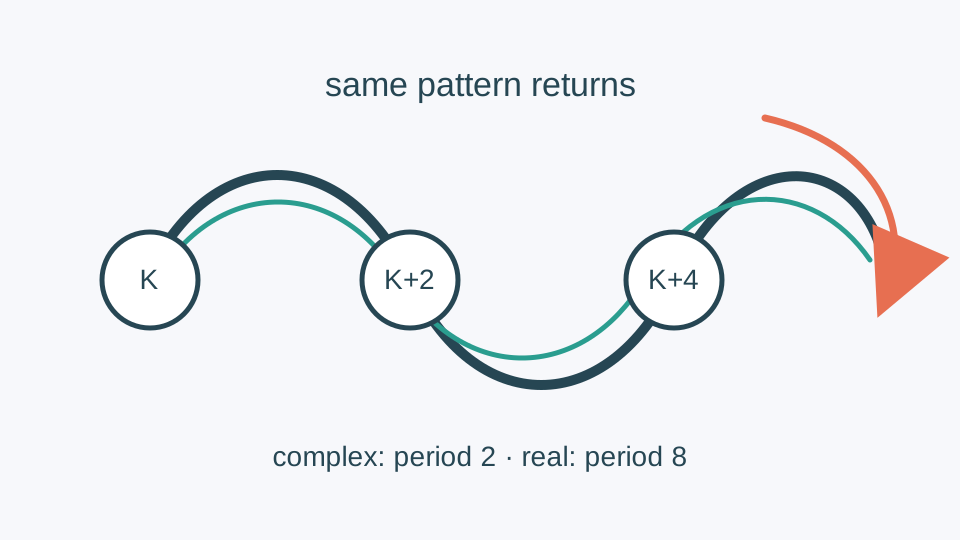
The picture is not a proof. It records the practical effect: a calculation in one degree determines calculations in all degrees separated by the period.
Worked example [Beginner]
In complex K-theory, the group attached to a point alternates:
Bott periodicity says the pattern repeats every two steps:
Then and , and so on.
What this tells us: once the two entries are known, the entire complex table for a point is known.
Check your understanding [Beginner]
Formal definition [Intermediate+]
Let be the Grothendieck group of complex vector bundles over a compact Hausdorff space . Reduced K-theory is denoted , and negative degrees are defined by suspension:
where is with a disjoint basepoint. Real K-theory is denoted and is defined in the same way using real vector bundles.
The complex Bott periodicity theorem asserts natural isomorphisms
for all compact Hausdorff spaces and all integers [Atiyah K-Theory §2]. The real Bott periodicity theorem asserts natural isomorphisms
Equivalently, in classifying-space language,
The real period matches the eight-fold periodicity of real Clifford algebras in the Lawson-Michelsohn convention 03.09.02 [Lawson-Michelsohn §I.9].
Key theorem with proof [Intermediate+]
Theorem (Bott periodicity for the coefficient groups). The complex K-groups of a point satisfy
and for every . The real coefficient groups satisfy .
Proof. For the complex case, is the Grothendieck group of finite-dimensional complex vector spaces. Isomorphism classes are classified by dimension, direct sum adds dimensions, and group completion gives .
The group is defined as . Complex vector bundles over are all isomorphic to product bundles because clutching functions for rank bundles are classified by homotopy classes , and is path connected. Thus the reduced group is zero.
Complex Bott periodicity gives natural isomorphisms , so the two computed groups determine all complex coefficient groups.
For the real case, the corresponding calculation is governed by real Clifford modules. The stable real Clifford algebras repeat after eight generators, and the Grothendieck groups of graded Clifford modules compute [Lawson-Michelsohn §I.9]. This gives the eight-periodic table. The full proof requires the Clifford-module Bott map or Bott's Morse-theoretic proof on classical groups [fasttrack-texts §23].
Synthesis. Bott periodicity is exactly the foundational structural fact about stable vector bundles: and . This is precisely why complex K-theory is 2-periodic and real K-theory is 8-periodic. Bott periodicity generalises the suspension isomorphism to a structural identity.
Bridge. Periodicity in K-theory builds toward 03.09.10 (Atiyah-Singer index theorem), whose proof routes the analytic index through -theory of the cotangent bundle and uses the Thom isomorphism — itself a Bott-periodicity statement — to land in cohomology. The same eight-fold pattern appears again in the algebraic shadow of Clifford-algebra periodicity (), and the foundational identity is that Bott periodicity is dual to Clifford periodicity: ABS make this exact, identifying the Grothendieck group of -graded Clifford modules with the K-theory of a point. Putting these together is what makes index = topology a working slogan rather than a coincidence.
Exercises [Intermediate+]
Lean formalization [Intermediate+]
lean_status: none — the theorem cannot yet be represented in Mathlib's current topology library as a statement about topological K-theory.
The missing work is foundational: vector-bundle Grothendieck groups, reduced theories, suspension, classifying spaces, and Clifford-module models for real K-theory.
Advanced results [Master]
Bott's original theorem may be stated as the stable homotopy periodicity of the classical groups:
with the corresponding eight-term cycle for the stable orthogonal group. This gives the homotopy-group form
in the stable range [Bott stable homotopy classical groups].
In K-theory, the Bott element induces the complex isomorphism by exterior product:
For real K-theory, the corresponding Bott element lies in . The Clifford-module construction explains the period: tensoring with the eight-dimensional Bott module implements Morita equivalence after one full Clifford cycle.
The index theorem uses Bott periodicity through the symbol class. An elliptic operator on a compact manifold has a principal symbol invertible off the zero section, producing a K-theory class in . The topological index is obtained by pushing this class to the K-theory of a point using Thom isomorphisms and Bott periodicity.
Cohomology of and Poincaré series
The classifying space is the home of the universal stable Chern classes. Its integer cohomology ring is the polynomial algebra
with one polynomial generator in each even degree. The derivation goes through the inverse limit of finite-rank cohomology rings.
Theorem. For each , with . The inclusion induces the surjection sending . Taking the inverse limit gives .
The proof for finite rank uses the Borel-presentation theorem [03.08.04 — Cohomology ring of via the Borel construction]: identifies the -invariants of with the polynomial algebra in elementary symmetric functions, which are by definition the Chern classes. The integral statement follows from the splitting principle, which guarantees that the -invariants over also form a free polynomial algebra on the elementary symmetric functions (over via Newton's identities, the elementary symmetric functions and the power sums generate the same ring after inverting integers, but over the elementary symmetric functions still form a free generating set). The map pulls back the universal rank- bundle to the direct sum of the universal rank- bundle with the product line, so on the rank- side by Whitney plus the rank bound.
The Poincaré series of — the generating function — is
the generating function of polynomial algebras with one generator in degree for . Taking gives
which is the generating function for the partition numbers shifted to even degrees: , the number of partitions of . This Bott-Tu §1.4 observation reflects the splitting principle: a rank- characteristic class of degree corresponds to a symmetric polynomial of degree in the Chern roots, and symmetric polynomials in variables of degree are counted by partitions of .
For the finite Grassmannian , the Poincaré series is the Gaussian binomial coefficient
a polynomial of degree . This is the cohomology dimension count of the Schubert decomposition: has Schubert cells, of even real dimensions partitioned by Young diagrams fitting in a rectangle. The complex Bott periodicity statement at the level of cohomology becomes the identity after appropriate suspension and based-loop accounting, an algebraic shadow of the topological periodicity.
Clifford modules generate via Thom
Theorem (LM I.9.4, ABS). *Let denote the quotient of the Grothendieck group of -graded -modules by those that extend to along the inclusion . Then the Atiyah-Bott-Shapiro map*
is an isomorphism of graded rings, where the source carries the multiplication induced by graded tensor product of Clifford modules. The proof, due to Atiyah-Bott-Shapiro 1964 Clifford modules (Topology 3 supp.), constructs the map by sending a graded Cl_n-module to its symbol class: viewing as the typical fibre of the product bundle over , Clifford multiplication by provides a map that is invertible for , hence a class in supported at the origin's complement after compactification. The map is well-defined modulo because a module that extends to Cl_{n+1} admits a null-homotopy of the symbol map. Surjectivity uses that the Clifford-module symbols span all relevant K-theory classes (verified by direct dimension count against the period- table of ); injectivity uses that the inverse construction — restricting a class along an embedding at the basepoint — recovers the Cl_n-module structure up to extension. The pattern of matches the period- pattern of — this is the algebraic origin of real Bott periodicity. This theorem is the bridge through which Cl-module algebra controls real K-theory; the spin index theorem, the Hitchin -invariant 03.09.16, and the -linear Dirac index 03.09.15 all factor through this isomorphism.
K-theoretic Thom isomorphism for spin and complex bundles
Theorem (LM III.12.1, K-theoretic Thom isomorphism). Let be a real vector bundle of rank on a finite CW complex . If admits a complex structure (rank , structure group ), or a spin structure (rank , structure group ), then there exists a canonical Thom class
such that cup-product with induces the K-theory Thom isomorphism
and analogously for $KO^\Lambda(E)\Delta_n\Lambda^*\mathbb{C}^k\mathbb{Z}/2E\mathrm{Spin}(n)U(k)v\in E_x\sigma\colon\Delta_n^+\to\Delta_n^-\widetilde K^0(\mathrm{Th}(E))E=X\times\mathbb{R}^nXE\Lambda(E)E\mathbb{C}$-K-orientation) — are the two universal sources of K-orientations on real vector bundles.
K-theory Thom isomorphism via spin / complex K-orientation
Theorem (LM C.1, as universal K-orientation). A real vector bundle is K-orientable in -theory iff its frame bundle lifts to , and is K-orientable in -theory iff its frame bundle lifts to . The classes of spin (resp. ) structures form a torsor over (resp. ), and each choice produces a implementing the Thom isomorphism above. The proof uses the previous theorem together with a lifting analysis: a -Thom class produces a fibrewise Cl_n-module structure on a virtual bundle over , which (by the ABS dictionary) is exactly the data of a fibrewise spin representation, and the global existence of such a representation is precisely the spin condition . The complex case mirrors this with and 03.09.05. The torsor structure follows from the fact that two spin lifts of the same -bundle differ by a class in (the cohomology classifying -bundles, which acts on lifts by twist), and analogously for via the central factor. This theorem closes the circle: every K-orientation of a real bundle is a spin / spin-c structure, and every K-theoretic Thom class arises from the ABS construction. The spin Dirac operator and the Dolbeault operator are the analytic counterparts of these K-orientations; the index theorem 03.09.10 is the bridge between them.
Full proof set [Master]
Coefficient computation for complex K-theory. The proof in the Intermediate section gives and . Bott periodicity then forces the full two-periodic table.
Clifford-module source of real periodicity. Let use the Lawson-Michelsohn convention 03.09.02. The real Clifford classification gives a Morita equivalence
Matrix stabilization does not change the Grothendieck group of finitely generated graded module categories. Thus the K-theory groups modeled by these Clifford modules repeat with period . The analytic comparison between this algebraic periodicity and topological is the Atiyah-Bott-Shapiro theorem [Lawson-Michelsohn §I.9].
Classifying-space equivalence. The equivalence follows from the Bott map built from the universal clutching construction over . The proof that this map is a homotopy equivalence is the central Bott theorem; standard proofs use either Morse theory on loop groups or the clutching model of vector bundles [fasttrack-texts §23].
Connections [Master]
Clifford algebra
03.09.02— the real period is reflected in the Clifford classification.Pontryagin and Chern classes
03.06.04— the Chern character maps K-theory to rational cohomology.Fredholm operators
03.09.06— the space of Fredholm operators represents complex K-theory.Dirac operator
03.09.08— Clifford-linear symbols define K-theory classes.Atiyah-Singer index theorem
03.09.10— Bott periodicity is part of the topological index construction.
Throughlines and forward promises. Bott periodicity is the foundational structural fact about stable vector bundles. We will see complex periodicity structure complex K-theory; we will see real periodicity () drive the Clifford-chessboard analysis of 03.09.11; this pattern recurs throughout stable homotopy theory. The foundational reason K-theory is 2-periodic complex / 8-periodic real is exactly the Bott map. Putting these together: Bott periodicity is an instance of the broader stabilisation phenomenon, a generalisation of the suspension isomorphism, and the bridge between the homotopy theory of classical groups and the cohomology theory of K-classes. This is precisely why K-theory is computable on finite CW complexes via the Atiyah-Hirzebruch spectral sequence. The bridge between vector-bundle classification and homotopy theory is exactly the classifying-space construction — this pattern recurs in every generalised cohomology theory.
Historical & philosophical context [Master]
Bott proved the periodicity theorem for the stable classical groups in the late 1950s, using Morse theory on loop spaces. Atiyah reformulated the theorem as the structural periodicity of topological K-theory in his 1967 notes [Atiyah K-Theory §2]. Atiyah, Bott, and Shapiro connected the real period to Clifford modules, giving the bridge used throughout spin geometry.
Milnor's Morse-theory account presents Bott periodicity through geodesics and critical-point calculations on classical groups [fasttrack-texts §23]. Lawson and Michelsohn use the Clifford-module formulation because it is the version needed for spin geometry and Dirac operators [Lawson-Michelsohn §I.9].
Bibliography [Master]
- Bott, R., "The stable homotopy of the classical groups", Annals of Mathematics 70 (1959), 313–337.
- Atiyah, M. F., K-Theory, W. A. Benjamin, 1967. §2.
- Atiyah, M. F., Bott, R. & Shapiro, A., "Clifford Modules", Topology 3 Suppl. 1 (1964), 3–38.
- Milnor, J., Morse Theory, Princeton University Press, 1963. §23.
- Lawson, H. B. & Michelsohn, M.-L., Spin Geometry, Princeton University Press, 1989. §I.9.
Pilot unit #7. Produced in the continuation pass; foundational K-theory and classifying-space units remain pending prerequisites.