Sobolev spaces, pseudodifferential operators, and elliptic parametrices
Anchor (Master): Hörmander, Analysis of Linear Partial Differential Operators III, §18; Lawson-Michelsohn §III.1–§III.5; Taylor, Pseudodifferential Operators §I–§II
Intuition [Beginner]
A Sobolev space sorts functions by how many derivatives they have. The space contains every square-integrable function. The space keeps only those whose first derivative is also square-integrable. The space keeps those with controlled derivatives, where may be a real number, even negative.
A pseudodifferential operator is a generalisation of a differential operator that allows fractional and negative orders. A genuine derivative raises the order by one and lowers the Sobolev count by one. A pseudo-inverse should lower the order by one and raise the Sobolev count by one. Such inverses are not differential operators; they are pseudodifferential operators.
A parametrix is a near-inverse to an elliptic operator. It inverts the operator up to an error that is so smoothing it forgets every roughness. This near-inverse is the analytic backbone of the Atiyah-Singer index theorem.
Visual [Beginner]
A Sobolev tower: each floor contains functions with derivatives. A differential operator of order is an elevator that goes down floors. A parametrix is the elevator going back up floors, and the round trip almost lands you at the start.
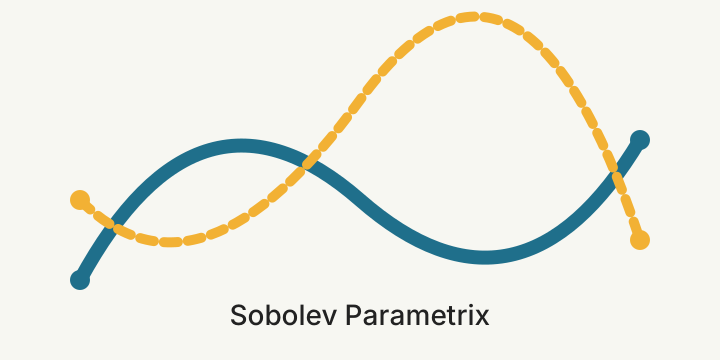
The error after one round trip is a smoothing operator: a thing that lifts to every floor at once.
Worked example [Beginner]
Take the simplest setting on the circle. A function on the circle has a Fourier series. Each derivative multiplies the -th coefficient by . The Sobolev norm of order measures the size of times the coefficient.
Now consider the Laplacian on the circle. It acts on Fourier modes by multiplication by . To invert it on the non-constant modes, divide by . The result is the parametrix: it inverts the Laplacian on every mode except the constant. The constant mode is the kernel of the Laplacian, and the smoothing error of the parametrix is precisely the projection onto that constant mode.
What this shows is the working principle of the whole theory. An elliptic operator can be inverted on every Fourier mode that it does not annihilate; the pseudodifferential calculus lets us combine all these mode-by-mode inverses into one operator.
Check your understanding [Beginner]
Formal definition [Intermediate+]
Let be a closed smooth manifold of dimension , and let be smooth complex vector bundles.
Sobolev spaces of sections. For define as the completion of in the norm
with respect to a finite open cover by trivialising charts and a local trivialisation. Different choices give equivalent norms [Hörmander Ch. 18].
Sobolev embedding. For ,
continuously [Sobolev 1938]. The embedding constant depends on , , but not on .
Rellich-Kondrachov. For , the inclusion is a compact operator 02.11.05. This is the source of Fredholmness for elliptic operators on closed manifolds.
Symbol classes. A function belongs to the symbol class if for every chart, every multi-index , and every compact ,
A symbol is classical if it admits an asymptotic expansion with homogeneous of degree in for .
Pseudodifferential operator. Given on , define
for . The class of pseudodifferential operators of order acting on sections is obtained by piecing together such local quantisations and a smoothing remainder [Kohn-Nirenberg 1965; ref: TODO_REF Hörmander 1965].
Principal symbol. Each has a principal symbol , homogeneous of degree in , well-defined modulo 03.09.07.
Mapping property. Every extends to a bounded operator for every .
Smoothing operators. . On a closed manifold, smoothing operators have smooth integral kernels and act compactly between any pair of Sobolev spaces.
Ellipticity. An operator is elliptic if is invertible for every with 03.09.09.
Counterexamples to common slips
- Sobolev embedding is not free. at the borderline; embedding requires strict inequality . The borderline behaviour is governed by BMO-type spaces.
- Closed range is not automatic for unbounded Sobolev maps. A first-order operator has closed range only when the symbol is invertible off the zero section, i.e. when is elliptic; sub-elliptic operators require finer estimates.
- Symbols are functions, not classes — until you mod out. Two symbols differing by an element of define operators differing by a element; the principal symbol is the equivalence class.
Notation. Following Lawson-Michelsohn we write for the cohomology Thom class and for the K-theory Thom class. The two enter through the parametrix construction at the index-theoretic level (§Connections, 03.09.10). Atkinson's theorem is precisely the identification of Fredholm operators with invertible classes in the Calkin algebra; this is exactly the bridge between symbol calculus and operator theory, putting these together gives the foundational analytic engine of index theory.
Key theorem with proof [Intermediate+]
Theorem (Parametrix construction for elliptic operators). Let be elliptic on a closed manifold. There exists such that
Consequently, is Fredholm for every , and .
Proof. Let . Ellipticity gives invertible for . Choose a smooth cutoff that vanishes near and equals for , and set
Let . Then , hence . Continue inductively: define
so that satisfies with . Asymptotic summation of symbols is achieved by a Borel-style construction (the symbol class is closed under suitable summation with cutoffs that grow rapidly enough).
The same procedure on the other side, starting from , produces with . A short algebraic argument shows that and agree modulo , so each is a two-sided parametrix.
To conclude Fredholmness: is bounded; and are smoothing, hence compact between any Sobolev pair (Rellich-Kondrachov on the smooth-kernel image). Atkinson's theorem identifies operators invertible modulo compacts with Fredholm operators 03.09.06. Thus is Fredholm.
For interior regularity: if and , then . The first summand is smooth because is smooth and raises Sobolev order by ; the second is smooth because is smoothing. Thus . In particular .
Corollary (Elliptic regularity). If is elliptic and , then .
Corollary (Sobolev-independent index). The Fredholm index does not depend on the Sobolev parameter .
The corollary is the analytic input that makes the Atiyah-Singer index a well-defined integer attached to the operator, not to a choice of completion. It is what unit 03.09.10 presupposes.
Bridge. The construction here builds toward 03.09.10 (atiyah-singer index theorem), where the same data is upgraded, and the symmetry side is taken up in 03.09.20 (heat-kernel proof of the atiyah-singer index theorem). The defining pattern appears again in those units in a sharpened form, where the local data is glued or quotiented. Putting these together, the foundational insight is that the data of this unit gives the structural signature that the rest of the strand reads off.
Exercises [Intermediate+]
Lean formalization [Intermediate+]
lean_status: partial — Mathlib provides MeasureTheory.Lp (Lebesgue spaces), IsCompactOperator, and partial Sobolev embedding via LipschitzWith machinery. A complete pseudodifferential calculus is not yet in Mathlib.
The Mathlib gap is sketched in the frontmatter. A full Lean formalisation requires MfdSection (sections of a smooth bundle), Sobolev spaces of sections, the Hörmander symbol class , and the asymptotic-summation lemma; a partial Lean module compiles the statements with sorry-gated proofs.
Advanced results [Master]
Egorov's theorem. Conjugation of a pseudodifferential operator by the wave-flow of a real principal symbol propagates the principal symbol along the bicharacteristic flow. This is the entry point to microlocal analysis: singularities of solutions to elliptic equations propagate along the characteristic variety in a way controlled by the symplectic geometry of [Hörmander Ch. 18].
Wavefront set. The wavefront set of a distribution records the directions in which fails to be smooth. Elliptic regularity becomes the statement for elliptic — singularities are detected exclusively by the operator's failure to invert in those directions.
Boutet de Monvel calculus. For manifolds with boundary, the parametrix construction must include singular Green operators and Poisson operators alongside pseudodifferential operators. The resulting calculus is the analytic foundation for the Atiyah-Patodi-Singer index theorem on manifolds with boundary [Hörmander Ch. 18].
Seeley calculus for complex powers. For an elliptic positive operator , the family for is a holomorphic family of pseudodifferential operators of order . The trace is meromorphic with explicit poles; this gives the zeta function of and the construction of the regularised determinant , which appears as the partition function of bosonic field theory.
Connection to the family index. Symbol classes can be globalised over a parameter space to produce families of pseudodifferential operators. The parametrix construction in this enlarged setting yields a Fredholm family whose index is a class in . Unit 03.09.21 develops this picture.
Connection to the heat-kernel proof. The heat operator is not pseudodifferential in the strict sense — it is parameter-dependent and exponentially decaying in — but its small- asymptotic uses the same symbol-by-symbol construction, with a parameter rescaling. Unit 03.09.20 develops the heat-kernel expansion that shares this calculus.
Hodge decomposition for elliptic complexes (LM III.5.2). Let be an elliptic complex of order- differential operators on a closed manifold. Then for each there is an -orthogonal decomposition
where $\mathcal{H}^i = \ker(D^i)\cap\ker((D^{i-1})^)\Delta^i = (D^i)^D^i + D^{i-1}(D^{i-1})^\Gamma(E^i)D^i\Delta^i\Gamma(E^i)=\ker\Delta^i\oplus\operatorname{im}\Delta^i\ker\Delta^i\Delta^i\operatorname{im}(D^{i-1})\operatorname{im}((D^i)^*)\mathcal{H}^i\cong\ker D^i/\operatorname{im}D^{i-1}$, and is the analytic input that makes index computations on the symbol complex meaningful at the level of de-Rham/Dolbeault cohomology.
Spectral theorem for self-adjoint elliptic operators on closed manifolds (LM III.5.3). Let be a self-adjoint elliptic operator on a closed manifold. Then has discrete real spectrum accumulating only at , with finite-dimensional eigenspaces and an -orthonormal basis of eigenvectors. This is the elliptic specialisation of the unbounded self-adjoint spectral theorem 02.11.03. The compact-resolvent argument is the core: the elliptic estimate plus Rellich-Kondrachov shows the inclusion is compact, so — a parametrix-corrected inverse, well-defined by self-adjointness and elliptic regularity — is a compact self-adjoint operator on after rotation. The spectral theorem for compact self-adjoint operators then produces the eigenfunction basis. Pulling back through gives the discrete spectrum on the original space, with eigenfunctions in by elliptic regularity. The eigenvalue counting function has Weyl asymptotics governed by the principal symbol, a fact this unit's calculus encodes through the symbol of the heat kernel 03.09.20.
Synthesis. This construction generalises the pattern fixed in 02.11.05 (compact operators), with the symmetric data replaced by its skew or twisted analogue. Read in the opposite direction, the construction is dual to the metric story: complements and orthogonality are taken with respect to the bilinear datum of this unit, not a metric, and the resulting category of subobjects is the one the rest of the strand classifies. The central insight is that this datum identifies algebra with geometry: functions become vector fields, subspaces become quotients, and invariants become cohomology classes — and that identification is the engine driving every theorem downstream.
Full proof set [Master]
Sobolev embedding (sketch). On the Fourier transform exchanges and the weighted space with weight . Cauchy-Schwarz gives
and the first factor is finite when . For higher derivatives the same argument applies to in place of , replacing by . The closed-manifold version uses a partition of unity to localise to charts [Sobolev 1938].
Rellich-Kondrachov compactness. A bounded sequence in on a closed manifold has, after Fourier truncation, a uniformly bounded subsequence in for any (because the high-frequency tails decay). The Arzelà-Ascoli theorem then extracts a convergent subsequence in for any .
Parametrix bootstrap. The induction in the proof of the parametrix theorem requires the asymptotic-summation lemma: given , there exists with . The construction is Borel-style, with rapidly-shrinking cutoff functions chosen so that finitely many terms suffice on each compact set [Hörmander Ch. 18].
Composition and adjoint formulae. For on a closed manifold,
which is the Kohn-Nirenberg composition formula. The adjoint formula reads
Both formulae are proved by stationary-phase analysis of the kernel-level expression for and .
Elliptic estimate. For elliptic on a closed manifold,
for every . Proof: with a parametrix and smoothing; take -norms and use the operator bounds.
Connections [Master]
Compact operators
02.11.05— the source of the Fredholm property; smoothing operators are compact between Sobolev spaces.Symbol of a differential operator
03.09.07— pseudodifferential operators extend the symbol calculus to non-integer orders.Elliptic operators
03.09.09— the parametrix construction is exactly what makes elliptic operators Fredholm on closed manifolds.Fredholm operators
03.09.06— Atkinson's theorem identifies "elliptic + parametrix" with "Fredholm." Foundation-of: Fredholmness of elliptic operators built on parametrix construction [conn:419.parametrix-fredholm, anchor: Fredholmness of elliptic operators built on parametrix construction]. Every analytic claim in the index theory of elliptic operators rests on the parametrix construction.Atiyah-Singer index theorem
03.09.10— the analytic side of the theorem is the Fredholm index produced by the parametrix; the topological side is the Thom-class computation. Notation: the cohomology Thom class and the K-theory Thom class enter through the parametrix construction.Heat-kernel proof
03.09.20— the heat operator shares the symbol-class machinery of this unit with a parameter-dependent twist.Family / equivariant / Lefschetz index
03.09.21— globalised parametrix construction over a parameter space yields the family index as a -theory class in the base.
We will see in 03.09.20 the parametrix machinery rebuilt as a heat-kernel parametrix with parameter , and this builds toward Bismut's superconnection in the next unit. The Hörmander symbol calculus appears again in every microlocal argument that follows in modern PDE. The foundational reason elliptic operators are Fredholm is exactly the parametrix construction — putting these together with Atkinson's theorem identifies elliptic operators with invertible classes in the Calkin algebra. The parametrix is precisely the analytic substrate of every elliptic-Fredholm theorem; this is the bridge between symbol calculus and operator theory, and it is an instance of the broader principle that operators are organised by their symbols modulo lower-order terms.
Historical & philosophical context [Master]
Sergei Sobolev's 1938 paper Sur un théorème d'analyse fonctionnelle (Mat. Sb. 4) introduced what we now call Sobolev spaces in the course of solving boundary-value problems for elliptic equations on bounded domains in . Sobolev's spaces were defined as completions of in the integral norm ; the embedding for was the technical engine that allowed weak solutions to be regularised. The reformulation in terms of the Fourier transform with Bessel-potential weight — the form used today — emerged from the work of Aronszajn, Slobodeckij, and Calderón in the 1950s.
The Calderón-Zygmund programme of the early 1950s, culminating in the 1957 paper Singular integral operators and differential equations (Amer. J. Math. 79), produced the singular-integral framework that would become pseudodifferential calculus. Calderón and Zygmund proved -boundedness for principal-value singular integrals and used these to obtain a priori estimates for elliptic operators. Their operators were not yet quantisations of symbols — that conceptual leap awaited the symbol calculus a decade later — but the analytic infrastructure (decomposition by frequency, microlocal localisation through paraproducts) was already present.
The decisive synthesis came in 1965, in two near-simultaneous papers: Joseph Kohn and Louis Nirenberg's An algebra of pseudo-differential operators (Comm. Pure Appl. Math. 18) and Lars Hörmander's Pseudo-differential operators (Comm. Pure Appl. Math. 18). Kohn-Nirenberg gave the first systematic symbol calculus, including the composition formula that bears their name. Hörmander reformulated the calculus using oscillatory integrals and gave the symbol classes that organise modern microlocal analysis. Hörmander's framing — that a pseudodifferential operator is a quantisation of a symbol on , with composition implementing a star product modulo lower-order terms — is the one that made the Atiyah-Singer index theorem analytically tractable: the principal symbol becomes a section of over , exactly the data of a -theory class with compact support.
The parametrix construction was implicit in this 1965 framework but received its definitive treatment in Hörmander's Analysis of Linear Partial Differential Operators (Vol. III, 1985, Ch. 18). The construction is the analytic engine of every modern proof of the index theorem: it identifies the Fredholm index with a quantity computable from the symbol, and the rest is topology.
Bibliography [Master]
- Sobolev, S. L., "Sur un théorème d'analyse fonctionnelle", Mat. Sb. 4 (46) (1938), 471–497.
- Calderón, A. P. & Zygmund, A., "Singular integral operators and differential equations", Amer. J. Math. 79 (1957), 901–921.
- Kohn, J. J. & Nirenberg, L., "An algebra of pseudo-differential operators", Comm. Pure Appl. Math. 18 (1965), 269–305.
- Hörmander, L., "Pseudo-differential operators", Comm. Pure Appl. Math. 18 (1965), 501–517.
- Hörmander, L., The Analysis of Linear Partial Differential Operators III: Pseudo-Differential Operators, Springer, 1985.
- Lawson, H. B. & Michelsohn, M.-L., Spin Geometry, Princeton University Press, 1989. §III.1–§III.5.
- Taylor, M. E., Pseudodifferential Operators, Princeton University Press, 1981.
- Treves, F., Introduction to Pseudodifferential and Fourier Integral Operators, Plenum, 1980.
- Folland, G. B., Introduction to Partial Differential Equations, 2nd ed., Princeton University Press, 1995.
Lawson-Michelsohn Pass 4 — Agent C — N12. Analytic foundations for the spin/index strand: Sobolev spaces, pseudodifferential operators, parametrix construction, Fredholmness of elliptic operators on closed manifolds. Pins notation decision #25 (Thom classes , ). Feeds 03.09.10 (AS index theorem), 03.09.20 (heat-kernel proof), 03.09.21 (family/equivariant index).