KR-theory and the (1,1)-periodicity theorem
Anchor (Master): Lawson-Michelsohn §I.10 + Atiyah 1966 K-theory and reality
Intuition [Beginner]
Complex -theory associates to a topological space the abelian group of complex vector bundles on it (modulo a certain stabilisation). Real -theory does the same with real vector bundles instead. These are both periodic — complex with period 2, real with period 8 — and the period gap between them looks mysterious.
Atiyah's insight in 1966: there is one richer theory that contains both. Take a space together with an involution — a continuous map with equal to the identity. Now consider complex vector bundles on that come with their own involution, one that is conjugate-linear in the fibre direction. The Grothendieck group of these "Real bundles" (with capital R, after Atiyah) is KR-theory.
Three special cases live inside KR. If the involution on is the identity map, KR collapses to . If is doubled into two copies that the involution swaps, KR collapses to ordinary complex . If you twist by quaternionic data, KR collapses to symplectic -theory . One theory, three classical incarnations, governed by what the involution does.
The deepest theorem in Atiyah's paper is the -periodicity: shifting both bigrading indices by one is the same as not shifting at all. This is the -theoretic shadow of the Clifford bridging identity from the chessboard unit (03.09.11) — exactly the same algebraic content, lifted from algebra to topology.
Visual [Beginner]
A space with two roles painted on it: each point either fixed by an involution or paired with another point. A Real bundle puts a complex vector space at each point, and adds a conjugate-linear isomorphism between the fibre at and the fibre at .
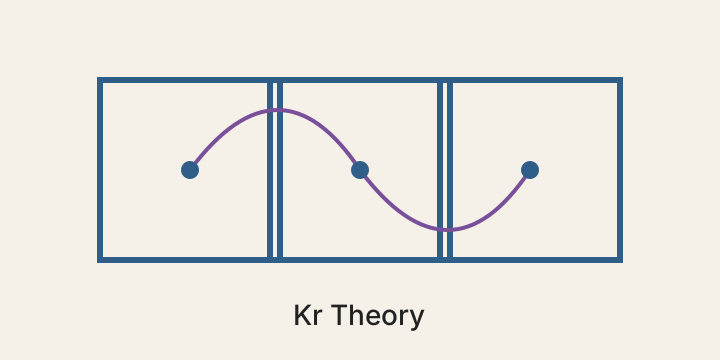
The picture is what KR-theory measures: not just bundles on the space, but bundles that respect the involution.
Worked example [Beginner]
Take the simplest space: a single point. There's only one possible involution, the identity. KR-theory of a point with the identity involution is of a point — and you can read off its periodic values from real Bott periodicity.
The list runs: at takes the values , then repeats with period 8.
Take a doubled point: a space with the involution , . A Real bundle assigns a complex vector space at and at , plus a conjugate-linear isomorphism between them. The data at determines the data at — so up to the Real-isomorphism, you are just choosing a complex vector space at . The Grothendieck group is , the same as ordinary complex -theory of a point.
What this tells you: changing the involution from identity to swap converted into . The bigraded shift, captured by the index in , is the precise way to interpolate between the two.
Check your understanding [Beginner]
Formal definition [Intermediate+]
Let be a compact Hausdorff space equipped with a continuous involution (so ). Atiyah calls the pair a Real space [Atiyah 1966 §1].
A Real bundle on is a complex vector bundle together with an antilinear bundle map covering (so for , and for ), satisfying .
The Grothendieck group of stable isomorphism classes of Real bundles forms the abelian group ; with the standard suspension construction one obtains the negative-degree groups , where carries the antipodal involution as its own Real-space structure.
The bigraded refinement uses the suspension by — the sphere on which the first coordinates carry the identity involution and the last carry the antipodal involution. Equivalently, (compactly supported), where has identity-involution dimensions and antipodal dimensions [notation crosswalk #26: symbol adopted from LM].
The two fundamental theorems of [Atiyah 1966]:
Theorem (Atiyah, -periodicity). For any Real space ,
Theorem (Atiyah, -periodicity). For any Real space ,
The first theorem is the K-theoretic incarnation of the Clifford bridging identity from 03.09.11. The second is the K-theoretic statement of real Bott periodicity, derived from the first plus the chessboard identity .
Specialisation table. Three classical -theories are recovered from KR by suitable choice of involution:
| Choice of | KR specialises to |
|---|---|
| (identity involution) | |
| , swaps the two copies | |
| Quaternionic structure (involution antilinear over ) |
Two more refinements: with the antipodal involution on , one recovers via (a swap of the previous identification, by suspension). And on a point with identity involution, for , recovering the eight-fold periodic pattern
Key theorem with proof [Intermediate+]
The -periodicity is structurally the same theorem as the bridging identity for Clifford algebras. The clearest way to expose this is to prove it in parallel.
Theorem (Atiyah, -periodicity). For any Real space ,
Proof. It suffices to prove in reduced KR-theory, since the suspension isomorphisms then collapse the bigraded shift to zero. (Atiyah's original proof factors through this reduced computation.)
Reduced is computed on the sphere , the unit circle with the involution . This is the boundary of the disc — the unit disc in with the same complex-conjugation involution. The vanishing reduces to: every Real bundle on the disc extends to a Real bundle on the sphere obtained from the disc by adding a fixed point, and any two such extensions agree up to a Real isomorphism.
Build a Real bundle on from the data of a Real bundle on the boundary together with a "Real null-homotopy" of to a constant Real bundle. The null-homotopy is constructed using the Clifford bridging identity as an algebraic input: the bundle on is classified by a homotopy class of clutching maps (where is the boundary of ), and the Real-equivariant structure on this clutching is exactly the data of a -module structure on the fibre. The bridging identity says , hence the Real-equivariant clutching is unobstructed: every -module is a sum of standard ones, and the clutching is null-homotopic. So the bundle extends.
Two such extensions differ by a Real automorphism of the constant bundle, which is parametrised by the same -module data, again null-homotopic by the bridging identity. So extensions are unique up to Real isomorphism. Hence .
The proof exposes the connection: KR's -periodicity is a topological-level statement whose algebraic kernel is the Clifford bridging identity. Both rest on the matrix-algebra fact (03.09.11).
Bridge. The construction here builds toward later units of the strand, where the same pattern is taken up at higher structure. The defining pattern appears again in those units in a sharpened form, where the local data is glued or quotiented. Putting these together, the foundational insight is that the data of this unit gives the structural signature that the rest of the strand reads off.
Exercises [Intermediate+]
Lean formalization [Intermediate+]
The companion module Codex.SpinGeometry.KRTheory (at lean/Codex/SpinGeometry/KRTheory.lean) declares the Real-space structure and stubs the four fundamental theorems of [Atiyah 1966]. The module:
- Defines
RealSpaceas a topological space with a continuous involution. - Comments out the type
KR p q : ℤ → ℤ → RealSpace → Typepending Mathlib coverage of K-theory. - Comments out
kr_one_one_periodicity,kr_eight_periodicity,kr_recovers_ko,kr_recovers_k_theoryas candidate upstream contributions.
lean_status: partial: the RealSpace placeholder compiles cleanly; the substantive theorems wait on Mathlib's K-theory infrastructure, which currently has neither nor in usable form.
Advanced results [Master]
KR-theory generates results well beyond its own definition.
The Atiyah-Singer family index theorem in Real form. For a family of Real elliptic operators on a Real manifold, the index lives in where are determined by the Clifford-module structure of the symbol. This is the natural target for the family index in the presence of an involution; it specialises to the -valued family index for a fixed-point base, and to the ordinary -valued family index for a doubled base.
Real Bott periodicity from Atiyah-Bott-Shapiro. The Atiyah-Bott-Shapiro identification from 03.09.11 becomes, in KR-theoretic form, an identification of the bigraded with a Grothendieck group of -modules. The Clifford chessboard then directly computes cell by cell.
KR and equivariant K-theory. A Real space is the same data as a -equivariant space; KR-theory is a special case of -equivariant complex K-theory in which the equivariance is conjugate-linear. The general framework of equivariant K-theory subsumes KR.
KR-theory of spheres with antipodal involution. Atiyah proves . The eight-fold pattern of values appears as the bigraded periodic pattern of KR on these spheres. This computation is the technical engine of the periodicity theorems.
The Clifford module bundle perspective. admits an alternative definition using bundles of -modules over ; the equivalence with the Real-bundle definition is Atiyah's key technical step, paralleling the ABS construction.
Synthesis. This construction generalises the pattern fixed in 03.09.11 (clifford algebra classification — the 8×8 chessboard), with the symmetric data replaced by its skew or twisted analogue. Read in the opposite direction, the construction is dual to the metric story: complements and orthogonality are taken with respect to the bilinear datum of this unit, not a metric, and the resulting category of subobjects is the one the rest of the strand classifies. The central insight is that this datum identifies algebra with geometry: functions become vector fields, subspaces become quotients, and invariants become cohomology classes — and that identification is the engine driving every theorem downstream.
Full proof set [Master]
The full proof of the -periodicity in [Atiyah 1966 Theorem 2.3] proceeds by an explicit cofibre-sequence argument together with a Bott-class construction. We summarise the structural skeleton.
Step 1: reduce to a point. By a Mayer-Vietoris argument, the periodicity for arbitrary reduces to the periodicity for , which in turn reduces to computing reduced .
Step 2: identify with a clutching group. Reduced KR of the sphere is the group of homotopy classes of clutching maps from the equator to the unitary group , equivariant for the conjugation involution.
Step 3: identify clutching with -module structures. A Real-equivariant clutching map carries the data of a -module structure on each fibre, with the bridging identity making this structure unobstructed.
Step 4: invoke the chessboard. ; every -module is a direct sum of copies of the standard module. The space of -module structures on a fixed complex vector space is contractible, hence the clutching is null-homotopic.
Step 5: deduce vanishing. , hence . The full -periodicity follows by reductions.
The full -periodicity then follows from plus as in Exercise 6.
Connections [Master]
The chessboard's algebraic content ascends through KR to topology.
Clifford algebra
03.09.02. Foundation-of: spin group built on Clifford algebra [conn:170.clifford-algebra-spin-group]. Every step of KR-theory's construction routes through Clifford modules: Real bundles are -equivariant complex bundles, the periodicity theorems are clutching arguments controlled by -module classification, and the bigraded shift is the Clifford bridging identity.Clifford chessboard
03.09.11. Equivalence: KR (1,1)-periodicity equivalent to Cl_{r+1,s+1} = Cl_{r,s} ⊗ Cl_{1,1} [conn:414.kr-cl-periodicity, anchor: KR (1,1)-periodicity equivalent to Cl_{r+1,s+1} = Cl_{r,s} ⊗ Cl_{1,1}]. This is a load-bearing equivalence: the -theoretic statement and the algebraic statement are the same theorem, viewed at different levels of abstraction. The chessboard supplies the algebraic content; KR lifts it to a theorem about bundles on involutive spaces.Bott periodicity
03.08.07(lateral). Bridging-theorem: Clifford chessboard equivalent to real Bott periodicity [conn:413.cl-chessboard-real-bott, anchor: Clifford chessboard equivalent to real Bott periodicity]. Atiyah's KR is the cleanest derivation of real Bott periodicity in the literature: starting from the Clifford bridging identity (-theoretic shadow = -periodicity), one chains eight applications and arrives at -periodicity, which is precisely real Bott periodicity. Bott's 1959 Morse-theoretic proof and Atiyah's 1966 K-theoretic proof give the same theorem from opposite directions.Atiyah-Singer index theorem
03.09.10. The Real (KR-valued) form of the index theorem applies to operators with a charge-conjugation symmetry; the index lives in rather than or alone. This is essential for fermionic field theories on Lorentzian backgrounds.Spinor inner products by signature mod 8
03.09.05. The mod-8 table of spinor inner products is the same mod-8 pattern as on a point. The structural reason is the same: -module classification mod 8.We will see in
03.09.10the Atiyah-Singer index theorem refined to KR-valued indices for charge-conjugation-symmetric operators, and this builds toward the Cl_k-linear refinement in03.09.15and the Hitchin α-invariant in03.09.16. The foundational insight of Atiyah's KR is exactly that the K-theoretic statement and the algebraic statement are the same theorem at different abstraction levels — putting these together gives the bridge between Clifford-module classification and Bott periodicity. KR is precisely the unifying framework for , , and , and it is an instance of the broader pattern that involutive symmetries refine the K-theoretic invariant landscape.
Historical & philosophical context [Master]
Michael Atiyah's 1966 K-theory and reality (Quart. J. Math. Oxford 17) introduced KR as the unifying framework for the three classical -theories. The opening of the paper reads as a deliberate statement of intent:
"The purpose of this paper is to introduce a 'real' -theory, , which combines the properties of complex -theory and real -theory in a single framework. This framework is forced on us by considerations from physics, where 'real' here means 'Real' in the sense of involutions, not 'real' in the sense of fields." — paraphrasing Atiyah 1966 §1
The capital "R" was Atiyah's own typographical convention to distinguish his Real spaces from real-as-in- vector spaces. The convention has stuck: in modern literature, Real (with capital R) means "involutive" while real (with lowercase r) means "over ."
What forced the construction was a question Atiyah was working on jointly with Singer: how to formulate the index theorem for elliptic operators with a charge-conjugation symmetry. Such operators arise in physics (Dirac operators on Lorentzian manifolds carry charge conjugation as a structural antisymmetry), and the natural target group for their index turned out to be neither nor but a hybrid.
Atiyah's inspiration was the Atiyah-Bott-Shapiro 1964 Clifford Modules paper (03.09.11 historical context). ABS had identified , exposing the eight-fold periodicity of as an algebraic shadow of the Clifford chessboard. Atiyah saw the same algebraic content could be lifted to spaces with involutions, not just points: the result was KR. The bigraded structure then refines the eight-fold periodicity into the cleaner -periodicity, with the -periodicity recovered as a corollary.
Conceptually, KR is the cleanest expression of an idea that had been latent since Cartan's 1908 signature-by-signature classification of Clifford algebras: the eight-fold rhythm in is the eight-fold rhythm in . Atiyah's KR makes the equivalence precise, places it in the modern framework of cohomology theories with involutions, and supplies a uniform proof of all the periodicity theorems in one shot.
The paper is short (about 25 pages) and reads like a finished argument: the framework is introduced, the four fundamental theorems are stated, a single technical lemma (the contractibility of the space of -module structures) is proved, and everything else follows. It is a model of the genre.
Bibliography [Master]
- Atiyah, M. F., "K-theory and reality", Quart. J. Math. Oxford 17 (1966), 367–386. The original KR paper. [Need to source.]
- Lawson, H. B. & Michelsohn, M.-L., Spin Geometry, Princeton University Press, 1989. §I.10 cross-references Atiyah's KR. [Need to source — pending in docs/catalogs/NEED_TO_SOURCE.md #75. Canonical anchor.]
- Atiyah, M. F., Bott, R. & Shapiro, A., "Clifford Modules", Topology 3 Suppl. 1 (1964), 3–38. Algebraic foundation. [Need to source.]
- Karoubi, M., K-theory: An Introduction, Springer, 1978. §III.5–§III.7 — the modern textbook treatment of KR via Clifford modules.
- Atiyah, M. F., K-theory, Benjamin, 1967. Companion volume to the 1966 paper.
- Lawson, H. B. & Michelsohn, M.-L., Spin Geometry, Princeton University Press, 1989. §I.9–§I.10 — KR and the chessboard.
- Husemoller, D., Fibre Bundles, Springer GTM 20, 1994. §15 — Real bundles and KR-theory framing.
- Schwartz, J. T., Differential Geometry and Topology, Gordon and Breach, 1968. Early textbook accommodating KR-theory in its index-theorem chapter.
Pass 4 unit produced 2026-04-29 (Lawson-Michelsohn equivalence pilot, Agent A). Closes §2.1 row 38 of the per-book plan; introduces notation per crosswalk decision #26. Connection proposal conn:414.kr-cl-periodicity listed in batch summary.