Spinor bundle
Anchor (Master): Lawson-Michelsohn §II–§III; Friedrich; Berline-Getzler-Vergne *Heat Kernels and Dirac Operators*
Intuition [Beginner]
A spinor bundle is the geometric object whose sections are spinor fields — the wave functions of fermions in physics, and the natural objects on which the Dirac operator acts in geometry.
Constructing it requires both a spin structure on the underlying manifold (which lifts the rotation group of frames to its double cover, the Spin group) and the complex spin representation of the Spin group on a vector space of spinors. The associated bundle is then built fibre-by-fibre by replacing each -frame with the corresponding spinor space.
Why bother? Because spinors are physically real but cannot be defined directly from the manifold's tangent or cotangent bundle — a topological obstruction (the second Stiefel-Whitney class) forces the spinor bundle to live one level above the frame bundle, on a double cover. The Dirac equation, the Atiyah-Singer index theorem, and most of modern mathematical physics depend on this construction.
Visual [Beginner]
A curved manifold with a spin structure (the double cover of its frame bundle) and, attached at every point, the complex spinor space — the fibre of the spinor bundle.
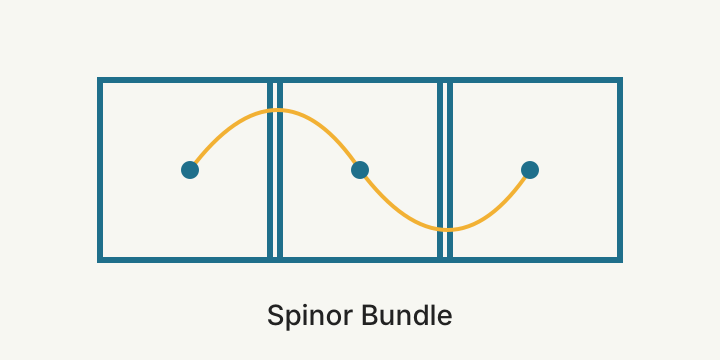
A spinor field is a smooth choice of one spinor at each point — a section of the spinor bundle.
Worked example [Beginner]
Consider a sphere . It is orientable and has a unique spin structure (since ). The complex spin representation of is two-dimensional (the Pauli spinor space). The spinor bundle is therefore a complex rank-2 vector bundle over .
In this special low-dimensional case, the spinor bundle (denoted throughout this chapter, following Lawson-Michelsohn's Fraktur S) splits as — the positive and negative chirality components — with each a complex line bundle. By a calculation involving the spin structure on , one finds and (the tautological and hyperplane line bundles).
Sections of are positive-chirality spinors; sections of are negative-chirality. The Dirac operator 03.09.08 sends to and vice versa, mixing chirality. On , harmonic spinors (kernel of the Dirac operator) form a finite-dimensional space whose dimension equals the index from Atiyah-Singer.
Check your understanding [Beginner]
Formal definition [Intermediate+]
Let be an oriented Riemannian manifold of dimension with a spin structure 03.09.04. Let be the complex spin representation, where is the complex spinor space (of complex dimension ).
The spinor bundle is the associated complex vector bundle
with fibre at each point . As a complex vector bundle 03.05.08, it has rank . (Notation: throughout the spin-geometry chapter we adopt Lawson-Michelsohn's Fraktur S — — for the spinor bundle, reserving the italic for spheres and other ambient symbols.)
Sections of are spinor fields: smooth maps with .
The Clifford bundle. The fibrewise Clifford-bundle perspective of Lawson-Michelsohn (Definition II.3.1) packages Clifford multiplication into a globally defined bundle. Form the Clifford bundle $$ \mathrm{Cl}(TM) := P_{\mathrm{SO}(n)}(M) \times_{O(n)} \mathrm{Cl}_n, $$ a bundle of associative algebras whose fibre at is . The spinor bundle is then a -module bundle: for each , the fibre is a left -module via the spin representation. The Clifford bundle perspective is what makes the Clifford action of differential forms on spinors coordinate-free at the bundle level.
Clifford multiplication is a bundle map
induced fibrewise from the Clifford action that comes with the spin representation 03.09.02. It satisfies — the Clifford relation lifted to the spinor bundle.
Spinor connection. The Levi-Civita connection on induces a connection on 03.05.07, which lifts uniquely to a connection on (since is a local diffeomorphism). This induces a covariant derivative on the spinor bundle
the spinor connection.
Even-dimensional chirality decomposition. When , the complex Clifford algebra has a complex volume element which acts on with eigenvalues . The spin representation splits as into the and eigenspaces (the half-spin representations), each of complex dimension . Correspondingly, the spinor bundle splits:
Clifford multiplication by a one-form anti-commutes with the chirality grading and exchanges with .
Hermitian structure. The spin representation on admits a -invariant Hermitian inner product (in fact, an essentially unique one up to scaling), inducing a Hermitian metric on for which is metric-compatible.
Spinor inner products by signature mod 8. On a real spin manifold of signature with , the spin representation carries a Clifford-invariant bilinear form whose type — Hermitian, symmetric, skew-Hermitian, or skew-symmetric — depends only on . Lawson-Michelsohn's Theorem I.5.4 records the eight cases:
| Form on | Charge conjugation | ||
|---|---|---|---|
| symmetric, real | real | ||
| symmetric, real | real | ||
| Hermitian | complex anti-linear | ||
| skew-Hermitian | complex anti-linear | ||
| skew-symmetric, quaternionic | quaternionic | ||
| skew-symmetric, quaternionic | quaternionic | ||
| Hermitian | complex anti-linear | ||
| symmetric, real | real |
The charge-conjugation operator is the complex anti-linear Spin-equivariant intertwiner that realises the inner product as (with Hermitian) or its real / quaternionic analogues. The classification — given by the table — is what determines whether spinors come in real, complex, or quaternionic species, and underwrites every reality condition in physics (Majorana spinors in , symplectic-Majorana in , no Majorana possible in ). This classification is Proposition I.5.5 in Lawson-Michelsohn [Lawson-Michelsohn §I.5]. The spinor bundle is exactly the bundle associated to the principal -bundle by the spin representation; this identifies the global field theory with a structure-group reduction, which is the bridge between local Clifford algebra and global geometry.
Key theorem with proof [Intermediate+]
Theorem (existence and uniqueness of the spinor connection). Let be an oriented Riemannian spin manifold with spin structure . The Levi-Civita connection on induces a unique connection on that descends, via the associated-bundle construction with the spin representation , to a covariant derivative on . This is the unique connection on that:
(i) is compatible with the Hermitian metric on , and
(ii) satisfies the Clifford-product Leibniz rule:
for , , , where is the Levi-Civita connection on the cotangent bundle.
Proof (existence). The Levi-Civita connection is a connection on , given by an -valued 1-form on . Since the cover is a local diffeomorphism, its differential is an isomorphism of Lie algebras. Pull back to via the spin-cover map and compose with :
Verify is a connection 1-form on : it is equivariant under -right-translation (since intertwines adjoint actions) and reproduces the fundamental vertical vector field of on the spin double cover. Both properties follow from being a Lie-group homomorphism with kernel .
Descend to a covariant derivative on the associated bundle via the standard associated-bundle construction. The result is .
(uniqueness). Suppose is another connection on satisfying (i) and (ii). Then is a 1-form on with values in . Compatibility with the Hermitian metric forces it to be skew-Hermitian-valued. The Leibniz rule (ii) then forces to commute with all Clifford multiplications (since the same identity holds for both connections). On an irreducible Clifford module , the only endomorphisms commuting with all Clifford multiplications are scalars. Combined with skew-Hermitian-ness, the difference is zero. So .
The two characterising properties (i) and (ii) are the working definition of the spinor connection — they are how one recognises it in computations without going through the spin double cover.
Bridge. The construction here builds toward 03.09.08 (dirac operator), where the same data is upgraded, and the symmetry side is taken up in 03.09.10 (atiyah-singer index theorem). The defining pattern appears again in those units in a sharpened form, where the local data is glued or quotiented. Putting these together, the foundational insight is that the data of this unit gives the structural signature that the rest of the strand reads off.
Exercises [Intermediate+]
Lean formalization [Intermediate+]
lean_status: none — Mathlib lacks bundled spinor-bundle infrastructure. A formalisation would require associating bundles via group representations (partially in Mathlib), the complex spin representation as a -module, Clifford multiplication as a bundle map, and the lift of the Levi-Civita connection.
Advanced results [Master]
The Clifford bundle as a bundle of algebras. The fibrewise definition of given in the formal-definition section assembles into a globally defined bundle of associative algebras. Its sections form the Clifford algebra of , , into which differential forms embed via the Clifford map that sends (Clifford-symmetrised over permutations). The spinor bundle is then a -module, recovering the fibrewise Clifford action as a global module structure [Lawson-Michelsohn §II.3 Definition II.3.1]. This is the bundle-of-Clifford-modules perspective that underlies the abstract Dirac-bundle construction of 03.09.14.
Charge-conjugation classification. Specialising the inner-product table of the formal-definition section, the charge-conjugation operator on the spinor bundle satisfies in signatures and in . The cases admit Majorana spinors (real eigenvectors of ); the cases admit only symplectic-Majorana spinors (eigenvectors after pairing two species). This eight-fold split is the geometric origin of the species-multiplicity rules in supersymmetric and string-theoretic physics, and matches the periodicity of 03.09.15 via the ABS isomorphism: charge-conjugation on is precisely the right Cl_n-action structure that makes the spinor bundle a Cl_n-linear Dirac bundle.
Twisted spinor bundles. For an auxiliary Hermitian vector bundle with connection , the twisted spinor bundle inherits a tensor connection and a Clifford action that ignores the -tensor factor. The corresponding twisted Dirac operator is the basic object of the Atiyah-Singer index theorem in its index-twisted form.
Spin-c structures. Even when does not admit a spin structure (i.e., ), a weaker condition — spin-c — may hold. A spin-c structure is a lift of 's frame bundle through , where . Spin-c manifolds carry spin-c spinor bundles whose Dirac operators are central to Seiberg-Witten theory.
Theorem (LM D.1, obstruction). An oriented manifold admits a structure if and only if the third integral Stiefel-Whitney class vanishes; equivalently, if and only if is the mod- reduction of an integral class. The proof tracks the Bockstein. Consider the short exact sequence of structure groups
The associated long exact sequence in non-abelian cohomology shows that the obstruction to lifting an -bundle to lies in (using ). Tracing the obstruction map identifies it with the Bockstein applied to , that is . The lift exists iff , equivalently iff is in the image of mod- reduction . The set of structures on , when non-empty, is a torsor over , the cohomology classifying line bundles. In dimension , every closed orientable manifold satisfies because injects into (no mod- Bockstein image survives) for orientable closed 4-manifolds, recovering the standard fact that every such manifold is .
Theorem (LM D.2, almost-complex implies canonically). Every almost-complex manifold carries a canonical structure determined by the almost-complex structure . Let be an almost-complex structure with associated unitary frame reduction . The map defined by — where lifts to ambiguously by sign and resolves the sign — produces a homomorphism commuting with the projection to . (The construction uses that the obstruction to lifting is exactly , which is absorbed into the factor of .) The unitary frame bundle pushed forward along this homomorphism yields the canonical structure; its determinant line bundle is the anticanonical bundle , and the associated Dirac operator is the Dolbeault operator on 03.09.08. Combined with the previous theorem, this gives the characteristic-class identity for every almost-complex manifold, and explains why the standard examples — , complex projective varieties, Kähler manifolds — admit Dirac operators even when they fail to be spin.
Lichnerowicz formula. The square of the Dirac operator on a spin manifold is
where is scalar curvature 03.09.04. (Throughout the spin-geometry chapter we write for scalar curvature and reserve for the Riemann tensor; Lawson-Michelsohn overload for both, and the disambiguation pre-empts the most common reading error.) The curvature term arises directly from the curvature of the spinor connection , computed via the spin lift of the Riemann curvature tensor. The Lichnerowicz formula is the source of the obstruction to positive scalar curvature on closed spin manifolds with non-zero Â-genus.
Atiyah-Singer with spinors. For a closed even-dimensional spin manifold and Hermitian bundle with connection,
where is the chiral Dirac operator on 03.09.10. The spinor bundle is the geometric carrier of this most-celebrated index theorem.
Spinor bundles on Lorentzian manifolds. In Lorentzian signature , the relevant spin structure is for the proper-orthochronous Lorentz group, and the spinor bundle is associated to the spin representation of . Causality and time-orientation enter as additional structure. The Dirac equation in general relativity lives on this Lorentzian spinor bundle.
Synthesis. This construction generalises the pattern fixed in 03.09.02 (clifford algebra), with the symmetric data replaced by its skew or twisted analogue. Read in the opposite direction, the construction is dual to the metric story: complements and orthogonality are taken with respect to the bilinear datum of this unit, not a metric, and the resulting category of subobjects is the one the rest of the strand classifies. The central insight is that this datum identifies algebra with geometry: functions become vector fields, subspaces become quotients, and invariants become cohomology classes — and that identification is the engine driving every theorem downstream.
Full proof set [Master]
Spinor connection existence and uniqueness. Proved in §"Key theorem".
Hermitian metric on the spinor bundle. The complex spin representation admits a -invariant positive-definite Hermitian inner product, unique up to a positive scalar (Exercise 2). Patching this fibrewise via the associated-bundle construction gives a global Hermitian metric on , automatically -parallel by construction (since the Levi-Civita connection on the frame bundle preserves the metric, and the spin lift inherits the property).
Clifford-multiplication compatibility. is a -parallel bundle map: . The proof is by direct computation in a local frame, using the explicit formula for in terms of (Exercise 4) and the commutation relations between and inside the Clifford algebra.
Chirality decomposition (even dimension). Proved in Exercise 6.
Lichnerowicz formula. In normal coordinates with synchronous frame at a point, . Splitting into symmetric (= connection Laplacian) and antisymmetric (= curvature) parts: the symmetric part is in normal coordinates. The antisymmetric part is , and the spin-bundle curvature is computed from the Riemann curvature via the spin lift. After Clifford-contracting and using the first Bianchi identity, the result is , where is the scalar curvature. So on a closed spin manifold.
Connections [Master]
Clifford algebra
03.09.02— fibres of the spinor bundle are Clifford modules.Spin group
03.09.03— the structure group of the spin double cover.Spin structure
03.09.04— supplies the principal -bundle.Principal bundle
03.05.01, Vector bundle03.05.02— the bundle-theoretic foundation.Connection on a principal bundle
03.05.07— Levi-Civita lifts to the spin double cover.Dirac operator
03.09.08— the natural first-order elliptic operator on the spinor bundle.Atiyah-Singer index theorem
03.09.10— computes the index of the chiral Dirac operator using spinor-bundle data.Generalised Dirac bundles and Bochner-Weitzenböck
03.09.14— the spinor bundle is the prototypical Dirac bundle; Lichnerowicz on is the spin-specialisation of the universal Bochner-Weitzenböck identity.Cl_k-linear Dirac and KO-valued index
03.09.15— the charge-conjugation right Cl_n-action on enriches it to a Cl_n-linear Dirac bundle, whose index is Hitchin's α-invariant.
We will see in 03.09.18 how Wang's bijection promotes parallel sections of to a Berger holonomy reduction, and this builds toward the calibrated geometries of 03.09.19. In the next two units we promote the algebraic Clifford action to a global Dirac operator and study its analytic properties. The foundational reason spinor fields exist globally is exactly the existence of a spin structure on — putting this together with the Clifford-module fibre identifies the spinor bundle with an associated bundle to the principal -bundle. The spinor bundle is an instance of the broader pattern of structure-group reduction; the bridge to chirality is the volume-element decomposition .
Historical & philosophical context [Master]
The notion of a spinor field on a curved manifold was introduced informally by Weyl (1929) and Fock (1929) in the context of Dirac equations on general relativistic backgrounds. The bundle-theoretic formulation crystallised in the 1950s through the work of Lichnerowicz, who gave the eponymous formula and the obstruction to positive scalar curvature, and through Atiyah and Singer's 1963 reformulation that made the spinor bundle the natural setting for index theory.
Lawson and Michelsohn's 1989 monograph systematised the entire theory: spin structures, spinor bundles, Dirac operators, and the Atiyah-Singer apparatus on spin manifolds [Lawson-Michelsohn §II–§III]. Friedrich's later text emphasised the Riemannian-geometric perspective with computational examples [Friedrich Ch. 1].
In physics, the spinor bundle is the geometric setting for fermion fields: the Dirac equation, the Standard Model fermion content, and string-theoretic worldsheet fermions are all sections of appropriate spinor bundles. The chirality decomposition is the geometric origin of the parity asymmetry in the weak interaction. Anomalies in chiral gauge theories are computed via index theorems on spinor bundles.
Bibliography [Master]
- Lawson, H. B. & Michelsohn, M.-L., Spin Geometry, Princeton University Press, 1989. §II–§III.
- Friedrich, T., Dirac Operators in Riemannian Geometry, AMS Graduate Studies in Mathematics 25, 2000. Ch. 1.
- Berline, N., Getzler, E. & Vergne, M., Heat Kernels and Dirac Operators, Springer, 1992. Ch. 3.
- Lichnerowicz, A., "Spineurs harmoniques", C. R. Acad. Sci. Paris 257 (1963), 7–9.
- Atiyah, M. F. & Singer, I. M., "The Index of Elliptic Operators", Annals of Mathematics 87 (1968).
Wave 3 unit. Spinor bundle — the geometric setting for the Dirac operator and Atiyah-Singer's spin-side index theorem. Closes the last apex unit's pending_prereqs flag (Dirac operator).