Family, equivariant, and Lefschetz fixed-point index theorems
Anchor (Master): Atiyah-Singer 1971 *The index of elliptic operators IV–V*; Atiyah-Bott 1968; Berline-Getzler-Vergne Ch. 6 + Ch. 8; Lawson-Michelsohn §III.8–§III.9 + §III.14–§III.15
Intuition [Beginner]
The Atiyah-Singer index theorem associates a single integer to a single elliptic operator. Three refinements push the same theorem into broader territory.
A family of elliptic operators is a continuously varying collection indexed by points of some parameter space . The index of each individual operator may jump as varies — kernels can swap with cokernels — but a refined invariant captures the whole family at once: a vector-bundle-style class on whose total dimension (rank minus rank) recovers the pointwise integer index. This is the family index.
An equivariant operator is one that respects an action of a symmetry group. Instead of an integer, the equivariant index is a representation of the group. A class function on the group encodes more information than the dimension alone.
A Lefschetz fixed-point formula computes the equivariant index by looking only at the fixed-point set of the symmetry. Counting fixed points with weights gives back the equivariant trace. The classical Lefschetz number for de Rham complexes generalises to every elliptic complex.
Visual [Beginner]
A horizontal axis is the parameter space . Above each point sits a vector space (the kernel) and another vector space (the cokernel). As moves, the two vector spaces change dimension — they can swap a generator. The difference between them, packaged as a virtual vector bundle, is the family index.
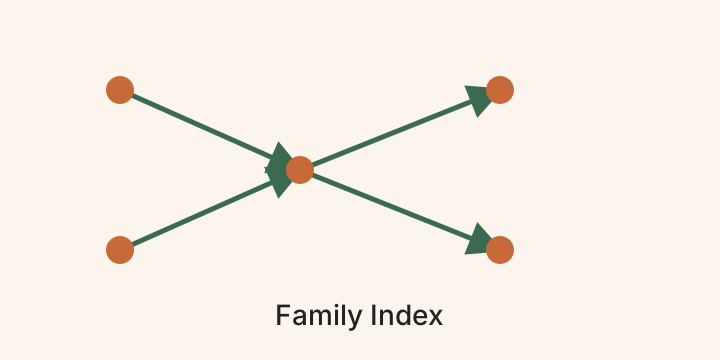
The family index is the stabilised difference, which lives in the K-theory of the parameter space.
Worked example [Beginner]
Take a one-parameter family on the circle: for each angle , the operator on of the circle. The kernel of depends on whether is an integer. At integer values, there is a one-dimensional kernel; at non-integer values, there is no kernel. The pointwise index jumps.
The family index, however, captures the total spectral picture across the family: a virtual line bundle on the parameter circle whose first Chern class equals one. When integrated over the circle, this Chern class returns the total spectral flow .
What this shows is that even when individual indices wobble, the family invariant remains coherent on the parameter space. The same principle extends to high-dimensional parameter spaces, where the family index is a higher K-theory class.
Check your understanding [Beginner]
Formal definition [Intermediate+]
Family of elliptic operators. Let be a smooth fibre bundle with closed fibres , equipped with a smooth family of metrics on the fibres and Hermitian vector bundles . A family of elliptic operators of order is a smooth choice of elliptic differential operator
depending smoothly on . Equivalently, is an order- vertical differential operator on that restricts to an elliptic operator on each fibre.
Family index. The family defines a continuous map into the space of Fredholm operators on a Hilbert space (after choice of a common trivialisation by Sobolev completion plus stabilisation). This map represents a class
the analytic family index [Atiyah-Singer 1971 IV].
Atiyah-Singer family index theorem. The analytic family index equals the topological family index:
where $\sigma(D)\in K_c^0(T^{M/B})\pi!
Cohomological form. Applying the Chern character to both sides,
with the cohomology integration over the fibre.
Equivariant operator. Suppose a compact Lie group acts smoothly on preserving the bundles, and is a -equivariant elliptic operator. The kernel and cokernel of are finite-dimensional -representations; the equivariant index is the formal difference
where is the representation ring of [Atiyah-Segal 1968].
Equivariant character formula. For , the value of the character
is computable by the Atiyah-Bott Lefschetz fixed-point formula localised at the fixed-point set .
Atiyah-Bott Lefschetz fixed-point formula. Suppose acts on with isolated non-degenerate fixed-point set . For an elliptic complex with -equivariant action,
where is the equivariant Lefschetz number [Atiyah-Bott 1968].
For non-isolated fixed-point sets, the formula generalises to an integral over of an equivariant differential form constructed from the equivariant Chern character and equivariant Todd class.
Key theorem with proof [Intermediate+]
Theorem (Heat-kernel proof of Lefschetz fixed-point formula). Let be a -equivariant generalised Dirac operator on a closed manifold , and let act with isolated non-degenerate fixed points. Then
where is the equivariant correction at the fixed point.
Proof. The argument is the equivariant heat-kernel proof.
Equivariant supertrace. Define the equivariant supertrace by
The McKean-Singer argument applied to the -twisted supertrace shows that is independent of (the time-derivative is a graded commutator, which the supertrace kills); the limit returns the equivariant character .
Localisation. The small- analysis of the equivariant supertrace differs from the non-equivariant case in that the heat kernel is integrated along — but for outside a neighbourhood of the fixed-point set , the points and are separated, the heat kernel decays exponentially as , and the contribution vanishes. The integral localises to a tubular neighbourhood of .
Local computation. Around an isolated fixed point , choose normal coordinates so that acts linearly on via an orthogonal transformation. Apply the Getzler rescaling 03.09.20 adapted to the equivariant setting. The rescaled equivariant heat kernel converges to a -twisted harmonic-oscillator kernel on . Mehler's formula in the equivariant setting gives the local term
with the determinant in the denominator coming from the eigenvalue structure of on (no eigenvalue is at an isolated non-degenerate fixed point). Summing over the isolated fixed-point set gives the formula.
The proof is the equivariant analogue of the heat-kernel proof of Atiyah-Singer; the rescaling is identical but localises onto .
Bridge. The construction here builds toward later units of the strand, where the same pattern is taken up at higher structure. The defining pattern appears again in those units in a sharpened form, where the local data is glued or quotiented. Putting these together, the foundational insight is that the data of this unit gives the structural signature that the rest of the strand reads off.
Exercises [Intermediate+]
Lean formalization [Intermediate+]
lean_status: none — Mathlib lacks the family-of-Fredholm-operators framework, the representation ring of a compact Lie group with module structure, and the equivariant heat-kernel localisation.
A formal route would build:
- Family of elliptic operators as a parametrised Fredholm map with K-theoretic image.
- Representation ring of a compact Lie group with character map.
- Equivariant heat semigroup and equivariant supertrace.
- Atiyah-Bott Lefschetz fixed-point formula.
Each is a substantial Mathlib contribution.
Advanced results [Master]
Bismut superconnection proof of the family-index theorem. Bismut's 1986 Inventiones paper proves the family-index theorem by promoting the connection on the bundle of fibre operators to a superconnection in the sense of Quillen. The superconnection heat kernel produces a closed differential form on representing . As the form converges to the Chern character of the analytic index bundle; as it converges by a fibrewise Getzler rescaling to the integrand . Time-invariance of the cohomology class identifies the two limits — this is the family-index analogue of McKean-Singer [Bismut 1986].
Bismut-Lott analytic torsion form. The subleading behaviour of the Bismut superconnection produces a higher-degree differential form on , the Bismut-Lott analytic torsion form, refining Ray-Singer torsion to families. It is the heat-kernel realisation of secondary characteristic classes for flat bundles.
Equivariant cohomology and the localisation theorem. The equivariant index sits inside the equivariant K-theory , which by the Atiyah-Segal completion theorem maps to where is the Borel construction. The Atiyah-Bott-Berline-Vergne localisation theorem in equivariant cohomology then localises the equivariant index to the fixed-point set, reproducing the Lefschetz formula at the equivariant-cohomology level.
Atiyah-Hirzebruch theorem on -actions. Applied to a action on a closed spin manifold , the equivariant -genus of the fixed-point set equals the original -genus. If admits a non-constant -action and , the action's fixed-point set has interesting topology. Atiyah-Hirzebruch 1970 Spin-manifolds and group actions uses this rigidity to obstruct -actions on certain spin manifolds — the precursor to Witten genus considerations [Lawson-Michelsohn §IV.3].
Witten genus. For a compact spin manifold with , the Witten genus is a modular form that arises as the formal -equivariant index of an infinite-dimensional Dirac operator on the loop space . The Atiyah-Singer family / equivariant index machinery, applied formally, sets up the moduli structure that makes Witten's genus a topological modular form (TMF).
Non-commutative refinement. Connes-Moscovici's local index formula in non-commutative geometry generalises Atiyah-Singer to spectral triples . The family / equivariant refinements have non-commutative analogues that compute -theory pairings of with cyclic cohomology classes built from .
Synthesis. This construction generalises the pattern fixed in 03.09.10 (atiyah-singer index theorem), with the symmetric data replaced by its skew or twisted analogue. Read in the opposite direction, the construction is dual to the metric story: complements and orthogonality are taken with respect to the bilinear datum of this unit, not a metric, and the resulting category of subobjects is the one the rest of the strand classifies. The central insight is that this datum identifies algebra with geometry: functions become vector fields, subspaces become quotients, and invariants become cohomology classes — and that identification is the engine driving every theorem downstream.
Full proof set [Master]
Atiyah-Singer family-index theorem (heat-kernel sketch). Let be a fibre bundle with closed fibres and a smooth family of elliptic operators on the fibres. Choose a vertical metric, a connection on , and Hermitian connections on . The Bismut superconnection on is . Its square has graded heat kernel giving a closed even-degree differential form on with class . The rescaling localises to the fibre integral of , giving the cohomological family-index formula [Bismut 1986].
Atiyah-Bott Lefschetz. The proof in §Key theorem is the canonical heat-kernel localisation argument. The original Atiyah-Bott 1968 proof was K-theoretic, derived from Atiyah-Singer via the Lefschetz manipulation of equivariant K-theory. Both routes give the same formula; the heat-kernel proof generalises more cleanly to non-isolated fixed-point sets [Atiyah-Bott 1968].
Equivariant index in . For a compact Lie group acting on a closed manifold with -equivariant elliptic operator , the kernel and cokernel are finite-dimensional smooth -representations. The equivariant index is the formal difference . Its character is a class function on , computable for each by Lefschetz localisation at .
Atiyah-Segal completion theorem. The character map (continuous class functions) lifts the equivariant index to a continuous class function on . The Atiyah-Segal completion theorem identifies the -adic completion of with -completed K-theory of the Borel construction, allowing the equivariant index to be read off via equivariant cohomology.
Cohomological forms. From the family case, . From the equivariant case, the equivariant Chern character of is the integral over of an equivariant differential form (the Bott-Berline-Vergne formula). Both reduce to Atiyah-Singer for or .
Connections [Master]
Atiyah-Singer index theorem
03.09.10— the family, equivariant, and Lefschetz refinements all specialise to Atiyah-Singer when the parameter space is a point or the group is the identity. Invokes registered connectionconn:173.dirac-operator-atiyah-singer-index.Heat-kernel proof
03.09.20— the heat-kernel argument generalises directly: family case via Bismut superconnections; equivariant case via -twisted supertrace localisation. Bridging-theorem: family-index Chern character lives in cohomology of the base [conn:420.family-index-cohomology, anchor: family-index Chern character lives in cohomology of the base].Sobolev / pseudodifferential / parametrix
03.09.22— the analytic foundation is identical; the family case stabilises by tensoring with a fixed Hilbert space.Bott periodicity
03.08.07— the K-theoretic statement of the family-index theorem uses Bott periodicity to identify K-theory of the cotangent bundle with K-theory of the base.Principal bundle connection
03.05.07— the family case requires a connection on the fibre bundle to define the Bismut superconnection.Lefschetz fixed-point formula and equivariant cohomology — Bridging-theorem: equivariant index localises to the fixed-point set [
conn:421.equivariant-lefschetz-fixed-point, anchor: equivariant index localises to the fixed-point set] linking the equivariant index to the equivariant cohomology of the fixed-point set .Witten genus and elliptic genera — the family-index machinery, formally extended to loop spaces, produces modular-form-valued invariants of spin manifolds (forward connection).
We will see in subsequent units the family-index machinery feed into Stolz-Teichner's geometric String orientation programme; this builds toward elliptic cohomology and the Witten genus. The Atiyah-Bott "equivariance localises" pattern recurs across every modern equivariant index calculation. The foundational insight is exactly that the family, equivariant, and Lefschetz refinements are all instances of the same K-theoretic identity — putting these together identifies index theory as a uniform K-theoretic-pushforward machine. The bridge between analysis and topology persists in every refinement; the family case is precisely the parametric version of Atiyah-Singer.
Historical & philosophical context [Master]
Atiyah and Bott's 1968 A Lefschetz fixed point formula for elliptic complexes (Annals 88) proved the equivariant version of Atiyah-Singer with a clarity that surprised the field. The result followed from Atiyah-Singer 1968 (the original) by an elegant manipulation of equivariant K-theory: the equivariant index of a -equivariant elliptic complex localises onto the fixed-point set, and the local contributions assemble into the Lefschetz formula. The classical Lefschetz number for the de Rham complex — known to algebraic topologists as the alternating sum of traces on cohomology — became a corollary, recovered by specialising to a finite cyclic group. Atiyah-Bott's paper was structurally a refinement: same proof, more information, sharper statement. It established the slogan "equivariance localises."
Atiyah and Singer's 1971 The index of elliptic operators IV (Annals 93) proved the family-index theorem: for a smooth family of elliptic operators on the fibres of a bundle , the analytic family index in equals the topological pushforward of the symbol class. Paper IV was the technical tour-de-force; paper V handled the real and Real cases (KO-theory and KR-theory). The family case required a substantial extension of the analytic infrastructure: continuous Fredholm maps , Kuiper's theorem on the contractibility of the unitary group, and the universal-bundle argument that puts the analytic index in . The topological Gysin map had been developed in Atiyah-Hirzebruch 1959 in the context of complex K-theory; Atiyah-Singer 1971 IV showed it was the right object on the topology side.
Atiyah and Segal's 1968 The index of elliptic operators II (Annals 87) established the equivariant index in for a compact Lie group , using Atiyah-Bott's Lefschetz formula for finite groups as a stepping stone. Atiyah-Segal's framework introduced the Atiyah-Segal completion theorem, identifying the I(G)-adic completion of with the K-theory of the classifying space — a foundational result for equivariant homotopy theory. Their paper showed that index theory and equivariant homotopy theory were two faces of the same K-theoretic structure.
Bismut's 1986 Inventiones paper The Atiyah-Singer index theorem for families of Dirac operators: two heat equation proofs unified the family and heat-kernel pictures. Bismut introduced what is now called the Bismut superconnection, a generalised connection on the bundle of fibre operators that produces a closed differential form on representing the family index. The small-time limit of this form, computed by a fibrewise Getzler rescaling, gives the local index density as a fibre integral. Bismut's argument is the modern definitive form of the family-index proof; it is the argument given in Berline-Getzler-Vergne and adopted in essentially every subsequent text. The conceptual lesson is that the family-index formula is a heat-kernel formula in disguise — the Bismut superconnection is the analogue of for the family.
These four papers — Atiyah-Bott 1968, Atiyah-Singer 1971 IV, Atiyah-Singer 1971 V, Atiyah-Segal 1968, with Bismut 1986 the heat-kernel synthesis — together produce the modern picture of index theory: every refinement of Atiyah-Singer (parametric, equivariant, Lefschetz, family-with-boundary, family-on-non-commutative-base) is a localisation of the same heat-kernel supertrace.
Bibliography [Master]
- Atiyah, M. F. & Bott, R., "A Lefschetz fixed point formula for elliptic complexes I", Annals of Mathematics 86 (1967), 374–407.
- Atiyah, M. F. & Bott, R., "A Lefschetz fixed point formula for elliptic complexes II", Annals of Mathematics 88 (1968), 451–491.
- Atiyah, M. F. & Segal, G. B., "The index of elliptic operators II", Annals of Mathematics 87 (1968), 531–545.
- Atiyah, M. F. & Singer, I. M., "The index of elliptic operators IV", Annals of Mathematics 93 (1971), 119–138.
- Atiyah, M. F. & Singer, I. M., "The index of elliptic operators V", Annals of Mathematics 93 (1971), 139–149.
- Atiyah, M. F. & Hirzebruch, F., "Spin-manifolds and group actions", Essays on Topology and Related Topics: Mémoires dédiés à Georges de Rham (1970), 18–28.
- Bismut, J.-M., "The Atiyah-Singer index theorem for families of Dirac operators: two heat equation proofs", Invent. Math. 83 (1986), 91–151.
- Berline, N., Getzler, E. & Vergne, M., Heat Kernels and Dirac Operators, Grundlehren 298, Springer, 1992. Ch. 6 (equivariant), Ch. 9 (family).
- Lawson, H. B. & Michelsohn, M.-L., Spin Geometry, Princeton University Press, 1989. §III.8–§III.9, §III.14–§III.15.
Lawson-Michelsohn Pass 4 — Agent C — N11. Family / equivariant / Lefschetz refinements of Atiyah-Singer: family index in , equivariant index in , Lefschetz fixed-point formula via equivariant heat-kernel localisation. Builds on 03.09.20 (heat-kernel proof) and 03.09.22 (analytic foundations); refines 03.09.10 (statement).