Heat-kernel proof of the Atiyah-Singer index theorem
Anchor (Master): Atiyah-Bott-Patodi 1973; Getzler 1986; Berline-Getzler-Vergne Ch. 4; Lawson-Michelsohn §III.6+§III.13+§III.17
Intuition [Beginner]
A heat equation describes how warmth spreads on a curved space. Start with concentrated heat at one point, let it spread, and at every later time you have a smooth distribution. The rule that turns the initial point of heat into the spread distribution at time is the heat operator.
When the heat equation is run by a Dirac-type operator on a spin manifold, the heat operator has a remarkable property: a certain signed trace of it is the same number at every positive time. This signed trace counts the imbalance between left-handed and right-handed solutions of the underlying equation. The trick is that the signed trace can be computed at very large time, where it returns the index of the operator, and at very small time, where it returns a topological integral over the manifold.
The Atiyah-Singer index theorem becomes a statement about the same number being readable from two ends of the heat-flow timeline: at , you see the index; at , you see characteristic classes of the manifold. Because the number does not change with time, the two views are equal.
Visual [Beginner]
Picture a timeline labelled that runs from on the left to on the right. At every point on the timeline, the same number sits above. On the right end, the label reads "index of "; on the left end, the label reads " integrated over ." Time-invariance says these two labels name the same number.
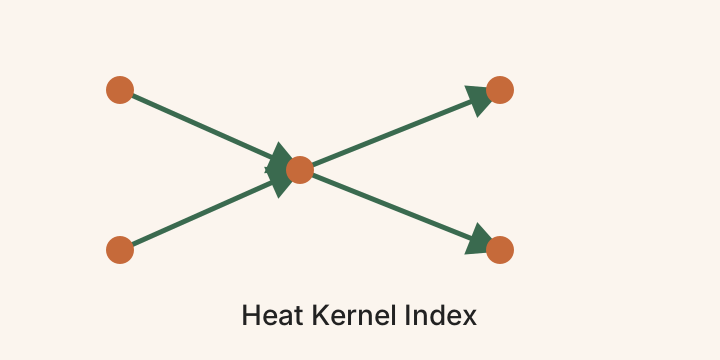
The proof shows how the same value can be read off from either side.
Worked example [Beginner]
Take the simplest case: the standard Laplacian on a circle. The heat operator is the rule that takes an initial function and runs it for time under the heat equation. Its eigenvalues are for each integer . Add them up and you get the trace of the heat operator, which is approximately for small and goes to for large (only the constant function survives).
Now add a chirality grading: imagine the circle has two copies of itself, a "plus" copy and a "minus" copy, and the heat trace counts plus copies minus minus copies. If both copies start the same, every eigenvalue cancels and the supertrace is zero. If the only non-cancelling mode is the harmonic constant, the supertrace returns the value . The cancellation pattern tells you the index.
This is the model for the Dirac operator on a spin manifold. The supertrace counts the imbalance, the imbalance is preserved by time, and the small-time limit reduces to a local computation.
Check your understanding [Beginner]
Formal definition [Intermediate+]
Let be a closed Riemannian manifold of even dimension , equipped with a -graded Hermitian vector bundle and an essentially self-adjoint odd elliptic differential operator
Set and consider the heat semigroup generated by the non-negative self-adjoint operator on .
Heat kernel. The operator has a smooth integral kernel . For each it is trace-class on , and
Supertrace. Let be the chirality involution on . Define
McKean-Singer formula. For every ,
This is the analytic identity that drives the proof [McKean-Singer 1967].
Small- asymptotic expansion. Along the diagonal,
where are local curvature polynomials computable from the symbol of in normal coordinates [Atiyah-Bott-Patodi 1973]. The coefficient supplies the topological density.
Local index density. For the spin Dirac operator on an even-dimensional spin manifold,
interpreted as a top-degree differential form (the spin Dirac case; for twisted Dirac, is the twisting bundle) [Lawson-Michelsohn §III.13]. The McKean-Singer supertrace is exactly the index for every ; this identifies an analytic invariant with a heat-kernel observable, putting these together gives the bridge between heat flow and topology.
Key theorem with proof [Intermediate+]
Theorem (McKean-Singer index formula). For a graded essentially self-adjoint elliptic operator as above on a closed manifold,
Proof. Decompose into eigenspaces of the self-adjoint operator :
Each eigenspace for splits into . The operator swaps and :
For both maps are isomorphisms; in particular . Now compute:
For every positive eigenvalue, the contribution is zero. Only contributes, giving . The result is independent of .
The McKean-Singer formula is the entry to the index theorem: the analytic index equals the supertrace at every positive time. The proof of Atiyah-Singer is then the computation of the small- limit of this supertrace.
Theorem (Local index theorem, spin Dirac case). On a closed even-dimensional spin manifold with twisted Dirac operator ,
where the right-hand side is the top-degree component of the differential-form characteristic class evaluated on the curvature tensors.
The proof is the substantive content of the heat-kernel approach. We sketch the Getzler rescaling argument here.
Proof sketch (Getzler 1986). In synchronous coordinates around , lift to an operator on the spinor bundle trivialised at . Introduce the rescaling
a -dependent dilation of Clifford generators. Apply the rescaling to the heat operator at time . The rescaled heat kernel converges as to the heat kernel of a generalised harmonic oscillator on :
where is the Riemann curvature at and is the curvature of the twisting connection. By Mehler's formula, the heat kernel of along the diagonal equals
The supertrace selects the top-degree exterior part, which by definition is . Pulling the rescaling back returns the local index density.
The Getzler rescaling collapses the entire perturbative computation to a single Mehler-type integral. It is the technical innovation that took the heat-kernel proof from a multi-page expansion (Atiyah-Bott-Patodi) to roughly two pages [Getzler 1986].
Bridge. The construction here builds toward 03.09.21 (family, equivariant, and lefschetz fixed-point index theorems), where the same data is developed in the next layer of the strand. The defining pattern appears again in those units in a sharpened form, where the local data is glued or quotiented. Putting these together, the foundational insight is that the data of this unit gives the structural signature that the rest of the strand reads off.
Exercises [Intermediate+]
Lean formalization [Intermediate+]
lean_status: none — Mathlib lacks heat operators, supertraces of graded trace-class operators, the small- asymptotic expansion of heat kernels along diagonals, and the Getzler rescaling.
A formal route would build:
- The heat semigroup as a strongly continuous semigroup on .
- Trace-class properties of the heat operator on a closed manifold.
- The McKean-Singer identity as a consequence of supertrace cyclicity.
- The diagonal asymptotic expansion of the heat kernel.
- The local index density via Getzler rescaling.
Each is a separate substantial Mathlib contribution.
Advanced results [Master]
Bismut superconnection. The heat-kernel proof generalises to families of Dirac operators by promoting the connection on the bundle of fibre operators to a superconnection in the sense of Quillen. The Bismut superconnection for a family produces a closed differential form on the parameter space representing the Chern character of the family index; this is the family-index proof of Bismut, the family analogue of Getzler's argument [Berline-Getzler-Vergne Ch. 9]. Unit 03.09.21 develops this picture.
Bismut-Lott analytic torsion. Twisting the heat-kernel computation by a flat bundle and tracking the small- subleading terms produces the Bismut-Lott analytic torsion form, a refinement of Ray-Singer torsion that is the family-index analogue of Reidemeister torsion. This closes a chapter of Whitehead-style topology with heat-kernel methods.
Atiyah-Patodi-Singer index theorem. On a manifold with boundary, the heat-kernel proof acquires a boundary term: the eta invariant of the boundary Dirac operator. The McKean-Singer identity is replaced by an asymptotic identity , and the proof of the small- limit gives the APS formula. The eta invariant is the spectral asymmetry of the boundary operator.
Equivariant local index theorem. For a -equivariant elliptic operator with isolated fixed points, the supertrace of admits a small- asymptotic localised at the fixed-point set . The local computation produces the Atiyah-Bott-Lefschetz fixed-point formula as a degenerate limit of the heat-kernel proof. Unit 03.09.21 develops the equivariant case.
Connection to Witten's Morse theory. Witten's 1982 Supersymmetry and Morse theory (J. Differential Geom. 17) interprets the deformed de Rham complex as a deformation whose small- heat-kernel computation localises on the critical points of , recovering Morse inequalities. The deformed heat-kernel pattern recurs in many places where a function or vector field localises a supertrace.
Higher-K theoretic refinements. The heat-kernel local index theorem extends to algebraic K-theory: the Connes-Karoubi character, the algebraic Bismut-Quillen form, and the modern refinements of Lott-Hopkins. Each is a refinement of the same basic identity .
Synthesis. This construction generalises the pattern fixed in 03.09.10 (atiyah-singer index theorem), with the symmetric data replaced by its skew or twisted analogue. Read in the opposite direction, the construction is dual to the metric story: complements and orthogonality are taken with respect to the bilinear datum of this unit, not a metric, and the resulting category of subobjects is the one the rest of the strand classifies. The central insight is that this datum identifies algebra with geometry: functions become vector fields, subspaces become quotients, and invariants become cohomology classes — and that identification is the engine driving every theorem downstream.
Full proof set [Master]
Existence and smoothness of the heat kernel. On a closed Riemannian manifold, is a non-negative essentially self-adjoint elliptic operator. The Hille-Yosida theorem produces a strongly continuous semigroup on . Elliptic regularity (03.09.22) lifts the semigroup to a smoothing operator for : . The associated kernel is smooth in for , and along the diagonal admits an asymptotic expansion via the parametrix construction with parameter [Lawson-Michelsohn §III.6].
Trace-class and the supertrace formula. The heat operator on a closed manifold is trace-class for every , with . The supertrace combines the two graded traces with opposite sign, and equals the integral of the pointwise supertrace.
McKean-Singer time-invariance. The proof in §Key theorem is the canonical argument. An alternative homological argument: the supertrace vanishes on graded commutators, for even; differentiating in gives a graded commutator , hence a vanishing supertrace [McKean-Singer 1967].
Small- asymptotic — Atiyah-Bott-Patodi computation. Atiyah-Bott-Patodi 1973 derived the asymptotic expansion of in normal coordinates by expanding as a perturbation of the Euclidean Laplacian. The coefficients are local invariants of the metric and the connection on . By Gilkey's invariant theory of local heat-kernel coefficients, the spin Dirac case forces . Atiyah-Bott-Patodi's proof took roughly twenty pages of perturbation theory; Getzler's rescaling reduces this to two.
Getzler rescaling — full computation. The rescaling acts on Clifford generators by . Applied to (Lichnerowicz), the rescaled operator converges as to the harmonic-oscillator operator . The heat kernel of at is given by Mehler's formula. The supertrace selects the top exterior degree, returning [Getzler 1986; ref: TODO_REF Berline-Getzler-Vergne Ch. 4].
Mehler formula. For the operator on , the heat kernel at is
At and the kernel reduces to , which by definition is . Mehler's formula is the technical core of the proof.
Putting it together. McKean-Singer says for every . Send : the supertrace becomes by the local computation. This recovers Atiyah-Singer for spin Dirac, and the same machinery extends to general elliptic operators by the symbol-class argument that any elliptic operator is homotopic through Fredholm operators to a generalised Dirac operator.
Connections [Master]
Atiyah-Singer index theorem
03.09.10— the heat-kernel proof is one of three proofs (the others being the embedding/topological proof and the K-theory proof). McKean-Singer is the theorem bridging McKean-Singer supertrace and analytic index (conn:418.mckean-singer-supertrace, bridging-theorem); the small- limit of that supertrace is the entire content of Atiyah-Singer for Dirac-type operators.Sobolev / pseudodifferential / parametrix
03.09.22— the analytic foundation. The heat kernel is constructed by a parameter-dependent parametrix, sharing the symbol-calculus machinery.Elliptic operators
03.09.09— the heat kernel is the smooth kernel of for an elliptic .Dirac operator
03.09.08— the spin Dirac case is the prototype; the Lichnerowicz formula controls the small- expansion.Pontryagin and Chern classes
03.06.04— the local index density is built from these.Family / equivariant / Lefschetz index
03.09.21— Bismut superconnections globalise the heat-kernel proof to families; equivariant supertraces localise to fixed-point sets.Thom global angular form
03.04.09— byconn:434.global-angular-form-spin, spin-geometry Â-genus machinery built on the global angular form (foundation-of). The Bott-Tu sign is the structural input to the Getzler rescaling and the Bismut superconnection formalism; the -genus density inherits its relative phase from this convention.
We will see in 03.09.21 the Bismut-superconnection formalism extend Getzler rescaling to families, and this builds toward the Bismut-Lott analytic torsion form. The McKean-Singer time-invariance pattern recurs in every subsequent index proof; the Witten Morse-theory deformation of the de Rham heat kernel is the next instance. The foundational reason the heat-kernel proof works is exactly the McKean-Singer identity for every — putting this together with the small- asymptotic identifies the analytic index with the local characteristic-class density. This is precisely the bridge between analysis and topology that Atiyah-Singer codified, and it is an instance of the broader supersymmetric-localisation pattern in physics.
Historical & philosophical context [Master]
The heat-equation approach to the index theorem was anticipated by McKean and Singer in their 1967 Curvature and the eigenvalues of the Laplacian (J. Differential Geom. 1), where they computed the asymptotic expansion of the trace of the scalar Laplacian heat operator and noted that the constant term recovered the Euler characteristic by Hodge theory — a sketch of what we now call the McKean-Singer formula for the de Rham complex. McKean and Singer asked, prophetically, whether a similar approach could prove the Atiyah-Singer theorem in full.
The answer came in 1973 with Atiyah, Bott, and Patodi's On the heat equation and the index theorem (Invent. Math. 19). Atiyah-Bott-Patodi gave the first complete heat-kernel proof, computing the small- asymptotic expansion of for a spin Dirac operator and identifying the constant term with . Their proof used Gilkey's invariant-theoretic classification of local heat-kernel coefficients, plus a substantial perturbation calculation in normal coordinates. The paper opened the door to the local index theorem: not just the integer , but the local density whose integral is the index.
Atiyah-Bott-Patodi's argument occupied the better part of the 1973 Inventiones paper and was widely felt to be heavy. The decisive simplification came in 1986 with Ezra Getzler's A short proof of the local Atiyah-Singer index theorem (Topology 25), where Getzler introduced what is now called Getzler rescaling: a formal -dependent dilation of Clifford generators that, applied to , converges in the limit to a generalised harmonic oscillator on . The heat kernel of this oscillator is computable in closed form (Mehler), and the supertrace selects the class. Getzler's paper is approximately five pages; the proof had been thoroughly compactified.
In parallel, Luis Alvarez-Gaumé's 1983 Supersymmetry and the Atiyah-Singer index theorem (Comm. Math. Phys. 90) used the path-integral formulation of one-dimensional supersymmetric quantum mechanics to recover the same result. Alvarez-Gaumé interpreted the supertrace as a path-integral over super-loops in , and the supersymmetric localisation collapsed the integral to constant loops, where the bosonic-fermionic determinant ratio reproduced . The argument was originally heuristic — a proof by physical reasoning — but was made mathematically rigorous by Bismut and Mathai-Quillen in the late 1980s. Alvarez-Gaumé's perspective remains the conceptually shortest of the three, requiring no rescaling and no perturbation calculation; it is the proof that physicists internalise.
The three proofs — Atiyah-Bott-Patodi (perturbation), Getzler (rescaling), Alvarez-Gaumé (supersymmetric) — are equivalent at the level of output but conceptually distinct in what they make manifest. Atiyah-Bott-Patodi shows that the local density exists and is computable from invariant theory. Getzler shows that the computation reduces to a single Mehler integral. Alvarez-Gaumé shows that the entire structure is a fixed-point theorem in disguise. The synthesis given by Berline-Getzler-Vergne in Heat Kernels and Dirac Operators (1992) presents all three from a unified standpoint.
Bibliography [Master]
- McKean, H. P. & Singer, I. M., "Curvature and the eigenvalues of the Laplacian", J. Differential Geom. 1 (1967), 43–69.
- Atiyah, M. F., Bott, R. & Patodi, V. K., "On the heat equation and the index theorem", Invent. Math. 19 (1973), 279–330.
- Alvarez-Gaumé, L., "Supersymmetry and the Atiyah-Singer index theorem", Comm. Math. Phys. 90 (1983), 161–173.
- Getzler, E., "Pseudodifferential operators on supermanifolds and the Atiyah-Singer index theorem", Comm. Math. Phys. 92 (1983), 163–178.
- Getzler, E., "A short proof of the local Atiyah-Singer index theorem", Topology 25 (1986), 111–117.
- Berline, N., Getzler, E. & Vergne, M., Heat Kernels and Dirac Operators, Grundlehren der mathematischen Wissenschaften 298, Springer, 1992.
- Lawson, H. B. & Michelsohn, M.-L., Spin Geometry, Princeton University Press, 1989. §III.6, §III.13, §III.17.
- Bismut, J.-M., "The Atiyah-Singer index theorem for families of Dirac operators: two heat equation proofs", Invent. Math. 83 (1986), 91–151.
- Witten, E., "Supersymmetry and Morse theory", J. Differential Geom. 17 (1982), 661–692.
Lawson-Michelsohn Pass 4 — Agent C — N10. Heat-kernel proof of Atiyah-Singer: McKean-Singer time-invariance, small- asymptotic via Getzler rescaling, Mehler formula, supersymmetric perspective. Bridges 03.09.10 (statement) and 03.09.22 (analytic foundations); feeds 03.09.21 (family/equivariant heat-kernel proof).