Fundamental group
Anchor (Master): Poincaré 1895 *Analysis Situs* (originator); Hatcher §1.1; Brown *Topology and Groupoids* §6; tom Dieck *Algebraic Topology* §2
Intuition [Beginner]
Pick a point inside a space and consider every continuous loop that starts at , wanders around , and returns to . Two loops count as the same if you can continuously deform one into the other while keeping the endpoints pinned at . The collection of these "deformation classes" of loops is the fundamental group , with multiplication given by tracing one loop and then the other.
The fundamental group answers a single, sharp question: which loops in can be contracted to a point, and how do the non-contractible ones combine? On the plane, every loop shrinks — there are no obstructions. On a circle, a loop that winds twice around cannot be unwound to a loop that winds once: the integer count of how many times you go around is exactly . On a torus, the longitude and meridian loops are independent obstructions: .
This unit zooms in on the fundamental group itself — the loop construction, the group operation, the fact that continuous maps move around in a way that respects composition, and the standard examples computed in detail. The broader picture of homotopy and higher homotopy groups lives in 03.12.01.
Visual [Beginner]
A space with a chosen basepoint and several loops based at — some contractible, some winding around an obstruction. Two loops in the same homotopy class are connected by a continuous family of intermediate loops that all pass through at their endpoints.
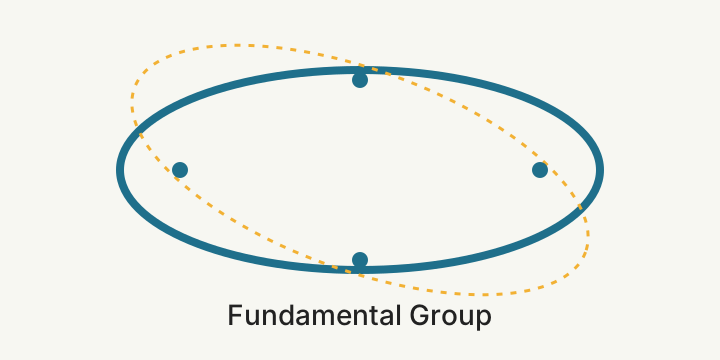
The group operation is concatenation: walk the first loop, then the second. The identity is the constant loop that never moves. The inverse is the same loop traversed backwards.
Worked example [Beginner]
Compute the fundamental group of the circle as the integers, by hand. Place the basepoint on the unit circle in the complex plane. The loop for an integer winds around exactly times — counterclockwise if is positive, clockwise if is negative.
Two loops with the same winding number can be deformed into each other: smoothly slide one onto the other while the winding count stays put. Two loops with different winding numbers cannot: the winding count is a continuous integer-valued function of a continuous family of loops, so it is constant on each homotopy class.
Concatenation adds winding numbers. Walking and then produces a loop that winds times. The constant loop has winding zero. Reversing gives . So the homotopy classes form a group with the integers as carrier and addition as operation: .
What this tells us: the fundamental group is the algebraic shadow of the topological obstructions to contracting loops. The integer is the winding number, and it is exactly the data that distinguishes loops on a circle.
Check your understanding [Beginner]
Formal definition [Intermediate+]
Let be a pointed topological space 02.01.01 02.01.02. A loop at is a continuous map with . Two loops are homotopic rel basepoint if there exists a continuous map with
The double endpoint condition pins the basepoint throughout the deformation; this is what distinguishes the based version of homotopy from the free version of 03.12.01.
Concatenation. For loops at , define
The constant loop is the candidate identity, and the reversed loop is the candidate inverse.
Definition. The fundamental group of is
with multiplication , identity , and inverse .
The verification that this is a group requires three steps. Associativity: the loops and are reparametrisations of one another; an explicit homotopy is built by interpolating linearly between the two reparametrisations of . Identity: is a reparametrisation of that pauses at on the first half; the homotopy compresses the pause. Inverse: is null-homotopic via the homotopy that retracts the loop to the basepoint along itself, on and on .
Functoriality. A based continuous map induces a homomorphism by . Composition is preserved: , and .
Homotopy invariance. If are based-homotopic, then . Hence is a homotopy-invariant of pointed spaces and descends to a functor on the homotopy category of pointed spaces.
Basepoint independence (path-connected case). For a path in , define
Then is a group isomorphism with inverse . Two paths from to produce isomorphisms , that differ by an inner automorphism of . Consequently, for path-connected , the fundamental group is well-defined up to inner automorphism, and one writes when only the isomorphism class is needed.
A space is simply connected if it is path-connected and for some (equivalently, every) basepoint.
Key theorem with proof [Intermediate+]
Theorem (). The map that sends a loop class to its winding number is a group isomorphism.
The proof uses the universal cover , . The deck-transformation group is acting on by integer translation, and .
Path-lifting lemma. For any path with and any , there is a unique continuous lift with and .
Homotopy-lifting lemma. For any homotopy with and any lift of , there is a unique continuous lift with and .
Both lemmas follow from the local-triviality of via a Lebesgue-number subdivision of the unit interval (resp. unit square) into pieces small enough that trivialises over each, and a step-by-step extension of the lift using the unique lift on each piece.
Definition of . For a loop at , take the unique lift with . Set , which is an integer because forces .
Well-definedness. If rel basepoint via a homotopy , lift to with . The endpoint is a continuous integer-valued function of , hence constant. So , which means .
Homomorphism. For loops at with respective lifts starting at , the lift of starting at is the concatenation , where the second piece is translated by so the lift is continuous. Its endpoint is .
Surjectivity. The loop lifts to , with . So .
Injectivity. If , the lift is a loop in based at . Since is contractible, is null-homotopic via the straight-line homotopy , which keeps the endpoints fixed at . Composing with gives a basepoint-fixing homotopy from to the constant loop. Hence , and is injective.
The map is therefore a group isomorphism .
Bridge. The lifting machinery proven here is exactly what builds 03.12.02 (covering space) into the classification theorem: subgroups of correspond to connected covering spaces of , with as the prototype example. The same data appears again in 03.12.08 (fundamental groupoid), where is recovered as the automorphism group of in the groupoid , and again in 03.12.09 (Seifert-van Kampen) as the central computational tool. Putting these together, the foundational reason this unit precedes the broader homotopy story is exactly that every later result on for builds on the loop-space identification , which only makes sense once the case has been pinned down independently.
Counterexamples to common slips
- Without basepoint pinning, "" collapses. A free homotopy of loops (no constraint on ) identifies with any conjugate . The free-homotopy classes form the conjugacy classes in , not the fundamental group itself. The basepoint pinning is what gives a group, not just a set with a partial structure.
- Concatenation is not strictly associative. The two parenthesisations and traverse the three loops at different speeds; they are equal only after a reparametrisation of . The group law is associative on homotopy classes, not on loops.
- Connectedness is not enough for basepoint independence. The connecting path requires path-connectedness, which is strictly stronger than connectedness. The topologist's sine curve is connected but not path-connected, and there is no canonical isomorphism between fundamental groups at points in different path-components.
- for , but . Real projective -space is the circle and inherits . The answer kicks in only once the higher cell collapses the generator into a -torsion element.
Exercises [Intermediate+]
Lean formalization [Intermediate+]
lean_status: none — Mathlib supplies FundamentalGroup as the automorphism group of a basepoint inside FundamentalGroupoid, but the surrounding loop-space API (compact-open topology on , via the universal cover, basepoint conjugation, recursive identification with higher homotopy) is not yet in place. The Codex companion module re-exports the existing skeleton and flags the missing pieces.
The five-piece formalisation roadmap is recorded in lean_mathlib_gap above and feeds the upstream Mathlib contribution queue.
Advanced results [Master]
Loop space. Equip the path space with the compact-open topology. The loop space at is the subspace
itself a pointed topological space (with the constant loop as basepoint). Concatenation gives an H-space structure on , associative and unital up to homotopy. Path-components are exactly homotopy classes:
The recursive identification for wires the fundamental group into the entire higher-homotopy tower of 03.12.01. The free loop space relaxes the basepoint condition; its connected components are conjugacy classes in , and the loop bundle relates the two.
Galois correspondence (preview, full statement in 03.12.02). Let be path-connected, locally path-connected, and semi-locally simply connected. Pick a basepoint . The map from connected pointed covering spaces of to subgroups of is a bijection. Normal subgroups correspond to regular (Galois) covers; the zero subgroup corresponds to the universal cover , on which acts by deck transformations.
Specialisation: surface groups. For a closed orientable genus- surface (), the standard -gon presentation
is computed via Seifert-van Kampen 03.12.09 applied to the polygon side identifications, with the single relator coming from the boundary of the -cell. The genus- case is the sphere, ; the genus- case is the torus, , with the relator degenerating to the abelianness condition; for the surface group is non-abelian, hyperbolic, and torsion-free.
Functoriality on the homotopy category. The functor factors through the homotopy category , since homotopic maps induce equal -maps. Restricted to path-connected pointed spaces with abelian fundamental group, takes values in and agrees with the first singular homology (Hurewicz, 03.12.19). On non-abelian fundamental groups, the abelianisation is the Hurewicz map, and the kernel is the commutator subgroup.
Relation to the fundamental groupoid 03.12.08. The fundamental groupoid has objects the points of and morphisms the path-homotopy classes of paths . The fundamental group is exactly the automorphism group at a basepoint:
For path-connected , the inclusion induces an equivalence of categories , where is the one-object groupoid built from the group. The groupoid framing is more flexible — it survives loss of path-connectedness, where the group framing fails — and is the right setting for Brown's groupoid Seifert-van Kampen theorem 03.12.09.
Synthesis. The fundamental group is the simplest nontrivial homotopy invariant, and every later structure in algebraic topology is in some sense a refinement of it. Read upward, the recursion identifies the higher homotopy groups as iterated loop spaces of , and the Eckmann-Hilton argument forces them to be abelian for . Read downward, the Galois correspondence identifies subgroups of with covering spaces, the abelianisation is the first homology , and the Hurewicz map is the bridge to the singular complex. Read sideways, the groupoid extension groupoid of path-homotopy classes recovers as and removes the path-connectedness assumption for Seifert-van Kampen. The central insight is that this single object — the group of based loop classes — is exactly the structural signature that the rest of the homotopy strand reads off.
Full proof set [Master]
Group axioms on . The verification consists of three explicit homotopies on the unit square. Associativity: define as the linear interpolation between the reparametrisations of underlying and ; explicitly, partition into three pieces with breakpoints linear in between at and at , and trace on the corresponding pieces. Identity: the homotopy from to shrinks the constant-loop interval to a point; explicitly, on and on . Inverse: is null-homotopic via on , on , retracting both halves to as .
Functoriality and homotopy invariance. A based continuous map takes a loop at to a loop at , and the basepoint-fixing condition on a homotopy rel endpoints transfers verbatim: is a basepoint-fixing homotopy from to . So is well-defined on classes. The point-by-point identity gives the homomorphism property. Functoriality is direct from associativity of function composition. For homotopy invariance, given a based homotopy , the composite is a based homotopy from to , so .
Basepoint independence. For , the map preserves concatenation up to homotopy (the inserted at the join is null-homotopic by the inverse relation just proved). The composite sends to , so is a group isomorphism with inverse .
. Proved in §"Key theorem".
for . Proved in Exercise 6.
. Apply Seifert-van Kampen 03.12.09 to the standard CW decomposition of as a -gon with sides identified in the pattern and one -cell attached via the boundary word. Cover by an open neighbourhood of the -skeleton (a wedge of circles, ) and an open neighbourhood of the open -cell (contractible). The intersection deformation-retracts to a circle, with generated by the loop around the boundary of the -cell. The amalgamated free product is , where is the normal subgroup generated by the boundary word , giving the standard surface-group presentation.
. A path in from to is a continuous map , equivalently a continuous map (by the exponential law for the compact-open topology, when is sufficiently nice — Hausdorff or compactly generated). The basepoint condition on forces , so a path in is exactly a basepoint-fixing homotopy in . Hence path-components of are homotopy classes of based loops, i.e. . The same argument iterated gives , and the H-space structure on from concatenation supplies the (abelian, by Eckmann-Hilton, for ) group operation on .
Connections [Master]
Topological space
02.01.01and continuous map02.01.02. The construction is functorial in the underlying pointed-space data: a continuous map of pointed spaces gives a homomorphism of fundamental groups, and a based homotopy of maps gives the equality of the induced homomorphisms. The fundamental group is therefore an invariant of based homotopy type.Homotopy and homotopy group
03.12.01. This unit deepens the portion of the broader homotopy unit; conversely,03.12.01provides the higher homotopy groups for and the surrounding category-theoretic apparatus. The recursion wires the two together.Covering space
03.12.02. Subgroups of correspond bijectively to connected pointed covering spaces of (Galois correspondence). The universal cover corresponds to the zero subgroup; regular covers correspond to normal subgroups; the deck-transformation group of the universal cover is . The lifting machinery used to compute in §"Key theorem" is the prototype.Fundamental groupoid
03.12.08. The fundamental group is the automorphism group of a basepoint inside the fundamental groupoid: . For path-connected , the groupoid is equivalent to the one-object groupoid , and the two contain the same homotopy information.Seifert-van Kampen
03.12.09. The principal computational tool: for with open path-connected and , is the amalgamated free product . The figure-eight, surface groups, and graph groups all compute via this rule.Hurewicz theorem
03.12.19. The abelianisation is naturally isomorphic to the first singular homology for path-connected . The Hurewicz map is the algebraic bridge from the (non-abelian) fundamental group to the (abelian) homology.
Historical & philosophical context [Master]
Henri Poincaré introduced the fundamental group in Analysis Situs (1895, Journal de l'École Polytechnique) [Poincaré 1895], using it to distinguish topological spaces that look identical under crude invariants. His motivating problem was the three-dimensional Poincaré conjecture: a closed simply-connected -manifold is the -sphere. Poincaré's framing was already implicitly groupoid (he considered loops at every point and how they conjugate under path-changes), but the explicit formulation as a group attached to a single basepoint, with the conjugation argument for basepoint independence, became standard during the 1920s and 1930s through the work of Reidemeister, Seifert, and Threlfall.
The set-theoretic and categorical reformulation became canonical in the mid-twentieth century, with Eilenberg-Mac Lane (1945) [EilenbergMacLane1945] and Hurewicz (1935-1936) [Hurewicz1935] extending the construction to higher dimensions and identifying the abelianisation with first singular homology. Brown (1967) [Brown1967] subsequently introduced the fundamental groupoid as the natural generalisation removing the basepoint hypothesis from Seifert-van Kampen.