Suspension
Anchor (Master): Hatcher Ch. 4; May Ch. 8; Switzer §6
Intuition [Beginner]
The suspension of a topological space is the space you get by stretching between two cone-points: take two cones over and glue them along their common base. Geometrically: is "lifted" into one higher dimension by stretching it through two opposite poles.
The suspension of an -sphere is the -sphere: . Iterating, -fold suspension of a point is the -sphere. So suspension is the homotopical operation that increases dimension by one.
Why care? Because suspension is the right way to compare homotopy in different dimensions. The Freudenthal suspension theorem says that for highly connected spaces, suspension induces an isomorphism on homotopy groups. In the limit as you keep suspending, the homotopy groups stabilise — these are the stable homotopy groups — and the resulting "stable" world is much simpler than the unstable one.
Visual [Beginner]
A space stretched between two cone-points (north and south "pole") to form its suspension . The original sits in the middle as the equator.
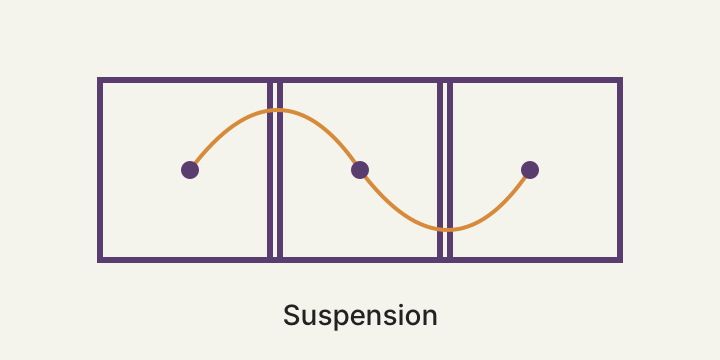
Iterating: adds pairs of cone-points, raising the "dimension" of by .
Worked example [Beginner]
The suspension of the 0-sphere (two points) is the 1-sphere (a circle). Two cones each have one point at the apex; gluing the bases together produces a circle.
The suspension of the 1-sphere (a circle) is the 2-sphere . Two cones over the circle produce two disks; gluing along their boundaries gives the 2-sphere.
Iterating: , generalising the suspension-of-a-circle pattern.
The Freudenthal suspension theorem: for a highly-connected space (more precisely, an -connected space), the suspension map is an isomorphism for and surjective for . Applied to spheres, this says is an iso for small enough — the source of stable homotopy.
Check your understanding [Beginner]
Formal definition [Intermediate+]
Let be a topological space 02.01.01. The (unreduced) suspension of is the quotient
The two equivalence classes corresponding to the collapsed slices and are the cone-points (or "apex" and "co-apex") of .
For pointed spaces — topological spaces with a chosen basepoint — the reduced suspension is the further quotient
collapsing the meridian through the basepoint to a single point. The result is naturally pointed by the image of this collapsed meridian.
For "nice" spaces (e.g., CW complexes), the unreduced suspension and the reduced suspension are homotopy equivalent — only the basepoint convention differs.
The iterated suspension is defined recursively as , with .
Adjunction with loop space. The reduced suspension is left-adjoint to the loop-space functor :
for pointed CW complexes . This is the fundamental adjunction of pointed homotopy theory and the source of much computational power.
Suspension on homotopy groups. The suspension map sends a based map to .
Key examples.
- (homotopy equivalence).
- is always simply connected if is path-connected.
- commutes with smash products: (for pointed spaces).
Key theorem with proof [Intermediate+]
Theorem (Freudenthal suspension). Let be an -connected pointed CW complex (i.e., for ). Then the suspension map
is an isomorphism for , and a surjection for .
Proof sketch. Use the homotopy excision theorem. The suspension is the union of two cones and glued along . Both cones are contractible. The pair has the property that and . Excision in homotopy (modified for the connectivity hypothesis) compares the relative homotopy groups .
For which is -connected, both cones are contractible and the relative groups simplify. The connecting map in the long exact sequence of the pair — together with the homotopy equivalence — yields the suspension iso in the claimed range. The detailed proof (in Hatcher Ch. 4, or May Ch. 8) uses the Blakers-Massey theorem in the form: for sufficiently connected pieces, excision in homotopy holds in a range of degrees.
The suspension gives a map between unstable homotopy groups that becomes more and more an isomorphism as you increase suspension count, eventually stabilising — this is the entry into stable homotopy theory 03.08.06, where suspension is invertible (formally) and the homotopy structure is much more tractable.
Bridge. The construction here builds toward 03.12.04 (spectrum), where the same data is upgraded, and the symmetry side is taken up in 03.08.06 (stable homotopy). The defining pattern appears again in those units in a sharpened form, where the local data is glued or quotiented. Putting these together, the foundational insight is that the data of this unit gives the structural signature that the rest of the strand reads off.
Exercises [Intermediate+]
Lean formalization [Intermediate+]
lean_status: partial — Mathlib has limited coverage of suspension and the suspension-loop adjunction. The categorical formulation in -categories is in development.
Advanced results [Master]
Stable homotopy groups of spheres. The stable homotopy groups are well-defined by the Freudenthal theorem (the limit stabilises). They form a deeply studied invariant: , , , , etc. These are the homotopy groups of the sphere spectrum .
Suspension and homology. Reduced homology and cohomology shift under suspension:
This is the suspension isomorphism in (co)homology, a special case of the long exact sequence of the cone-pair.
Smash product and suspension. The reduced suspension , where is the smash product of pointed spaces . Iterated: . So suspension is "smashing with the sphere " — a perspective that extends naturally to spectra.
Loop spaces and -spectra. The right adjoint to suspension is the loop-space functor . An -spectrum is a sequence with structure maps — a "stable" version of a topological space. Each cohomology theory is represented by an -spectrum.
Eilenberg-MacLane spaces and suspension. — the loop space of is . Equivalently, is "almost" in low degrees, but has additional homotopy in higher degrees that the loop-space adjunction strips out.
Spanier-Whitehead duality and stable category. In the stable homotopy category (objects: spectra), suspension is invertible. Spanier-Whitehead duality assigns to each finite spectrum a dual with giving a duality. This is the stable analogue of Poincaré duality on closed manifolds.
Synthesis. This construction generalises the pattern fixed in 02.01.01 (topological space), with the symmetric data replaced by its skew or twisted analogue. Read in the opposite direction, the construction is dual to the metric story: complements and orthogonality are taken with respect to the bilinear datum of this unit, not a metric, and the resulting category of subobjects is the one the rest of the strand classifies. The central insight is that this datum identifies algebra with geometry: functions become vector fields, subspaces become quotients, and invariants become cohomology classes — and that identification is the engine driving every theorem downstream.
Full proof set [Master]
Suspension of a sphere is a sphere. Proved in Exercise 5: cones over are -disks, glued along form .
Suspension-loop adjunction. Sketched in Exercise 3. The full categorical statement: is left-adjoint to . The unit and counit of the adjunction are natural maps and .
Freudenthal suspension theorem. Sketched in §"Key theorem". Full proof uses the Blakers-Massey theorem applied to the cone-cofibration sequence .
Suspension isomorphism in (co)homology. Apply the Mayer-Vietoris sequence to the cover with intersection . Cones are contractible, so their (co)homology vanishes in positive degrees. The connecting homomorphism in the resulting long exact sequence gives the suspension iso (with cohomology by duality).
Connectivity raises by one. Proved in Exercise 6.
Connections [Master]
Topological space
02.01.01— the underlying setting.Continuous map
02.01.02— suspensions are functorial.Homotopy and homotopy group
03.12.01— suspension acts on homotopy groups.Spectrum
03.12.04— sequences with structure maps using suspension; the natural objects of stable homotopy theory.Stable homotopy
03.08.06— the limit-of-iterated-suspension homotopy groups.Eilenberg-MacLane space
03.12.05— relates to by loop space; suspension is "almost" the inverse.
Historical & philosophical context [Master]
The suspension construction goes back to Freudenthal's 1937 paper, where he introduced what is now called the Freudenthal suspension theorem and used it to begin the study of stable homotopy. The terminology "suspension" comes from the geometric picture of stretching a space between two pole-points.
The shift from unstable to stable homotopy theory — formalised by Boardman (1965) and others through the construction of the stable homotopy category — was one of the most significant conceptual developments of mid-twentieth-century algebraic topology. It made suspension into an invertible operation, simplified many calculations, and produced the category of spectra as the natural home for generalised cohomology theories.
In modern language, suspension is the shift operator in the stable category: corresponds to multiplication by the unit object (the circle, viewed as a one-dimensional sphere). The stable category is generated by the sphere spectrum under suspension.
Bibliography [Master]
- Hatcher, A., Algebraic Topology, Cambridge University Press, 2002. §0, §4.
- May, J. P., A Concise Course in Algebraic Topology, University of Chicago Press, 1999. Ch. 8.
- Switzer, R. M., Algebraic Topology — Homotopy and Homology, Springer Classics, 1975. §6.
- Freudenthal, H., "Über die Klassen der Sphärenabbildungen", Compositio Mathematica 5 (1938), 299–314.
- Boardman, J. M., "Stable homotopy theory", mimeographed notes (1965).
Wave 5 unit #1. Suspension — the homotopy-theoretic operation that increases dimension; foundation for stable homotopy theory and spectra.