Stable homotopy
Anchor (Master): Hatcher §4; Switzer §8; Adams §I
Intuition [Beginner]
Suspension turns a space into a higher-dimensional version by stretching it between two new poles. A circle suspends to a sphere. A sphere suspends to a higher sphere.
Some topological questions change for a while under repeated suspension and then settle into a pattern. Stable homotopy studies the part that remains after enough suspensions.
This matters for Bott periodicity 03.08.07 because K-theory and classical groups have stable behavior. After enough dimension has been added, the same structure repeats in a controlled way.
Visual [Beginner]
Repeated suspension moves spaces upward in dimension. Stable information is the pattern that stops changing.
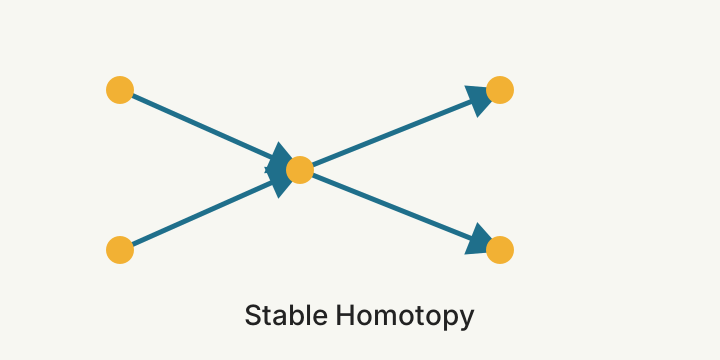
The picture shows a process, not a calculation: keep suspending until the invariant no longer depends on the early unstable accidents.
Worked example [Beginner]
Start with the zero-dimensional sphere, two points. Suspending it gives a circle. Suspending the circle gives the ordinary sphere. Suspending again gives a three-dimensional sphere.
The shapes change dimension each time, but the operation is uniform. Stable homotopy asks which features survive this repeated shift.
What this tells us: stable homotopy is topology after repeated suspension has removed low-dimensional special cases.
Check your understanding [Beginner]
Formal definition [Intermediate+]
For pointed spaces and , suspension gives maps
The stable homotopy set is the colimit of this sequence when the relevant group structures are present:
The stable homotopy groups of spheres are
This definition packages maps after enough suspension has been applied [Adams §I].
Key theorem with proof [Intermediate+]
Theorem (Suspension defines the stable colimit). Let be a sequence of sets or groups with maps . If all are isomorphisms for , then the colimit is canonically isomorphic to .
Proof. The universal map from to the colimit is induced by the structure maps. Since every for is an isomorphism, every element represented in some with has a unique representative in .
Elements from earlier map into by the finite composite . Thus every colimit element is represented by an element of . If two elements of become equal in the colimit, they become equal after applying some composite with ; that composite is an isomorphism, so the original elements were equal. The map is bijective, and it is a group isomorphism in the group case.
Bridge. The construction here builds toward 03.08.07 (bott periodicity), where the same data is developed in the next layer of the strand. The defining pattern appears again in those units in a sharpened form, where the local data is glued or quotiented. Putting these together, the foundational insight is that the data of this unit gives the structural signature that the rest of the strand reads off.
Exercises [Intermediate+]
Lean formalization [Intermediate+]
lean_status: none is recorded because the project lacks spectra, stable homotopy groups, and Freudenthal stabilization as formalized curriculum objects.
Advanced results [Master]
Freudenthal's suspension theorem identifies a range in which suspension maps on homotopy groups are isomorphisms, producing the stable stems of spheres [Hatcher §4]. The stable category refines this colimit picture by replacing individual spaces with spectra.
Generalized cohomology theories are represented by spectra; K-theory is represented by a Bott-periodic spectrum. Bott periodicity is therefore both a calculation in K-theory and a structural statement in stable homotopy theory [Adams §I].
Synthesis. This construction generalises the pattern fixed in 03.12.01 (homotopy and homotopy group), with the symmetric data replaced by its skew or twisted analogue. Read in the opposite direction, the construction is dual to the metric story: complements and orthogonality are taken with respect to the bilinear datum of this unit, not a metric, and the resulting category of subobjects is the one the rest of the strand classifies. The central insight is that this datum identifies algebra with geometry: functions become vector fields, subspaces become quotients, and invariants become cohomology classes — and that identification is the engine driving every theorem downstream.
Full proof set [Master]
The colimit theorem above supplies the formal mechanism by which eventual isomorphisms produce a stable answer. Freudenthal supplies the geometric theorem that suspension maps enter such ranges for connected spaces. The full theorem is cited here in its standard form rather than reproved, since its proof uses connectivity estimates for joins and loop-suspension adjunctions [Hatcher §4].
For Bott periodicity, the relevant stable behavior is not merely stabilization of homotopy groups of spheres. Stable classical groups and K-theory spectra provide the representing objects whose loop spaces repeat periodically 03.08.07.
Connections [Master]
Stable homotopy depends on homotopy theory
03.12.01, suspension03.12.03, and spheres03.12.04. It connects to classifying spaces03.08.04through stable classical groups and to topological K-theory03.08.01through spectra and Bott periodicity03.08.07.The Atiyah-Singer index theorem
03.09.10uses K-theoretic stable information in the construction of the topological index.
Historical & philosophical context [Master]
Freudenthal's suspension theorem established the stabilization phenomenon for homotopy groups. Adams developed stable homotopy and generalized homology as a coherent framework for these phenomena [Adams §I].
Switzer's text presents stable homotopy as part of generalized homology theory, while Hatcher gives the unstable-to-stable bridge through suspension and spectral sequences [Switzer §8; ref: TODO_REF Hatcher §4].
Bibliography [Master]
- J. F. Adams, Stable Homotopy and Generalised Homology, §I. [Adams §I]
- Robert Switzer, Algebraic Topology: Homotopy and Homology, §8. [Switzer §8]
- Allen Hatcher, Algebraic Topology, §4. [Hatcher §4]