Spectrum
Anchor (Master): Adams; Switzer §8–§13; Hovey-Shipley-Smith *Symmetric spectra*; Lurie *Higher Algebra* §1.4
Intuition [Beginner]
A spectrum is the homotopy-theoretic object that "stabilises" the homotopy of spaces with respect to suspension. Where a topological space has homotopy groups in finitely many connected directions, a spectrum has homotopy groups in all integer degrees — positive and negative.
The motivating idea: take a sequence of pointed spaces and structure maps connecting them via suspension. The simplest example is the sphere spectrum with suspension structure maps being the identity (homotopy-equivalence).
Spectra are the natural objects of generalised cohomology: every cohomology theory (singular, K-theory, bordism, …) is represented by a spectrum. They live in the stable homotopy category, where suspension is invertible — a much more algebraically tractable place than ordinary spaces.
Visual [Beginner]
A sequence of spaces stacked vertically, with suspension arrows connecting each to the next. Together they form one structured object — a spectrum.
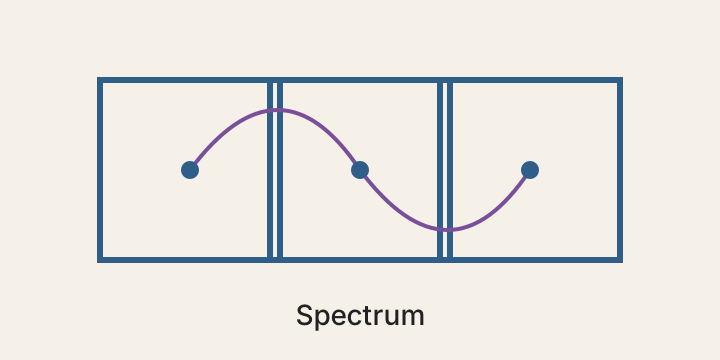
Stable homotopy theory is the study of these stacked sequences and their morphisms.
Worked example [Beginner]
The sphere spectrum is the simplest example: for , with structure maps . Its stable homotopy groups — the stable homotopy groups of spheres — form a deep computational and conceptual frontier.
The first few:
- (the degree)
- (Hopf)
These are highly nontrivial finite abelian groups. Computing them is one of the central challenges of algebraic topology.
Other spectra: Eilenberg-MacLane spectra for an abelian group (representing ordinary cohomology with coefficients in ), K-theory spectra (representing complex / real K-theory), bordism spectra (representing unoriented / complex / oriented bordism).
Check your understanding [Beginner]
Formal definition [Intermediate+]
A spectrum (in the simplest, sequential model) is a sequence of pointed topological spaces
together with structure maps
(or equivalently, by the suspension-loop adjunction, ).
A spectrum is an -spectrum if each is a (weak) homotopy equivalence. -spectra are the "fibrant" or "good" representatives of the stable homotopy type.
A morphism of spectra is a sequence of based maps commuting with the structure maps (up to homotopy in the appropriate sense).
The stable homotopy groups of a spectrum are
where the colimit is taken along the suspension maps. By the Freudenthal suspension theorem 03.12.03, for sufficiently connected spaces, the colimit stabilises, and the result is well-defined for all integers (positive and negative, depending on the spectrum's connectivity).
The stable homotopy category is the homotopy category of spectra under weak equivalence (maps inducing isomorphisms on stable homotopy groups). It is triangulated, symmetric monoidal (with smash product as the tensor), and generated (under colimits and suspension) by the sphere spectrum .
Key examples.
- Sphere spectrum : with identity structure maps. The unit object of the smash-product symmetric-monoidal structure.
- Eilenberg-MacLane spectrum for abelian : , the Eilenberg-MacLane space
03.12.05. Represents ordinary cohomology: where is the function spectrum. - K-theory spectrum : for even and for odd , with structure maps coming from Bott periodicity. Represents complex topological K-theory.
- Bordism spectrum : built from Thom spaces of universal bundles over . Represents unoriented bordism.
Generalised cohomology. Every spectrum defines a generalised cohomology theory
(homotopy classes of stable maps), satisfying the Eilenberg-Steenrod axioms except possibly the dimension axiom (which is replaced by the homotopy groups of ).
Conversely, by the Brown representability theorem, every generalised cohomology theory is represented by some spectrum, unique up to homotopy. So the stable homotopy category and the category of generalised cohomology theories are equivalent (this is sometimes called Brown representability).
Key theorem with proof [Intermediate+]
Theorem (Brown representability). Every additive cohomology theory on the homotopy category of pointed CW complexes that satisfies the Eilenberg-Steenrod axioms (except possibly dimension) is representable: there exists an -spectrum such that
Conversely, every -spectrum determines such a cohomology theory by the same formula.
Proof sketch (representability direction). Given a cohomology theory , construct to represent on each finite CW complex via the Yoneda lemma applied to the functor . The technical work is to verify the construction:
- is representable on finite CW: use the small-object argument plus the additivity and Mayer-Vietoris axioms to build a representing space as a colimit.
- The structure maps come from the suspension isomorphism (an axiom of additive cohomology theories).
- The -spectrum condition follows from the suspension iso, by the suspension-loop adjunction .
The uniqueness of the representing spectrum is up to weak equivalence in the stable category. The Yoneda-style formal construction makes this universal property precise.
Proof sketch (converse direction). Given an -spectrum , define . The Eilenberg-Steenrod axioms for additive cohomology — homotopy invariance, suspension isomorphism, Mayer-Vietoris, additivity over wedges — all follow from the spectrum structure of and the -spectrum condition.
This duality between spectra and cohomology theories is one of the central structural results of algebraic topology and is the conceptual reason spectra are the "right" objects for stable homotopy.
Bridge. The construction here builds toward 03.08.06 (stable homotopy), where the same data is developed in the next layer of the strand. The defining pattern appears again in those units in a sharpened form, where the local data is glued or quotiented. Putting these together, the foundational insight is that the data of this unit gives the structural signature that the rest of the strand reads off.
Exercises [Intermediate+]
Lean formalization [Intermediate+]
lean_status: none — Mathlib lacks a spectrum API. The forthcoming work would target either:
or (in a model-categorical formulation) the simplicial-sets-based symmetric-spectra model. A first formalisation would build the sphere spectrum, Eilenberg-MacLane spectra, the stable homotopy groups, and the smash product.
Advanced results [Master]
Brown representability. Stated and sketched in §"Key theorem".
Stable homotopy category as triangulated. is triangulated: every cofibre sequence produces a long exact sequence in homotopy. This is the homotopy-theoretic analogue of derived categories in homological algebra.
Smash product and ring spectra. A ring spectrum is a spectrum with a multiplication map and unit satisfying associativity and unit axioms up to homotopy. Every classical cohomology ring (singular, K-theory, bordism) lifts to a ring spectrum. Highly-structured ring spectra (, ) are the modern stable analogues of associative / commutative rings.
Adams spectral sequence. Computes stable homotopy groups via -groups in modules over the Steenrod algebra . The -page is purely algebraic; differentials encode the analytic / topological refinement. The Adams spectral sequence converges to (a localisation of) .
Bousfield localisation. A spectrum defines an -localisation functor on the stable category. -local objects are spectra with -isomorphisms inverted. Examples: rationalisation , -localisation (chromatic).
Stable category is the universal example of a stable -category. In Lurie's -categorical formalism, the stable category is the free stable -category on a single generator (the sphere spectrum). All stable -categories receive maps from , making it the "ground field" of higher algebra.
Formal group laws and chromatic homotopy. As in Exercise 7. The chromatic filtration is the source of much recent activity (topological modular forms, derived algebraic geometry, equivariant elliptic cohomology).
Synthesis. This construction generalises the pattern fixed in 03.12.01 (homotopy and homotopy group), with the symmetric data replaced by its skew or twisted analogue. Read in the opposite direction, the construction is dual to the metric story: complements and orthogonality are taken with respect to the bilinear datum of this unit, not a metric, and the resulting category of subobjects is the one the rest of the strand classifies. The central insight is that this datum identifies algebra with geometry: functions become vector fields, subspaces become quotients, and invariants become cohomology classes — and that identification is the engine driving every theorem downstream.
Full proof set [Master]
Stable homotopy is well-defined. Proved in Exercise 3.
Brown representability. Sketched in §"Key theorem". Full proof: Hatcher Ch. 4.E or Switzer §9.
Triangulated structure. Proved by checking the axioms (TR1–TR4) for the cofibre-sequence functor on spectra. The shift functor is suspension; cofibre sequences are stable cofibrations.
Symmetric monoidal structure. Modern construction (e.g., symmetric spectra) gives a strict symmetric monoidal model category. The smash product on objects produces a homotopy-symmetric-monoidal structure on .
-rings as commutative monoids. A commutative monoid in the symmetric-monoidal category of spectra (modulo homotopy, with all higher coherences) is an -ring spectrum. Examples include , , , the sphere .
Connections [Master]
Topological space
02.01.01— the sequential building blocks of a spectrum.Homotopy and homotopy group
03.12.01— homotopy groups in the stable category replace ordinary homotopy groups.Suspension
03.12.03— the structure-map operator that defines spectra.Stable homotopy
03.08.06— the homotopy groups of the sphere spectrum and other spectra.Eilenberg-MacLane space
03.12.05— ingredients of the Eilenberg-MacLane spectrum .K-theory
03.08.01— represented by the complex K-theory spectrum .Bott periodicity
03.08.07— the structure maps of via Bott periodicity.
Historical & philosophical context [Master]
Spectra were introduced by Lima (1959) and Whitehead (1962) as a formal device to make suspension invertible. Adams (1964) gave the first systematic exposition, including the Adams spectral sequence. Boardman (1965) constructed the stable homotopy category as the homotopy category of "naive" spectra, and Frank Adams's Stable Homotopy and Generalised Homology (1974) became the standard reference.
Modern strictifications — symmetric spectra (Hovey-Shipley-Smith, 2000), S-modules (Elmendorf-Kriz-Mandell-May, 1997), orthogonal spectra — turn the stable homotopy category into a strict symmetric monoidal category. Lurie's Higher Topos Theory (2009) and Higher Algebra (2011) reconstruct the stable category from -categorical foundations, integrating it with derived algebraic geometry and the theory of factorisation algebras.
The chromatic perspective (Quillen, Morava, Hopkins, Ravenel) connects stable homotopy theory to formal group laws and arithmetic geometry, opening connections to number theory, mathematical physics (string theory's elliptic cohomology), and the modern theory of moduli spaces.
Bibliography [Master]
- Adams, J. F., Stable Homotopy and Generalised Homology, University of Chicago Press, 1974.
- Switzer, R. M., Algebraic Topology — Homotopy and Homology, Springer Classics, 1975. §8.
- May, J. P., A Concise Course in Algebraic Topology, University of Chicago Press, 1999. Ch. 23.
- Hovey, M., Shipley, B., Smith, J., "Symmetric spectra", Journal of the AMS 13 (2000), 149–208.
- Lurie, J., Higher Algebra, draft monograph, 2017.
Wave 5 unit #2. Spectrum — the homotopy-theoretic object that stabilises spaces under suspension; foundation for stable homotopy and generalised cohomology theories.