Galilean group and Newtonian mechanics
Anchor (Master): Newton 1687 *Principia* (originator); Bargmann 1954 *Annals of Math.* 59; Souriau 1970 *Structure des systèmes dynamiques*; Marsden-Ratiu Ch. 1; Arnold *Mathematical Methods* Appendix 1
Intuition [Beginner]
Classical mechanics needs a stage. Before any equation of motion is written down, you have to say what spacetime looks like, what counts as a frame, and what the rules are for translating between frames. The Galilean answer is the one Galileo and Newton shared: time is a single universal clock running in the background, space is ordinary three-dimensional Euclidean space at each instant, and any two observers moving at constant velocity through this stage are equally entitled to call themselves "at rest".
A frame moving at constant velocity through another is called inertial. Galilean relativity says the laws of mechanics look the same in every inertial frame. If you drop a ball inside a smoothly-cruising train carriage with the windows shaded, no experiment confined to the carriage tells you whether the train is moving. The Galilean group is the precise list of changes of viewpoint that are allowed: shift the origin in space, shift the origin in time, rotate the spatial axes, or boost to a new uniformly-moving frame. Ten parameters in total — three for spatial shifts, one for time shift, three for rotations, three for boosts.
Newton's mechanics fits inside this stage. The state of a system is positions plus velocities at the current instant, the laws are Newton's three, and conservation of energy, momentum, and angular momentum can be traced back to invariance under the four kinds of Galilean change of frame.
Visual [Beginner]
A schematic of Galilean spacetime as a stack of horizontal Euclidean three-spaces, one per time slice, with two inertial worldlines threading through them at constant velocity. The Galilean boost tilts one worldline into the other while leaving every horizontal slice undistorted.
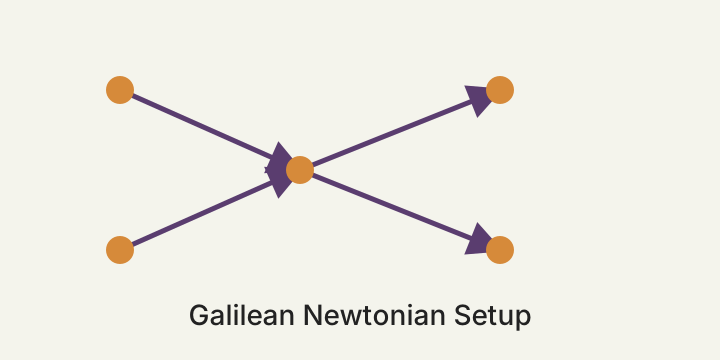
The picture to keep in mind: spacetime is sliced horizontally by the universal clock, each slice is ordinary Euclidean three-space, and a Galilean transformation shifts and tilts the slices in any of four ways.
Worked example [Beginner]
A train carriage moves along a straight track at constant speed relative to the platform. A passenger inside the carriage rolls a ball along the floor in the direction of motion at speed relative to the carriage. The two frames — platform frame and carriage frame — are related by a Galilean boost.
In the carriage frame, the ball's position at time is (taking ). In the platform frame, the carriage origin is at , so the ball's position is the carriage origin plus its position inside the carriage:
The ball moves at speed in the platform frame, in the carriage frame; the difference is exactly the relative speed of the frames. Now apply a force to the ball — say, friction decelerating it at rate . The ball's acceleration is in the carriage frame. Differentiate the boost relation twice and the linear-in- piece drops out: .
What this tells us: accelerations are the same in both frames, so takes the same form in either frame. This is Galilean invariance of Newton's second law in action.
Check your understanding [Beginner]
Formal definition [Intermediate+]
Galilean spacetime. Galilean spacetime is the affine four-dimensional space together with the following two pieces of structure. First, a surjective affine map called the absolute time function; the difference for two events is the time interval between them. Second, on each fibre — the simultaneity hyperplane at time — an affine three-dimensional Euclidean structure (a translation-invariant inner product on the underlying vector space of the affine fibre).
The Galilean group. The Galilean group is the group of affine bijections that preserve both pieces of structure: for some real constant (preservation of time differences) and the restriction of to each fibre is an affine isometry compatible with the linear-in-time structure. In coordinates adapted to a fixed inertial frame, an element of acts as
with (time translation), (spatial translation), (spatial rotation), and (Galilean boost). The decomposition is a semi-direct product
with the inner factor acting by rotation of boosts. The total dimension is .
Inertial frames. A Galilean coordinate system on is an affine isomorphism in which the time function reads off the first coordinate and the fibrewise Euclidean structure agrees with the standard inner product on . Inertial frames are exactly Galilean coordinate systems; two inertial frames are related by a unique element of . The principle of Galilean relativity asserts that the laws of mechanics take the same form in every inertial frame.
Newtonian mechanics on . A mechanical system of point particles has configuration space — the product of copies of the spatial fibre — or, more generally, a smooth manifold when constraints are present. A state of the system at time is a pair together with the time ; Newton's principle of determinacy asserts that the state determines the entire future and past trajectory of the system. The dynamical content is encoded in Newton's second law
where is a smooth force law. Galilean invariance of the system is the requirement that transforms covariantly under the Galilean group: rotations rotate forces, translations leave them invariant, and boosts and time translations leave them unchanged when the forces depend only on position differences and relative velocities.
Conservative forces and the Lagrangian. A force is conservative if for a smooth potential . For conservative systems the equations of motion are reproduced by the Lagrangian
via the Euler-Lagrange equations on . This is the bridge from the Galilean-Newtonian setup developed here to the Lagrangian formalism on the tangent bundle 05.00.01.
Sign convention. Throughout this unit the boost transformation acts as — the new frame's origin moves backward at velocity relative to the old frame's origin, equivalently, the old frame appears to move forward at when viewed from the new frame. The opposite sign convention is sometimes used in older texts; either is consistent provided force laws are written compatibly.
Counterexamples to common slips
- Time is not a coordinate on a fibre. is not the product canonically; choosing such a product is choosing an inertial frame. The intrinsic structure is the affine bundle together with the fibrewise Euclidean structure.
- The Galilean group is not abelian. Spatial rotations and boosts do not commute: is not in . The semi-direct product structure is essential.
- Galilean and Lorentzian boosts agree to first order in . The Inönü-Wigner contraction of the Poincaré group recovers as a singular limit; this is a Lie-algebra contraction, not a Lie-group limit in the naive sense.
Key theorem with proof [Intermediate+]
Theorem (Galilean invariance of the free-particle equation). On configuration space , the free-particle equation of motion is invariant under every Galilean transformation. Conversely, the most general second-order ODE on that is invariant under the full Galilean group is — the trajectory of a free particle is uniformly straight in every inertial frame, and no other dynamical law has this property.
Proof. Invariance. Let act on the worldline . Differentiate twice in . The first derivative is ; the second derivative is . The transformed worldline satisfies iff , iff since is invertible. The free-particle equation transforms to itself.
Maximality. Suppose a smooth force law produces an ODE that is invariant under every Galilean transformation. Apply translation invariance: for every , . So is independent of . Apply time-translation invariance: for every , . So is independent of . Apply boost invariance: under , the velocity transforms as and the acceleration is invariant; so the law must satisfy for every . Hence is independent of , so is a constant vector . Apply rotation invariance: for every , . The only fixed vector under all of is the zero vector, so and .
Bridge. The Galilean-invariance argument here builds toward Noether's theorem 05.00.04: each of the four families of Galilean symmetries — time translation, spatial translation, rotation, boost — produces a conserved quantity along solutions of an invariant equation of motion, and these conserved quantities are exactly energy, linear momentum, angular momentum, and the centre-of-mass motion. The same template appears again in 05.00.01 (Lagrangian on ): replace the configuration manifold with a general smooth manifold , replace the force law with a Lagrangian , and the variational principle reproduces Newton's second law in coordinate-free form. Putting these together one sees that the Galilean stage and Newton's three laws are not the foundation of mechanics but its first floor — the foundation is the geometry of together with a Lagrangian, and the Galilean group is exactly the symmetry group that picks out on flat configuration space. The bridge between the Galilean group and the Lagrangian formalism is the variational principle, and this is exactly what makes Newton's laws geometric rather than coordinate-bound.
Exercises [Intermediate+]
Advanced results [Master]
The Galilean-Newtonian setup is more than a list of ten parameters and a determinism principle. It carries the full Lie-theoretic, central-extension, and contraction structure that organises non-relativistic mechanics as a coherent geometric object — and it is the source from which every later structure on and inherits its symmetries.
The Galilean group as a 10-dimensional Lie group. is a connected, non-compact, non-semisimple Lie group of dimension 10. Its Lie algebra is generated by ten elements: time translation , spatial translations , rotations , boosts for . The non-vanishing brackets are
with , , , , . The structure exhibits the semi-direct decomposition at the algebra level: the abelian ideal is normal, and the quotient is the homogeneous Galilean group .
Action on configuration and phase spaces. acts on the configuration space of an -particle system, on the tangent bundle (the velocity-phase space), and on the cotangent bundle (the momentum-phase space). The action is by linear-affine transformations on , by their differentials on , and by the cotangent-lift on . For a Galilean-invariant Lagrangian (one whose value changes by a total time derivative under every Galilean transformation), Noether's theorem produces ten conserved quantities along the equations of motion: energy from , three components of linear momentum from , three of angular momentum from , and three centre-of-mass conditions from .
Theorem (Galilean Noether catalogue). For an -particle Lagrangian on with depending only on relative positions, the ten Galilean-symmetry generators give the following conserved quantities along solutions:
- time translation energy ,
- spatial translation total linear momentum ,
- rotation total angular momentum ,
- boost centre-of-mass condition .
The first three are conserved in the strict sense ; the centre-of-mass condition is explicitly time-dependent — is conserved as a function of time, equivalently moves uniformly. This time-dependence is the signature of a cocycle-modified Noether charge, and is the algebraic shadow of the Bargmann central extension.
The Bargmann central extension. The second Lie-algebra cohomology is one-dimensional, generated by the cocycle (other pairs vanish). The associated central extension is the Bargmann algebra
with bracket modified by , the central element commuting with everything. The Bargmann group is the simply-connected Lie group with this Lie algebra; it is a central extension classified by . The central charge acts in any unitary representation as multiplication by a real number — the mass — and the Bargmann group is exactly the symmetry group of non-relativistic quantum mechanics: ordinary unitary representations of are inadequate (Galilean wave functions transform projectively, with phase under boosts), and the projective representations of are exactly the unitary representations of at fixed .
Inönü-Wigner contraction. The Poincaré algebra is 10-dimensional, semi-simple-rank-zero, and has the same generator content as but with non-abelian boost-boost and non-abelian boost-translation brackets controlled by . The Inönü-Wigner contraction rescales boosts as and time translation as and takes the limit; the bracket becomes , and the bracket becomes , recovering exactly the centreless Galilean structure. The Bargmann central charge is the leading piece of recovered projectively, with the rest-mass-energy in the relativistic precursor — exactly the non-relativistic limit of identifying the Bargmann mass with the rest mass.
Synthesis. The Galilean-Newtonian setup is the symmetry-theoretic core of non-relativistic mechanics. The foundational reason this setup organises the subject is that the Galilean group is the maximal symmetry group of a stage in which time is universal and space is Euclidean per slice — and Newton's three laws are exactly the dynamical content compatible with this stage. The bridge between the Galilean group and the dynamics it carries is the principle of Galilean invariance: a force law is admissible if and only if it transforms covariantly under , and conservation of energy, momentum, angular momentum, and uniform centre-of-mass motion are the Noether shadows of the four families of generators. This is exactly the content carried over from the affine geometry of to the variational principle on : Galilean symmetry of the action functional gives Galilean Noether charges, and the Bargmann central extension records the projective phase that survives the passage to quantum mechanics.
Putting these together, the same template appears again in special relativity by the Inönü-Wigner contraction reversed: the Poincaré group is the deformation of , the Lorentz boost is the deformation of the Galilean boost, and the rest-mass parameter in is the deformation of the Bargmann central charge. Read in the opposite direction, the foundational reason classical mechanics is the limit of relativistic mechanics is that is a contraction of , and the foundational reason quantum mechanics requires a mass parameter in its very kinematics is that the Galilean group has a non-vanishing second Lie-algebra cohomology class.
Full proof set [Master]
Theorem (semi-direct decomposition of ). The Galilean group is isomorphic to , where the inner is the homogeneous Galilean group acting on space-time translations.
Proof. In adapted coordinates the action is . A general element is parametrised by . Composition is
The map identifies the group with the semi-direct product where acts on by . The composition formula above is exactly the semi-direct product law.
Theorem (Bargmann cocycle represents a non-zero class). The 2-cocycle defined on generators by and zero elsewhere is a Lie-algebra 2-cocycle, and its cohomology class in is non-zero.
Proof. Bilinearity and antisymmetry are immediate from the definition (extend ). The cocycle identity to check is
for all triples of generators. The only triples giving non-zero terms are those involving at least one and at least one . Consider : in , , . The cyclic sum is using cyclic symmetry of . The triples involving , two s and a , or two s and a either reduce to on every term or satisfy the identity by the symmetries of . So is a 2-cocycle.
Suppose is a coboundary, for some linear . Apply to the pair : . But . So is not a coboundary, and in .
Theorem (Galilean conserved quantities). Let on with a smooth function of relative positions only. Along any solution of the Euler-Lagrange equations:
(i) the energy is conserved;
(ii) the total linear momentum is conserved;
(iii) the total angular momentum is conserved;
(iv) the centre-of-mass quantity is conserved, equivalently moves uniformly.
Proof. Each statement follows from Noether's theorem 05.00.04 applied to the corresponding one-parameter subgroup of .
(i) Time translation leaves invariant (since is time-independent and depends only on ), so the conserved Noether charge is .
(ii) Spatial translation leaves invariant (depends only on differences) and leaves invariant; the Noether charge is , yielding in direction .
(iii) Rotation with a one-parameter subgroup of generated by : , . Both and (depending on ) are rotation-invariant. The Noether charge is .
(iv) Boost : under this transformation changes by and is unchanged (relative positions unchanged). The first piece is , a total time derivative; the second is itself a time derivative of . So with .
The cocycle-modified Noether charge is . Conservation for arbitrary gives , equivalently — uniform motion of the centre of mass. The presence of the term — a non-zero 1-cocycle on the boost subgroup — is the classical-mechanical signature of the Bargmann central extension.
Connections [Master]
Lagrangian on
05.00.01. The Galilean-Newtonian setup developed here is the flat-space, Cartesian special case of the general Lagrangian formulation: configuration manifold replaced by an arbitrary smooth manifold, force law replaced by a Lagrangian on . The Galilean group acts on by the cotangent-lift of its action on , and Galilean-invariant Lagrangians are exactly those whose value changes by a total time derivative under every Galilean transformation.Hamilton's principle of least action
05.00.02. Galilean invariance of the equations of motion lifts to Galilean invariance of the action functional up to boundary terms. The variational principle is the natural setting for the Galilean-Noether correspondence: continuous symmetries of produce conserved currents along solutions.Noether's theorem
05.00.04. The Galilean group is the prototypical 10-parameter Lie group of mechanical symmetries; its application to a Galilean-invariant Lagrangian yields the canonical ten conservation laws — energy, three momenta, three angular momenta, three centre-of-mass conditions — and the boost case exhibits the cocycle-modified Noether charge that is the algebraic origin of the Bargmann central extension.Symplectic manifold
05.01.02. The cotangent bundle of any configuration space is symplectic, and the Galilean group acts on it by symplectomorphisms — the cotangent-lift action. This is the bridge from the Galilean-Newtonian setup to the symplectic-geometric formulation of mechanics: Galilean orbits in are coadjoint orbits of , classified by the standard Kirillov-Souriau orbit method.Cotangent bundle
05.02.05. Phase space inherits the canonical symplectic structure; the Galilean group acts on by cotangent-lifted Galilean transformations, and the moment map packages the ten conserved quantities into a single equivariant map. The image of records which coadjoint orbit a given mechanical state lives on.Smooth manifold
03.02.01. The configuration spaces of the Galilean-Newtonian setup are flat (), but the same dynamical principles extend to mechanics on a smooth manifold via the tangent and cotangent bundle constructions; the manifold prerequisite is what allows the local-coordinate Newton equations to be coordinate-invariant.
Historical & philosophical context [Master]
Galileo's Dialogue Concerning the Two Chief World Systems (1632) [pending] introduced the principle of relativity in its non-relativistic form: an observer enclosed in a smoothly-moving ship cannot, by any mechanical experiment confined to the ship's interior, detect the ship's motion through the surrounding water. The principle was the conceptual centrepiece of Galileo's defence of Copernican heliocentrism — if mechanics is the same in every uniformly-moving frame, the apparent stillness of the Earth is not evidence of geocentrism. Galileo did not formulate the principle group-theoretically; that was a 20th-century rephrasing.
Isaac Newton's Philosophiae Naturalis Principia Mathematica (1687) [Newton 1687] supplied the first complete dynamical theory consistent with Galilean relativity. Newton's three laws — inertia, , action-reaction — together with the law of universal gravitation, are stated in absolute space and absolute time but transform covariantly under Galilean changes of frame. The framing of absolute space was contested already in Newton's lifetime (the Leibniz-Clarke correspondence) and abandoned in the 19th century; what remained was the Galilean-relativistic content of the laws.
Henri Poincaré's group-theoretic methods (1900s) and Hermann Minkowski's spacetime formulation of special relativity (1908) made it natural to view the Galilean and Lorentz groups as alternative spacetime symmetry groups, with the Galilean group recovered as the limiting case of the Lorentz group as . The precise statement of this limit as a Lie-algebra contraction was given by Erdal Inönü and Eugene Wigner (1953) [pending], and the Galilean-group decomposition into translations, rotations, and boosts as a 10-parameter Lie group was made canonical by Valentine Bargmann (1954) [Bargmann 1954] in his study of unitary ray representations. Bargmann showed that the Galilean group has a genuine central extension by — the Bargmann group — and that the projective representations of the Galilean group (the relevant ones for non-relativistic quantum mechanics) are classified by the central charge, which acts as multiplication by mass in any irreducible representation. Jean-Marie Lévy-Leblond (1963) [pending] made this concrete: the mass superselection rule of non-relativistic QM, the position-momentum uncertainty for a free particle, and the explicit projective phase under boosts are all consequences of the Bargmann extension.
Jean-Marie Souriau's Structure des systèmes dynamiques (1970) [Souriau 1970] codified the modern group-theoretic formulation: a mechanical system is a symplectic manifold equipped with a Galilean-group action by symplectomorphisms, and the moment map records the ten conserved quantities. The Souriau classification of elementary classical particles by coadjoint orbits of the Galilean group is the non-relativistic counterpart of the Wigner classification of relativistic particles by coadjoint orbits of the Poincaré group.