Induced representation
Anchor (Master): Frobenius 1898 *Über Relationen zwischen den Charakteren einer Gruppe und denen ihrer Untergruppen*; Serre §7; Fulton-Harris §3.3
Intuition [Beginner]
The induced representation is a construction that takes a representation of a subgroup and produces a representation of the larger group . The procedure is to "lift" to by allowing it to be transported around by all the cosets of in .
The intuition: think of as living over the single coset in . The induced representation creates a copy of for each coset of , and lets permute these copies according to how it permutes cosets, mixed with the original -action on each individual copy.
The formula is concrete: , the index of in times the dimension of . This is one of the most powerful constructions in representation theory: it lets you build representations of larger groups from understood representations of subgroups, and it is adjoint (in a precise sense) to the restriction operation that takes a -representation and forgets down to an -representation. This adjoint relationship is Frobenius reciprocity (unit 07.01.08).
Frobenius introduced the construction in 1898 as part of his investigations into how characters of subgroups relate to characters of the full group. Induction is the foundation of Mackey theory (Mackey 1949–52), the theory of -representations, the local Langlands programme, and modern automorphic forms.
Visual [Beginner]
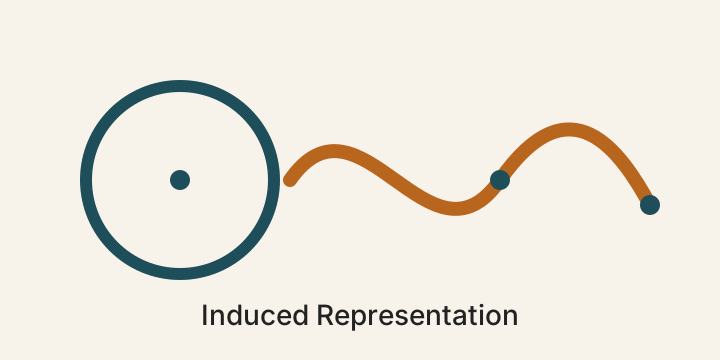
The induced representation: a copy of the subgroup-representation over each coset of in , with permuting the copies and acting within each according to .
Worked example [Beginner]
Take and , the cyclic subgroup of order 3. The index is .
Let be the 1-dimensional representation of where the generator acts by . Then .
The induced representation has basis indexed by coset representatives — two copies of , one for each coset. The action of on the basis vector indexed by the identity coset multiplies by (since acts on by ); the action of swaps the cosets.
What this tells us: starting from a 1-dimensional representation of a subgroup of order 3, we built a 2-dimensional representation of . By Frobenius reciprocity, this induced representation contains the standard 2-dimensional representation of — and indeed for the induced representation is exactly the standard representation. For (the principal representation of ), the induced representation contains both the principal and the sign characters of .
Check your understanding [Beginner]
Formal definition [Intermediate+]
Let be a group, a subgroup, and a representation of over a field . The induced representation is constructed as follows.
Tensor-product (left-module) construction. Form the -bimodule (with left -action and right -action), and define
where is viewed as a right -module via right multiplication and as a left -module via . The left -action on the first factor descends to give the -action on the induced representation.
Cosets-and-functions construction. Choose coset representatives for (so ). Then
as -vector spaces. The action of permutes the summands according to the action of on , with twists by : if , then for some , and sends to .
Equivalent definitions.
- Functions transformation: is isomorphic to the space of functions satisfying for all , , with acting by left translation .
- Adjoint construction: is the left adjoint to the restriction functor — see Frobenius reciprocity, unit
07.01.08.
Theorem (Character of induced representation, Frobenius 1898). For finite and , the character of at is
Equivalently, summing over coset representatives,
where the sum runs over those coset representatives for which [Serre §7.2].
Key theorem with proof [Intermediate+]
Theorem (Induced character formula). Let be a finite group, , an -representation with character . Then
Proof. Choose coset representatives for , so . As a -vector space, has basis where is a basis of . The -action on : write for some permutation of cosets and some . Then
The matrix entry of on takes to . The trace contributes only from indices where , i.e., , equivalently . For such , the contribution to the trace is .
Summing over fixed cosets:
To convert to the symmetric formula, observe that as ranges over the coset , the conjugate ranges over -conjugates of . The class function is invariant on -conjugacy classes, so
provided , and zero otherwise. Summing:
This induced-character formula is one of the most useful tools in representation theory: it lets you compute characters of induced representations by summing the subgroup-character over conjugates that land back in the subgroup [Frobenius 1898].
Bridge. The construction here builds toward later units of the strand, where the same pattern is taken up at higher structure. The defining pattern appears again in those units in a sharpened form, where the local data is glued or quotiented. Putting these together, the foundational insight is that the data of this unit gives the structural signature that the rest of the strand reads off.
Exercises [Intermediate+]
Lean formalization [Intermediate+]
lean_status: partial — Mathlib has the basic Representation.ind construction (induced representation from a subgroup) in Mathlib.RepresentationTheory.Induced. Frobenius reciprocity is partially formalised; the induced character formula can be stated.
Advanced results [Master]
Mackey's irreducibility criterion (1951). The induced representation is irreducible iff for every , the conjugate representation on is disjoint (no common irreducible constituents) from on . This was the foundational result of Mackey theory (Mackey, On induced representations of groups, 1951).
Brauer's induction theorem (1951). Every irreducible character of a finite group over is a -linear combination of characters where ranges over elementary subgroups (subgroups of the form with cyclic, a -group, ) and ranges over 1-dimensional characters of such . This deep theorem powers Artin's conjecture on Artin -functions and the rationality of character values.
Induced representations of Lie groups. For a Lie group with closed subgroup , the induced representation on a finite-dimensional unitary representation of is constructed as smooth sections of the homogeneous vector bundle . For semisimple and a parabolic subgroup, the induced representations are parabolic induction, the building blocks of admissible representations of real reductive Lie groups (Harish-Chandra) and of representations (Bernstein-Zelevinsky).
Local Langlands correspondence. The local Langlands correspondence for (Harris-Taylor 2001, Henniart 2000) parameterises irreducible admissible representations of ( a non-archimedean local field) by -dimensional representations of the Weil-Deligne group of . The match between "induced representation of from a parabolic subgroup" and "Galois representation reducible as a sum" is one of the most striking features of the correspondence.
Frobenius's theorem on Frobenius groups. A finite group acting transitively on a set such that every non-identity element fixes at most one point is called a Frobenius group. Frobenius (1901) proved that the elements of fixing no point, together with the identity, form a normal subgroup. The proof crucially uses induced characters; no proof avoiding character theory has been found.
Induction and tensor product (Mackey's projection formula). The projection formula relates induction and tensor product:
a -equivariant isomorphism for any -representation and -representation . This is the non-commutative analogue of "factor out what you can": if part of the input is already a -representation, you can pull it out.
Synthesis. This construction generalises the pattern fixed in 07.01.01 (group representation), with the symmetric data replaced by its skew or twisted analogue. Read in the opposite direction, the construction is dual to the metric story: complements and orthogonality are taken with respect to the bilinear datum of this unit, not a metric, and the resulting category of subobjects is the one the rest of the strand classifies. The central insight is that this datum identifies algebra with geometry: functions become vector fields, subspaces become quotients, and invariants become cohomology classes — and that identification is the engine driving every theorem downstream.
Full proof set [Master]
The induced-character formula is proved in the key-theorem section. Frobenius reciprocity at the character level is proved in Exercise 7 by direct manipulation of characters; the categorical version is in unit 07.01.08. Induction in stages and the dimension formula are proved in Exercises 2 and 5 respectively. Mackey's decomposition formula (Exercise 6) is the core of Mackey theory; its proof requires double-coset analysis and is in Serre §7.4 or Curtis-Reiner §10. Brauer's induction theorem is one of the deepest results in finite-group character theory; the proof occupies a chapter in Serre, Linear Representations of Finite Groups Part III (Chapters 9–10), using the integrality of character values via algebraic-integer arguments. The Lie-theoretic statements (parabolic induction, local Langlands) are stated without proof here; standard references are Knapp Representation Theory of Semisimple Groups, Bump Lie Groups Ch. 8, and Bushnell-Henniart The Local Langlands Conjecture for .
Connections [Master]
Group representation
07.01.01— induction is one of the four basic operations on representations (alongside direct sum, tensor product, restriction).Frobenius reciprocity
07.01.08— induction is left adjoint to restriction; this adjunction is the structural backbone of Mackey theory.Regular representation
07.01.05— the regular representation is , the induced representation from the identity subgroup.Character of a representation
07.01.03— the induced character formula computes characters explicitly.Tensor product of representations
07.01.06— the projection formula connects induction with tensor products via Mackey decomposition.Group
01.02.01— induction is a construction depending on the subgroup structure of .Highest weight representation
07.03.01— parabolic induction (the Lie-group analogue) is fundamental to the construction of admissible representations.Cartan-Weyl classification
07.04.01— induced representations from parabolic subgroups are central to the structure of complex/real reductive Lie group representations.
Historical & philosophical context [Master]
Ferdinand Frobenius introduced the induced representation in his 1898 paper Über Relationen zwischen den Charakteren einer Gruppe und denen ihrer Untergruppen (Sitzungsberichte der königlich preussischen Akademie der Wissenschaften zu Berlin), continuing his investigations of finite-group character theory begun in 1896. The motivation was directly stated in the title: relations between characters of a group and characters of its subgroups . Frobenius defined what is now called Frobenius reciprocity at the level of characters and gave the explicit induced-character formula proved in the key-theorem section.
The brilliance of Frobenius's construction was that it produced representations of from any starting point — even a 1-dimensional character of an arbitrarily small subgroup. By varying the subgroup and the input character, one could in principle construct enough representations to span the irreducible representations of . This intuition was made precise much later by Brauer's induction theorem (1951): every irreducible character of is a -linear combination of characters induced from 1-dimensional characters of elementary subgroups. The depth of Brauer's theorem comes from the integrality of character values, which Frobenius could not have anticipated in 1898.
George Mackey systematised induced representations in the late 1940s and early 1950s. His three-paper series On induced representations of groups (Amer. J. Math. 1949), Induced representations of locally compact groups, I (Ann. Math. 1952), and II (Ann. Math. 1953) extended the theory from finite groups to locally compact topological groups, providing the framework for Harish-Chandra's classification of admissible representations of real reductive Lie groups (1950s–1970s) and Bernstein-Zelevinsky's classification of admissible representations of over a -adic field (1976–77). The local Langlands correspondence — proved for by Harris-Taylor (2001) and Henniart (2000), extended to general reductive groups by Fargues-Scholze (2021) — sits at the modern apex of induced-representation theory, parameterising representations of -adic groups by Galois-side data via parabolic induction and Bernstein blocks.
Bibliography [Master]
- Frobenius, Über Relationen zwischen den Charakteren einer Gruppe und denen ihrer Untergruppen, Sitzungsberichte (1898) — original construction.
- Mackey, On induced representations of groups, Amer. J. Math. 73 (1951) — Mackey theory foundations.
- Mackey, Induced representations of locally compact groups, I, Ann. Math. 55 (1952), and II, Ann. Math. 58 (1953) — extension to topological groups.
- Brauer, A characterization of the characters of groups of finite order, Ann. Math. 57 (1953) — Brauer's induction theorem.
- Serre, Linear Representations of Finite Groups — §7, induced representations and Frobenius reciprocity, with Brauer's theorem in Part III.
- Fulton & Harris, Representation Theory: A First Course — §3.3.
- Bump, Lie Groups — Ch. 8, induced representations of Lie groups.
- Knapp, Representation Theory of Semisimple Groups — parabolic induction.
- Bushnell & Henniart, The Local Langlands Conjecture for — modern application.
- Curtis, Pioneers of Representation Theory (1999) — historical account of Frobenius's work.