Tensor product of representations
Anchor (Master): Schur 1901 PhD thesis; Weyl 1925-26 *Theorie der Darstellung kontinuierlicher halb-einfacher Gruppen*; Fulton-Harris §1.1, §2
Intuition [Beginner]
The tensor product of two representations combines them into a larger representation that captures their joint behaviour. If acts on a vector space via and on a vector space via , then acts on the tensor product space (written with the symbol explained in unit 03.01.01) by the rule "act on both factors simultaneously": apply on the first factor and on the second factor at the same time.
The dimension of the tensor product space is , so tensoring multiplies dimensions. Crucially, the character of the tensor product is the product of the individual characters: at any group element , the new character equals . This makes the character ring a commutative ring with direct sum as addition and tensor product as multiplication, and decomposing the tensor product into irreducibles becomes a polynomial-multiplication problem.
The decomposition of the tensor product as a sum of irreducibles is called the Clebsch-Gordan decomposition, and it is one of the central computations in representation theory: it controls coupling of angular momenta in quantum mechanics, the product of irreducibles for via Young tableaux, and the fusion rules in conformal field theory. The tensor product was introduced systematically for -representations by Issai Schur in his 1901 dissertation, and extended to compact Lie groups by Hermann Weyl in his 1925–26 papers.
Visual [Beginner]
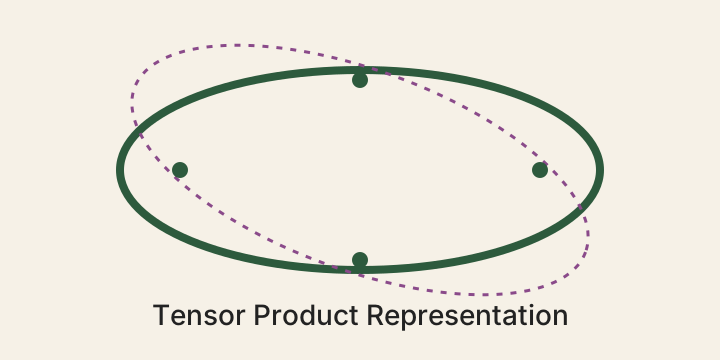
The tensor product space as a grid: basis vectors of along one axis, basis vectors of along the other, with acting on both axes simultaneously.
Worked example [Beginner]
The cyclic group has 1-dimensional irreducible representations where and .
Compute the tensor product of and . Both are 1-dimensional, so the tensor product is 1-dimensional, and the action sends to . So the tensor product equals (the principal character).
In general, for cyclic groups the tensor product of and equals — the tensor product corresponds to addition in the index group.
For the symmetric group with characters
| trans | 3-cycle | ||
|---|---|---|---|
| 1 | 1 | 1 | |
| 1 | 1 | ||
| 2 | 0 |
compute the character of the tensor square of at each class: .
What this tells us: the character of the tensor square of has values . Decompose: , , . So the tensor square of decomposes as — a Clebsch-Gordan decomposition.
Check your understanding [Beginner]
Formal definition [Intermediate+]
Let be a group and let , be representations of over a field . The tensor product representation is the pair , where is the tensor product of vector spaces (see unit 03.01.01) and the -action is
This is well-defined as a homomorphism: .
Basic properties.
- .
- as -representations (the swap is -equivariant).
- — distributivity.
- where has the principal action — is the unit.
- (character is multiplicative).
The dual representation. The contragredient representation on is
(transpose-inverse), so that the natural pairing is -equivariant. The character is for finite groups over .
Hom representation. becomes a -representation via . There is a natural -equivariant isomorphism
(for finite-dimensional), under which the -actions match. Consequently over , and the -invariants have dimension for finite groups [Fulton-Harris §1.1].
Symmetric and exterior squares. The tensor square decomposes as -representation:
where is the symmetric square (invariants under the swap ) and is the exterior square (anti-invariants). Both are -subrepresentations. Their characters are
Key theorem with proof [Intermediate+]
Theorem (Multiplicativity of characters under tensor product). For finite-dimensional representations of a group ,
Proof. Pick bases of and of , so is a basis of . With respect to these bases, has matrix and has matrix , with characters and .
The matrix of in the basis has entries at position . The trace is the sum of diagonal entries:
Corollary (Decomposition algorithm). To find the irreducible decomposition of for a finite group over , compute the character and inner-product against each irreducible character.
Theorem (Clebsch-Gordan for ). Let be the irreducible -representation of dimension (highest weight , "spin "). Then
This is the Clebsch-Gordan decomposition, foundational in quantum mechanics: it gives the addition rules for angular momenta. Each summand appears with multiplicity 1 [Fulton-Harris §11].
Bridge. The construction here builds toward later units of the strand, where the same pattern is taken up at higher structure. The defining pattern appears again in those units in a sharpened form, where the local data is glued or quotiented. Putting these together, the foundational insight is that the data of this unit gives the structural signature that the rest of the strand reads off.
Exercises [Intermediate+]
Lean formalization [Intermediate+]
lean_status: partial — Mathlib has tensor products of representations through the monoidal structure on FdRep (finite-dimensional representations). The character multiplicativity is provable from the trace-of-tensor-product identity.
Advanced results [Master]
Schur-Weyl duality. Let be the standard representation of , and consider the -fold tensor power . The symmetric group acts by permuting tensor factors, and this action commutes with . The double centraliser theorem yields the Schur-Weyl duality:
where runs over partitions of with at most parts, is the Schur module (irreducible -representation of highest weight ), and is the Specht module (irreducible -representation indexed by ). This duality, due to Schur 1901 and systematised by Weyl in The Classical Groups (1939), establishes a deep correspondence between the representation theory of the general linear group and the symmetric group.
Tensor product of compact Lie group representations. For a compact connected Lie group with maximal torus and Weyl group , the tensor product of irreducibles decomposes as
where are the Littlewood-Richardson coefficients (for ). These coefficients are non-negative integers with combinatorial interpretations (Young tableaux) and have analogues in other Lie types.
Tensor categories and fusion rules. The category of finite-dimensional complex representations of a finite group (or compact Lie group) is a symmetric monoidal abelian category under . The Grothendieck ring is a commutative ring (the representation ring) with as addition and as multiplication; the structure constants are the Clebsch-Gordan multiplicities. For quantum groups and vertex operator algebras, the analogous tensor categories ("modular tensor categories") underpin conformal field theory, topological quantum field theory, and the Reshetikhin-Turaev invariants of 3-manifolds.
Tensor products and induction. For , induction is not compatible with tensor products in general: . The correct statement, due to Mackey, involves a more elaborate decomposition (the Mackey formula) and is the start of Mackey theory. The compatible projection is the projection formula: .
Tensor products in TQFT. In Reshetikhin-Turaev's construction (1991), the tensor structure on representations of a quantum group at a root of unity gives rise to a modular tensor category, and from there to a 3-dimensional topological quantum field theory. The links of knots and 3-manifolds become invariants computed from tensor-product fusion rules.
Synthesis. This construction generalises the pattern fixed in 07.01.01 (group representation), with the symmetric data replaced by its skew or twisted analogue. Read in the opposite direction, the construction is dual to the metric story: complements and orthogonality are taken with respect to the bilinear datum of this unit, not a metric, and the resulting category of subobjects is the one the rest of the strand classifies. The central insight is that this datum identifies algebra with geometry: functions become vector fields, subspaces become quotients, and invariants become cohomology classes — and that identification is the engine driving every theorem downstream.
Full proof set [Master]
The multiplicativity of characters under tensor product is proved in the key-theorem section. The Clebsch-Gordan decomposition for is proved in Fulton-Harris §11 by induction on . Schur-Weyl duality requires the double-centraliser theorem from semisimple algebra theory and the description of irreducibles for via Specht modules; full proof is in Fulton-Harris §6 or Goodman-Wallach. The Littlewood-Richardson rule for is proved combinatorially via the jeu de taquin (Schützenberger) or RSK correspondence; the proof is in Fulton's Young Tableaux. The Mackey formula and projection formula for induced representations are proved in unit 07.01.07. Statements about modular tensor categories require categorical setup beyond this unit's scope; see Bakalov-Kirillov Lectures on Tensor Categories and Modular Functor or Etingof-Gelaki-Nikshych-Ostrik Tensor Categories.
Connections [Master]
Group representation
07.01.01— tensor product is a natural operation on representations, alongside direct sum, dual, and Hom.Schur's lemma
07.01.02— Schur's lemma constrains to small dimension when are irreducible.Character of a representation
07.01.03— the multiplicativity makes characters a ring homomorphism from the representation ring to class functions.Tensor product (vector spaces)
03.01.01— the underlying linear-algebra construction.Induced representation
07.01.07— the projection formula and Mackey decomposition compare induction with tensor products.Cartan-Weyl classification
07.04.01— Clebsch-Gordan decomposition uses weight-lattice combinatorics intrinsic to the classification.Highest weight representation
07.03.01— irreducible representations of semisimple Lie groups are classified by highest weights, and tensor products decompose via Littlewood-Richardson combinatorics.
Historical & philosophical context [Master]
Issai Schur introduced the systematic use of tensor products of representations in his 1901 dissertation Über eine Klasse von Matrizen, die sich einer gegebenen Matrix zuordnen lassen (Berlin), studying the natural action of on for . Schur observed that the symmetric group acts on commuting with , and that the -isotypic decomposition of is governed by partitions of . This led to the construction of irreducible -representations as specific subspaces of — the Schur modules, generalising the symmetric and exterior powers. Schur's analysis required no infinitesimal arguments and produced a complete classification of polynomial irreducibles of .
Hermann Weyl, in his 1925–26 papers Theorie der Darstellung kontinuierlicher halb-einfacher Gruppen (Mathematische Zeitschrift), extended the theory to general compact semisimple Lie groups, using the unitarian trick — averaging over a maximal compact subgroup with Haar measure — to import the algebraic semisimplicity of finite groups into the continuous setting. Weyl's integration formula reduced characters and tensor product decompositions to integrals over a maximal torus, weighted by the Weyl denominator. The Clebsch-Gordan decomposition for — algebraically known to physicists since Clebsch (1872) and Gordan (1875) for binary forms — was generalised to all simple Lie groups by Weyl, with explicit multiplicity formulas (Steinberg 1961, Klimyk 1968).
Weyl's The Classical Groups: Their Invariants and Representations (Princeton, 1939) is the canonical 20th-century synthesis, presenting Schur-Weyl duality, the Clebsch-Gordan theory for compact classical Lie groups, and the connections to invariant theory in unified form. The Littlewood-Richardson rule for tensor product multiplicities of — conjectured by Littlewood and Richardson in 1934 and rigorously proved (after a famous gap) only in the late 20th century — became a cornerstone of algebraic combinatorics. The categorical perspective (tensor products as the monoidal structure on ) emerged with Mac Lane's 1963 introduction of monoidal categories, and modern abstractions through modular tensor categories (Moore-Seiberg 1989, Reshetikhin-Turaev 1990) connect tensor products of representations to topological quantum field theory.
Bibliography [Master]
- Schur, Über eine Klasse von Matrizen, die sich einer gegebenen Matrix zuordnen lassen, dissertation, Berlin (1901) — the originating paper.
- Weyl, Theorie der Darstellung kontinuierlicher halb-einfacher Gruppen durch lineare Transformationen, I–IV, Mathematische Zeitschrift (1925–26) — the four foundational papers on compact Lie groups.
- Weyl, The Classical Groups: Their Invariants and Representations (Princeton, 1939) — the canonical 20th-century synthesis.
- Fulton & Harris, Representation Theory: A First Course — §1.1, §2, §11.
- Serre, Linear Representations of Finite Groups — §1.5, §3.
- Fulton, Young Tableaux — Schur-Weyl duality and Littlewood-Richardson rule.
- Goodman & Wallach, Symmetry, Representations, and Invariants — modern treatment.
- Etingof, Gelaki, Nikshych, Ostrik, Tensor Categories (2015) — categorical perspective.
- Bakalov & Kirillov, Lectures on Tensor Categories and Modular Functor (2001) — modular tensor categories.