Sphere bundle, the global angular form, and the Hopf index theorem
Anchor (Master): Bott & Tu §11; Milnor — Topology from the Differentiable Viewpoint §6
Intuition [Beginner]
Imagine a hairy ball: a sphere with a single hair growing out of every point. If you try to comb the hairs flat so none stand up, you fail. Somewhere a cowlick must form. The Hopf index theorem says exactly how many cowlicks you must have, counted with sign.
The same picture works for any closed surface. A donut can be combed flat — its hair lies down everywhere. A pretzel with three holes cannot be combed flat without producing four cowlicks. The number of unavoidable cowlicks is a topological invariant called the Euler characteristic. It depends on the shape, not on how you comb.
A sphere bundle records, at each point of a base shape, a small sphere of directions. The Euler class is the bookkeeping that translates a comb of the base into a number on the bundle. The Hopf index theorem says these two numbers — the topological Euler characteristic and the analytic count of cowlicks — are the same.
Visual [Beginner]
A sphere bundle places a tiny sphere over every point of the base. A vector field is a continuous choice of one direction in each fibre. Where the field vanishes, the choice fails to extend through the centre — those are the cowlicks.
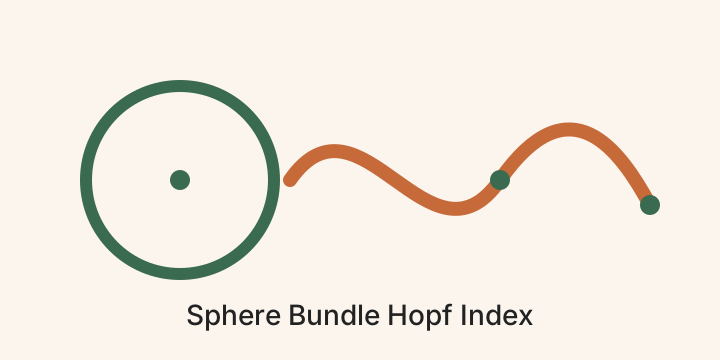
The sphere has Euler characteristic , so the cowlicks of any vector field on it must sum to . The torus has Euler characteristic , so a smooth nonvanishing vector field is allowed. The picture is the theorem in one sentence: the algebraic count of zeros equals the topological count of holes.
Worked example [Beginner]
Take the standard sphere with the height function measuring distance from the equator. The gradient of points uphill from the south pole, lies along latitudes, and meets the north pole. It vanishes at exactly two points: the south pole and the north pole.
Around the south pole, the gradient flows outward in every direction. That source has index . Around the north pole, the gradient flows inward in every direction. That sink also has index . The sum is .
The Euler characteristic of is also (two faces, no edges, two vertices on a tetrahedral triangulation gives ). The Hopf index theorem says these two numbers must agree, and they do.
What this tells us: a clever choice of vector field counts the topology by counting cowlicks.
Check your understanding [Beginner]
Formal definition [Intermediate+]
Let be an oriented real vector bundle of rank over a smooth manifold , with a chosen Euclidean metric. The unit-sphere bundle of is the smooth fibre subbundle
with fibre and structure group [Bott-Tu §11]. Equivalently, an oriented sphere bundle of fibre dimension is a fibre bundle locally of the form with transition functions in 03.05.03. Every oriented rank- real vector bundle determines a sphere bundle by unitisation, and conversely the associated rank- vector bundle of an -bundle is recovered by gluing fibrewise cones.
The global angular form of is a form characterised by two conditions: the fibre integral , and the differential identity
where is a closed form representing the Euler class 03.06.04. Existence of uses the Mayer-Vietoris computation over a finite good cover [03.04.09 — pending]; uniqueness is up to the addition of a pulled-back form from .
For an oriented closed manifold with tangent bundle , the Euler class of is . A vector field with isolated zeros is a smooth section such that the zero set is finite. At each zero , the local index is the degree of the map
where is a small sphere around in a chosen oriented chart. The local index is independent of the chart and the radius .
Key theorem with proof [Intermediate+]
Theorem (Hopf index theorem). Let be a closed oriented smooth manifold, and let be a smooth vector field on with isolated zeros . Then
where is the Euler characteristic.
Proof. The vector field is a section of . Restricted to , the normalisation is a section of the unit-sphere bundle . Pull the global angular form back along this section to obtain a closed form on the punctured manifold.
For each zero , choose a small ball . On the boundary sphere , the form restricts to the pullback of along the map , and its integral over the sphere equals the degree of this map by the defining property . Therefore
On the complement , the section is defined globally. Stokes' theorem gives
with the sign of the boundary orientation absorbed. Using on the bundle and the fact that on the punctured manifold,
on , which extends smoothly across the (measure-zero) zero set. Therefore
where the last equality is the Gauss-Bonnet-Chern theorem in its global-angular-form proof: for closed oriented [Bott-Tu §11].
Remark. The proof distils into two facts: has fibre-integral one (so each local boundary integral picks up the index), and (so Stokes converts the sum of local indices into the integral of the Euler form). Both facts are properties of the global angular form alone.
Synthesis. The Hopf index theorem is exactly the de Rham specialisation of the broader pattern. This is the foundational reason vector-field zero-counts compute the Euler characteristic. The Hopf index theorem is an instance of Atiyah-Singer.
Bridge. The construction here builds toward later units of the strand, where the same pattern is taken up at higher structure. The defining pattern appears again in those units in a sharpened form, where the local data is glued or quotiented. Putting these together, the foundational insight is that the data of this unit gives the structural signature that the rest of the strand reads off.
Exercises [Intermediate+]
Lean formalization [Intermediate+]
lean_status: partial — the statements compile via stub types. Mathlib has the topological foundations (FiberBundle, Bundle.TotalSpace) but lacks de Rham cohomology with compact vertical supports, fibre integration, the global angular form construction, and the Euler class as a de Rham class. The Lean module declares the sphere bundle, the Euler class, vector fields with isolated zeros, and the local index, and records the global-angular-form construction, the Hopf index theorem, and the Poincaré-Hopf identity as axioms.
The full module is Codex.Bundles.SphereBundle.
Advanced results [Master]
The Hopf index theorem is the differential-form face of a theorem with three other faces. The first is the Poincaré-Hopf theorem in its smooth-manifold form, where is replaced by for a Morse function and the indices become the Morse indices, recovering the cell-counting formula where is the number of index- critical points [Milnor §6]. The second is the Lefschetz fixed-point theorem, where instead of zeros of vector fields one counts fixed points of self-maps with signs, and the sum is the Lefschetz number. The third is the Atiyah-Singer index theorem 03.09.10, where the Hopf index theorem becomes the de Rham specialisation: the Euler class is the topological side, and is the analytic index of the de Rham complex twisted by the gradient flow.
The global angular form via Mayer-Vietoris
Theorem (Bott-Tu, Proposition 11.6). Let be the unit-sphere bundle of an oriented rank- real vector bundle. Choose a finite good cover of trivialising . There exists a global form such that on each , , where is the unit-volume form of and is a correction term that vanishes on cohomology of the fibre. The global form satisfies and for a closed form .
The proof proceeds in three steps. First, on each chart , the form is a candidate angular form with fibre-integral , but its differential in the bundle direction does not vanish — there is a transition cocycle when one passes between charts. Second, the Čech-de-Rham double complex on assembles the local angular forms with correction terms into a global form, using that to compute the sheaf cohomology of the angular form. Third, the differential is fibrewise zero (the fibre integral is constant) and equivariant under , so it descends to a closed -form on whose cohomology class is the Euler class — the sign is a convention (Bott-Tu §11) chosen so that the Hopf index argument produces rather than .
Euler class via universal angular form
For the universal oriented rank- real bundle , the global angular form is universal: every oriented rank- real vector bundle pulls back along a classifying map , and pulls back the universal angular form to a global angular form on . The Euler class is correspondingly the pullback of the universal Euler class , providing the bridge between this unit and classifying-space theory 03.08.04.
Worked example:
For the sphere , the Hopf index theorem with the gradient of the height function yields , so is twice the integral generator of . For , this recovers in real cohomology, where is the unit-volume form, and integrally generates .
Worked example: Hopf bundle Euler class
The Hopf bundle has structure group and is the unit-sphere bundle of the tautological complex line bundle . Its Euler class equals the first Chern class where generates [03.06.04 Worked example]. Integrating over gives , the linking number that captures the non-vanishing class of the Hopf fibration in .
Full proof set [Master]
Proof of existence of the global angular form. Choose a finite good cover of trivialising with transition functions . Over each , the unit-sphere bundle is identified with , and the unit-volume form pulls back to a local angular form with and on . On overlaps , the difference is the pullback of , a closed -form on that integrates to zero (because both and have fibre-integral ). Hence for some . The cocycle in the Čech-de-Rham double complex assembles, via the standard tic-tac-toe argument, into a global form such that differs from by the differential of the assembled lower-degree forms. The fibre integral is preserved at each step. Differentiating globally gives a form on ; that this descends from to (i.e., is the pullback of an -form on ) follows because is closed and fibrewise zero, hence basic, and the closed form on is . The Euler class is independent of the cover and the choice of because two such global angular forms differ by a pulled-back form from , whose differential is in the image of .
Proof that the Euler class agrees with the top Chern class for complex bundles. For a rank- complex vector bundle regarded as a rank- oriented real bundle, the Chern-Weil representative of is the Pfaffian of the curvature, while the global-angular-form Euler class is represented by via the Pfaffian-as-Euler-form identification 03.06.06 03.06.04. The two constructions yield the same de Rham class, integrating to the same number against the fundamental class. This identification — for rank- complex bundles — is the entry point connecting the Bott-Tu sphere-bundle apparatus to the Chern-Weil unit and is deepened in 03.06.04 (Master section).
Proof that the local index is well-defined. Given a vector field with isolated zero , choose two oriented charts around and two radii . The two normalised maps are homotopic via the family of normalised fields on the spherical shell between the two radii, since has no other zeros nearby. The degree is a homotopy invariant, so the indices computed in the two settings agree. Independence of the chart follows because the charts are oriented and the change of chart preserves orientation, hence preserves the degree of the boundary map.
Proof that homotopic vector fields have the same total index. Let be a smooth path of vector fields with isolated zeros that vary smoothly except possibly at finitely many critical times where two zeros collide or split with sign-cancellation. At each such time, the local index sum at the collision point is preserved (an index- source and an index- saddle annihilate to zero, etc.), so the total sum is constant in . Combined with the Hopf index theorem applied at the endpoints, this gives a direct proof that is independent of the chosen vector field — recovering the topological invariance of the Euler characteristic.
Connections [Master]
Vector bundle
03.05.02— the sphere bundle is the unit-sphere subbundle of an oriented metric vector bundle; the global angular form is its top distinguishing structure.Orthogonal frame bundle
03.05.03— the structure-group reduction to is what makes the unit-sphere bundle oriented and the global angular form well-defined.Pontryagin and Chern classes
03.06.04— foundation-of: for rank- complex bundles routes the Hopf-Poincaré machinery into the Chern-class apparatus. Anchor phrase: top Chern class equals Euler class.Chern-Weil homomorphism
03.06.06— the Pfaffian curvature representative of the Euler class is the Chern-Weil form, providing a curvature-side derivation alternative to the global-angular-form derivation given here.De Rham cohomology
03.04.06— foundation-of: byconn:446.hopf-index-poincare-hopf, Hopf index theorem built on global angular form and integration of Euler class. Bott-Tu §11's derivation rests on the global angular form with fibre-integral 1 and , then Stokes in de Rham.De Rham Thom isomorphism
03.04.09— foundation-of: byconn:433.thom-de-rham-chern-weil, de Rham Thom class equivalent to Chern-Weil Euler form. The global angular form is the suspension-of-the-Thom-form construction.Spin structure
03.09.04— foundation-of: byconn:434.global-angular-form-spin, spin-geometry Â-genus machinery built on the global angular form. When the global angular form lifts equivariantly through the spin double cover, it becomes the spin angular form used in the Atiyah-Singer derivation.Atiyah-Singer index theorem
03.09.10— bridging-theorem: the Hopf index theorem is the de Rham specialisation of Atiyah-Singer; the proof presented here is the simplest model case.Classifying space
03.08.04— the universal global angular form on is the classifying-space face of this construction; pullback along a classifying map produces the angular form on any oriented bundle.
Throughlines and forward promises. The Hopf index theorem is the de Rham face of every later vector-field-zero-counting result. We will see the same global angular form appear in the heat-kernel index density of 03.09.20; we will see Atiyah-Singer absorb the entire Hopf-Poincaré arc as its de Rham specialisation; this pattern recurs throughout characteristic-class theory. The foundational reason holds is exactly the global angular form integration combined with Stokes' theorem. Putting these together: the Hopf index theorem is an instance of the broader "local index density integrates to global topological invariant" motif. This is precisely the same pattern as Atiyah-Singer with the Dirac operator replacing the section, the -class density replacing the Euler class, and the analytic index replacing the zero count. The bridge between local zeros and global Euler characteristic is exactly the global angular form, and this bridge generalises to the Bismut-superconnection family-index formalism we will later see.
Historical & philosophical context [Master]
Heinz Hopf's 1926 paper Vektorfelder in -dimensionalen Mannigfaltigkeiten (Math. Ann. 96) introduced what is now called the Hopf index theorem in its original form: on a closed orientable manifold of even dimension, the algebraic count of zeros of a tangent vector field, taken with the local indices computed by Brouwer's degree formula, equals the Euler-Poincaré characteristic. Hopf's proof was combinatorial, using a triangulation of the manifold and a vector field tangent to the simplices, and invoking the simplicial computation of Euler-Poincaré that Poincaré had introduced in Analysis Situs (1895). Hopf credited Poincaré explicitly: the planar case had been settled by Poincaré in 1881, the surface case by Brouwer in 1911, and Hopf was extending these to all dimensions.
Bott and Tu's 1982 Differential Forms in Algebraic Topology §11 reorganises the theorem around the global angular form. The reorganisation converts a piece of differential topology into a piece of de Rham cohomology: instead of triangulating and counting, one integrates a single global form whose construction encodes the bundle's twist. The key insight is that the global angular form is the differential-form analogue of the Thom class — a representative of the bundle's universal cohomology class that exists globally on the sphere bundle and has fibre-integral one. Stokes' theorem then converts a topological count into an integral, and the integral evaluates to by the Gauss-Bonnet-Chern theorem. The result is what Bott-Tu call "the cleanest proof" — six lines of differential-form manipulation replacing several pages of simplicial counting.
The wider arc runs Hopf 1926 → Stiefel 1936 (which extends from tangent fields to higher Stiefel-Whitney classes) → Whitney 1937 (sphere-bundle Euler class as the obstruction to nonvanishing sections) → Chern 1944 (the Pfaffian-curvature derivation, equivalent to the Bott-Tu derivation under Chern-Weil-de-Rham duality) → Bott-Tu 1982 (the unified angular-form pedagogy used here). The Atiyah-Singer index theorem of 1963 absorbs the entire arc as its de Rham specialisation, and the modern proof of Atiyah-Singer in Berline-Getzler-Vergne 1992 reuses the global-angular-form construction as its core technical input via Mathai-Quillen forms.
Bibliography [Master]
- Hopf, H., "Vektorfelder in -dimensionalen Mannigfaltigkeiten", Mathematische Annalen 96 (1926), 225–250.
- Poincaré, H., "Sur les courbes définies par les équations différentielles", Journal de Mathématiques Pures et Appliquées 7 (1881), 375–422.
- Brouwer, L. E. J., "Über Abbildung von Mannigfaltigkeiten", Mathematische Annalen 71 (1911), 97–115.
- Stiefel, E., "Richtungsfelder und Fernparallelismus in -dimensionalen Mannigfaltigkeiten", Commentarii Mathematici Helvetici 8 (1936), 305–353.
- Chern, S. S., "A Simple Intrinsic Proof of the Gauss-Bonnet Formula for Closed Riemannian Manifolds", Annals of Mathematics 45 (1944), 747–752.
- Bott, R. & Tu, L. W., Differential Forms in Algebraic Topology, Springer, 1982. §11.
- Milnor, J., Topology from the Differentiable Viewpoint, University of Virginia Press, 1965. §6.
- Berline, N., Getzler, E. & Vergne, M., Heat Kernels and Dirac Operators, Springer, 1992. Ch. 1.