Orthogonal frame bundle
Anchor (Master): Kobayashi-Nomizu Vol. I §III.2; Lawson-Michelsohn §I.4; Steenrod §6
Intuition [Beginner]
A frame is a choice of rulers and right-angle directions at one point. On a surface, imagine placing a tiny pair of perpendicular arrows at each point. In higher dimensions, a frame is a full ordered list of perpendicular unit directions.
The orthogonal frame bundle collects all these choices. The base point tells where the frame sits; the fiber over that point contains every possible orthonormal frame there.
Changing a frame by a rotation or reflection gives another frame at the same point. That is why the orthogonal group acts on the frame bundle.
Visual [Beginner]
Each point of the base carries a whole circle of possible orthonormal frames in two dimensions.
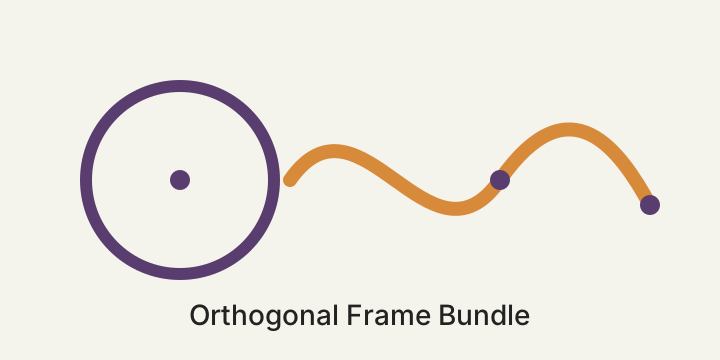
The frame bundle remembers both location and choice of local measuring axes.
Worked example [Beginner]
On a flat plane, stand at the origin with one unit arrow pointing east and one unit arrow pointing north. That ordered pair is an orthonormal frame.
Rotate both arrows by degrees. The new pair is still an orthonormal frame at the same point. Reflect the east arrow across a mirror line and adjust the second arrow to stay perpendicular. That also gives an orthonormal frame, but it may reverse orientation.
What this tells us: a frame bundle stores all possible local coordinate rulers, not one preferred ruler.
Check your understanding [Beginner]
Formal definition [Intermediate+]
Let be a rank- real vector bundle with a fiber metric. The orthogonal frame bundle has fiber over equal to the set of linear isometries
Equivalently, a point of the fiber is an ordered orthonormal basis of . The group acts on the right by precomposition,
For the tangent bundle of a Riemannian manifold , this is the orthonormal frame bundle . If is oriented, the oriented orthonormal frames form a principal -subbundle [Lawson-Michelsohn §I.4].
Key theorem with proof [Intermediate+]
Theorem (Orthogonal frames form a principal bundle). Let be a rank- real vector bundle with fiber metric. Then is a principal -bundle.
Proof. Choose a local orthonormal frame over an open set . Every orthonormal frame of over is uniquely of the form for some , where sends the standard basis to .
This gives a local trivialization
On overlaps, two local orthonormal frames differ by a smooth map because their change-of-frame matrices preserve the fiber metric. The right action of on each fiber is free and transitive, since implies , and any two isometries differ by a unique orthogonal automorphism of . These local trivializations and the free transitive right action give a principal -bundle.
Bridge. The construction here builds toward 03.09.04 (spin structure on an oriented riemannian manifold), where the same data is developed in the next layer of the strand. The defining pattern appears again in those units in a sharpened form, where the local data is glued or quotiented. Putting these together, the foundational insight is that the data of this unit gives the structural signature that the rest of the strand reads off.
Exercises [Intermediate+]
Lean formalization [Intermediate+]
lean_status: none is recorded because the required smooth bundle, Riemannian metric, orthonormal frame, and principal -bundle structures are not yet available in the project vocabulary.
Advanced results [Master]
The frame-bundle construction is functorial for isometric bundle isomorphisms. A metric on a rank- real vector bundle reduces the general frame bundle from to ; an orientation further reduces it to [Kobayashi-Nomizu §III.2].
For a Riemannian manifold, is the principal bundle whose lift through defines a spin structure 03.09.04. Connections on can be expressed as principal connections on this frame bundle, with the Levi-Civita connection characterized by metric compatibility and torsion-freeness.
Synthesis. This construction generalises the pattern fixed in 03.05.01 (principal bundle), with the symmetric data replaced by its skew or twisted analogue. Read in the opposite direction, the construction is dual to the metric story: complements and orthogonality are taken with respect to the bilinear datum of this unit, not a metric, and the resulting category of subobjects is the one the rest of the strand classifies. The central insight is that this datum identifies algebra with geometry: functions become vector fields, subspaces become quotients, and invariants become cohomology classes — and that identification is the engine driving every theorem downstream.
Full proof set [Master]
The principal-bundle proof above supplies the local trivializations and the free transitive right action. The reduction from to follows by applying Gram-Schmidt locally to a metric vector bundle and observing that metric-preserving transition functions are orthogonal.
The oriented reduction is obtained by selecting frames whose ordered basis is positively oriented. The transition functions between such frames have positive determinant and are orthogonal, hence lie in .
Connections [Master]
Orthogonal frame bundles depend on vector bundles
03.05.02, principal bundles03.05.01, and Lie groups03.04.02. Spin structures03.09.04lift the oriented orthonormal frame bundle through the double cover03.05.05supplied by the spin group03.09.03. The Dirac operator03.09.08later uses the lifted spin frame bundle to construct spinor bundles and Clifford multiplication.Connections on frame bundles also connect to vector bundle connections
03.05.04and principal bundle connections03.05.07.
Historical & philosophical context [Master]
Steenrod's treatment of fibre bundles includes coordinate bundles and frame bundles as central examples of principal bundles [Steenrod §6]. Kobayashi and Nomizu place frame bundles at the start of the differential-geometric theory of connections [Kobayashi-Nomizu §III.2].
Lawson and Michelsohn use the oriented orthonormal frame bundle as the object lifted by a spin structure, making it the immediate geometric input to spinor geometry [Lawson-Michelsohn §I.4].
Bibliography [Master]
- Shoshichi Kobayashi and Katsumi Nomizu, Foundations of Differential Geometry, Vol. I, §III.2. [Kobayashi-Nomizu §III.2]
- H. Blaine Lawson and Marie-Louise Michelsohn, Spin Geometry, §I.4. [Lawson-Michelsohn §I.4]
- Norman Steenrod, The Topology of Fibre Bundles, §6. [Steenrod §6]